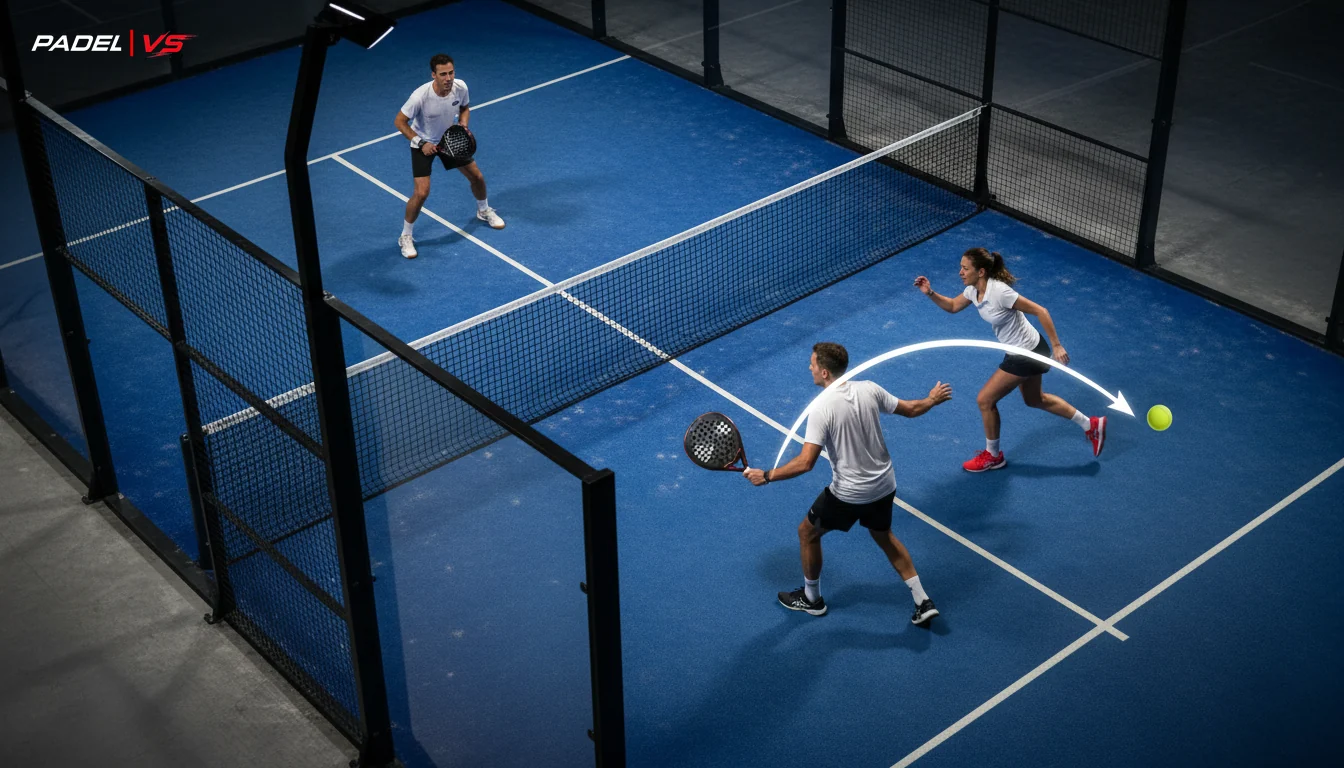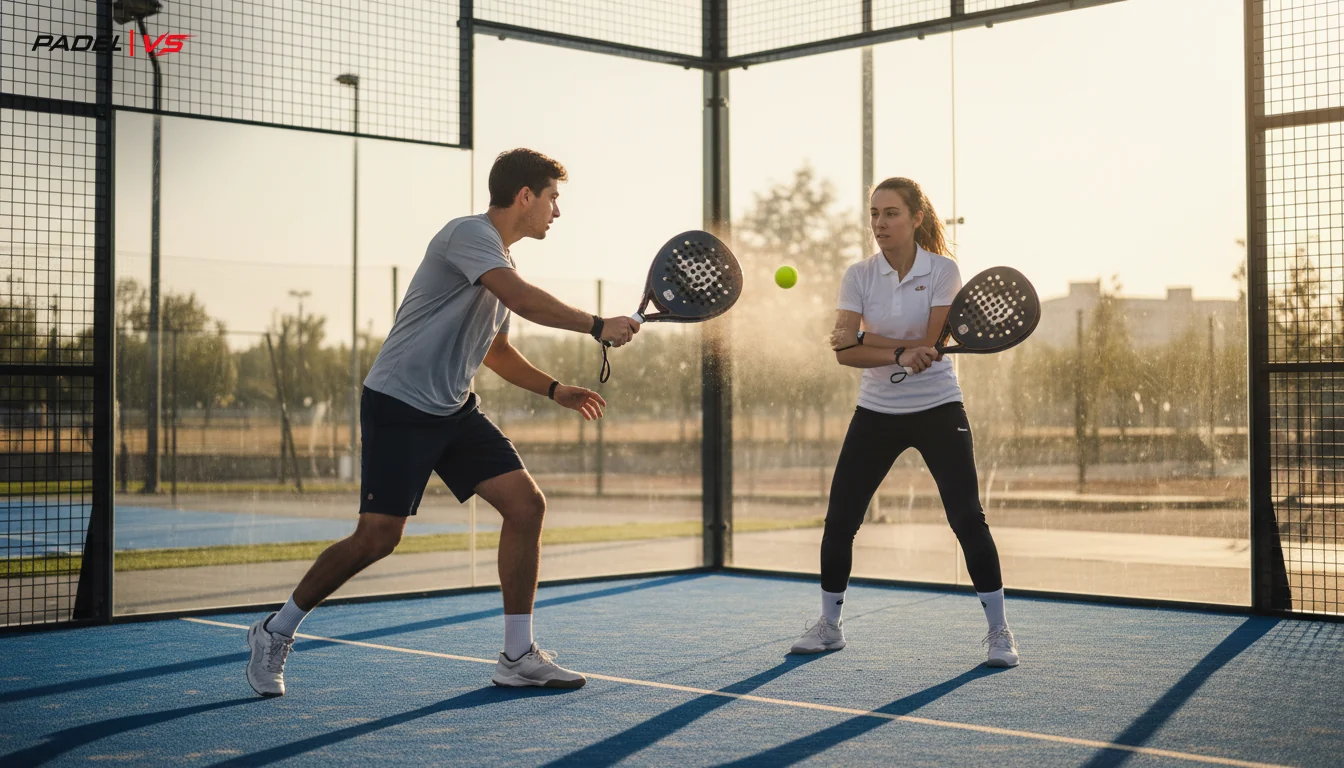

Padel is a sport of control over power. Players who are just starting out tend to believe that matches are won through smash winners, but data from the professional circuit tells a different story: in Primera/Open matches, fewer than 30% of points end with a smash. Most are won with deep bandejas, víboras to the side wall and the patience to wait for the right ball.
Knowing WHEN to use each overhead is what separates the player who moves up through the categories from the one who stagnates. In this guide we break down the 4 fundamental overhead shots: smash, bandeja, víbora and X3.
1. Smash — the ultimate offensive overhead

The smash is the most explosive shot in padel: high ball, arm fully extended, body weight forward, racket coming down with force. If you connect cleanly with the right angle, you end the point. If you miss the angle, the ball flies over the glass — the famous X3 — and your opponent retrieves it from outside.
When to use it
- A weak lob from the opponent that lands close to the net
- You have a clear angle toward the side wall or back glass
- You are well-positioned: feet set, arm free, no pressure
When NOT to use it
- Uncertain ball behind your body: use a bandeja instead
- Fatigue or imbalance: a poorly struck smash hands away the point
- The opponent is well-positioned and defending: go for a directed víbora
2. Bandeja — the defensive foundation of net play

The bandeja is the MOST important shot in competitive padel. It doesn't end the point, but it keeps you at the net — and that's what matters. It is executed at head height with a controlled slice motion, without finishing the swing upward like a smash.
Why it's essential
When the opponent lifts a deep lob, you have 2 options: defend from the back (losing your net position) or play a bandeja (staying up at the net). Good players hit 5–10 consecutive bandejas until they force the opponent into an error.
Common mistakes
- Hitting too hard: the ball goes long and hands away the point
- Not slicing enough: the ball comes out flat and the opponent punishes it
- Hitting down the middle: always aim for the side glass, directing the ball toward the opposite wall
3. Víbora — the offensive-defensive transition shot

The víbora sits between the smash and the bandeja: a sliced shot but hit with more pace, directed at the opponent's side. It bounces low (heavy slice effect), forcing the opponent to defend from below and preventing them from coming to the net.
What it's used for
The víbora is the perfect shot to apply pressure without taking risks. You don't hand away the point like with a mistimed smash, but you push your opponent far more than with a neutral bandeja. Players at Tercera/Segunda level who add the víbora to their repertoire tend to move up a category quickly.
Key technique
- Sideways stance, shoulders rotated
- Vertical slice over the ball (racket moving top to bottom)
- Direction: opponent's side glass (NOT down the middle)
- Finish the swing at waist level (not extended like a smash)
4. X3 — the ball that flies over the glass
The X3 is not a shot you hit intentionally — it is the result of a smash or lob that leaves the court over the side glass. Padel rules allow the opponent to retrieve it from outside and play it back into the court. If they manage it, the point continues.
How to defend an X3
- Exit the court through the side door immediately
- Track the ball as it travels outside
- When it bounces on the ground (outside the court), you have one single chance to play it back over the glass
- Aim for the middle of the opponent's court — most of the time, the effect off the glass moves the ball
How to set up an X3 (advanced)
Some Primera/Open players deliberately go for the X3 with a smash aimed at the side glass at an open angle. The idea is for the ball to leave the court overhead and leave the opponent in an impossible position — even if they retrieve it, they won't be able to play it with any danger.
Progression by level
If you're just starting out, this is the recommended sequence for mastering overhead shots in order of difficulty:
| Level | Priority |
|---|---|
| Fifth | Basic bandeja down the middle · Stop smashing everything |
| Fourth | Bandeja to the side wall · Smash with angle when there's a clear opening |
| Third | Add the víbora to your repertoire · Defend X3 from outside the court |
| Second | Directed víbora · Chain 5–10 bandejas while applying pressure |
| Primera/Open | Offensive X3 (setting it up deliberately) · Split-second decision between smash/bandeja/víbora |
The #1 beginner mistake: smashing everything
We'll say it straight: most beginners lose points by smashing balls they should be playing as a bandeja. The rule is simple — if in doubt, do NOT smash. Bandeja to the side wall, hold your position and wait for the right ball.
At PADEL VS we calculate your real rating with ELO after every match. Once you start using the bandeja instead of smashing everything, you'll see your rating rise consistently. Create your free account and start calibrating your true level match by match.
Related resources
- Padel glossary — all technical terms explained
- Tactics for padel doubles — what to hit and when based on your opponents
- How the rating system works — ELO explained
- More competitive padel articles