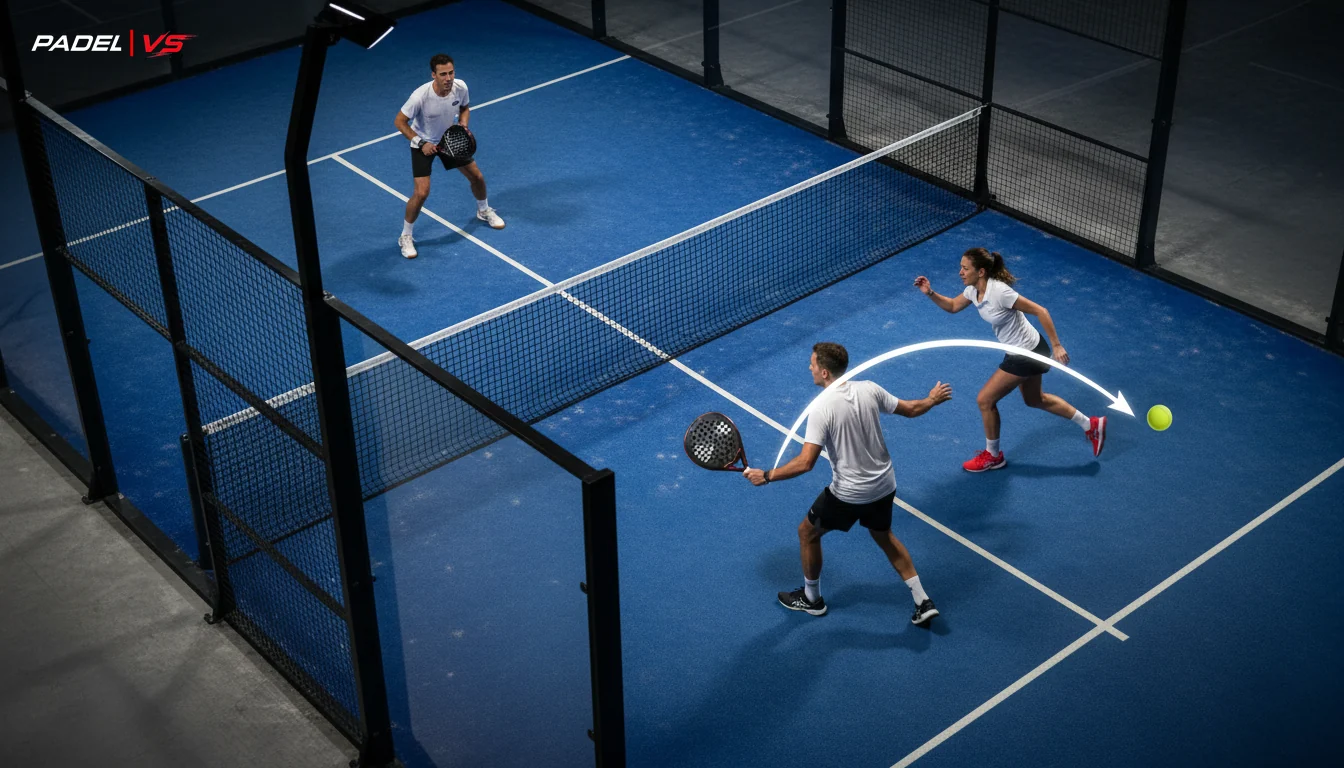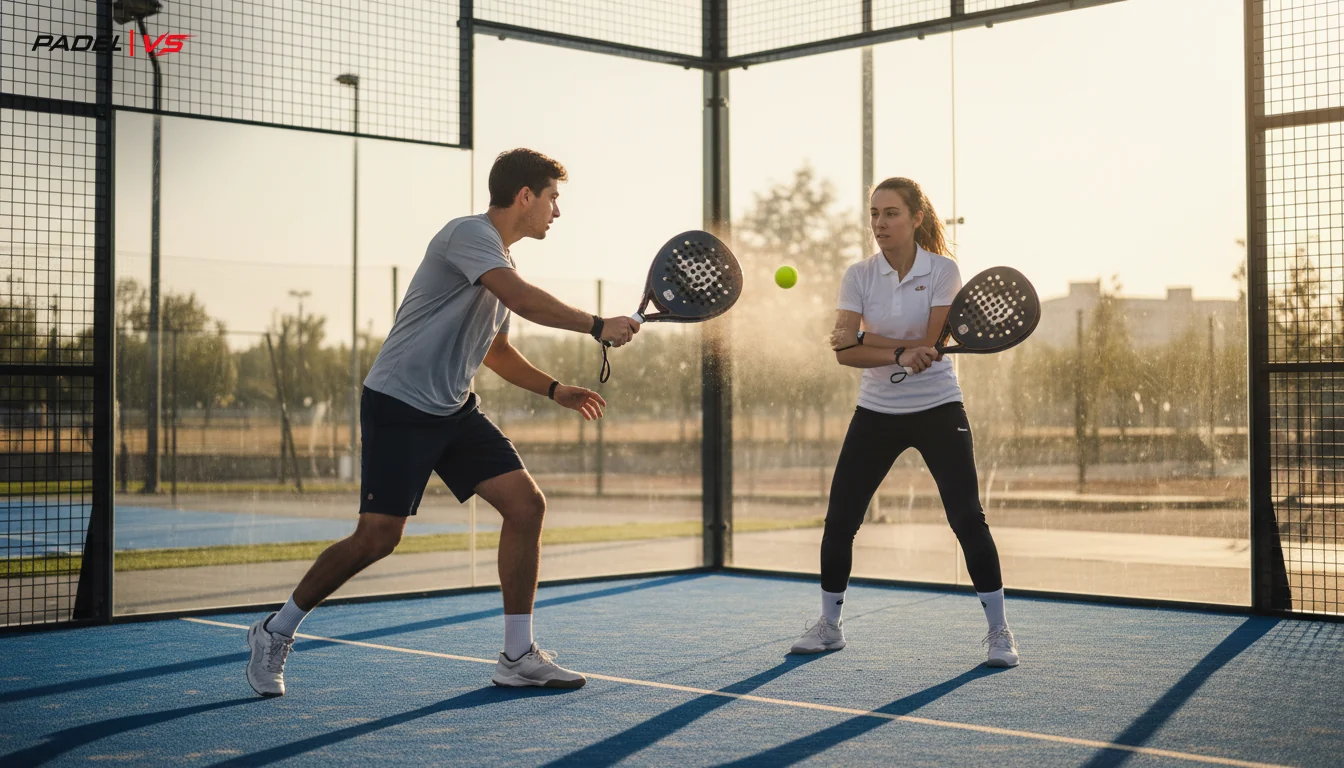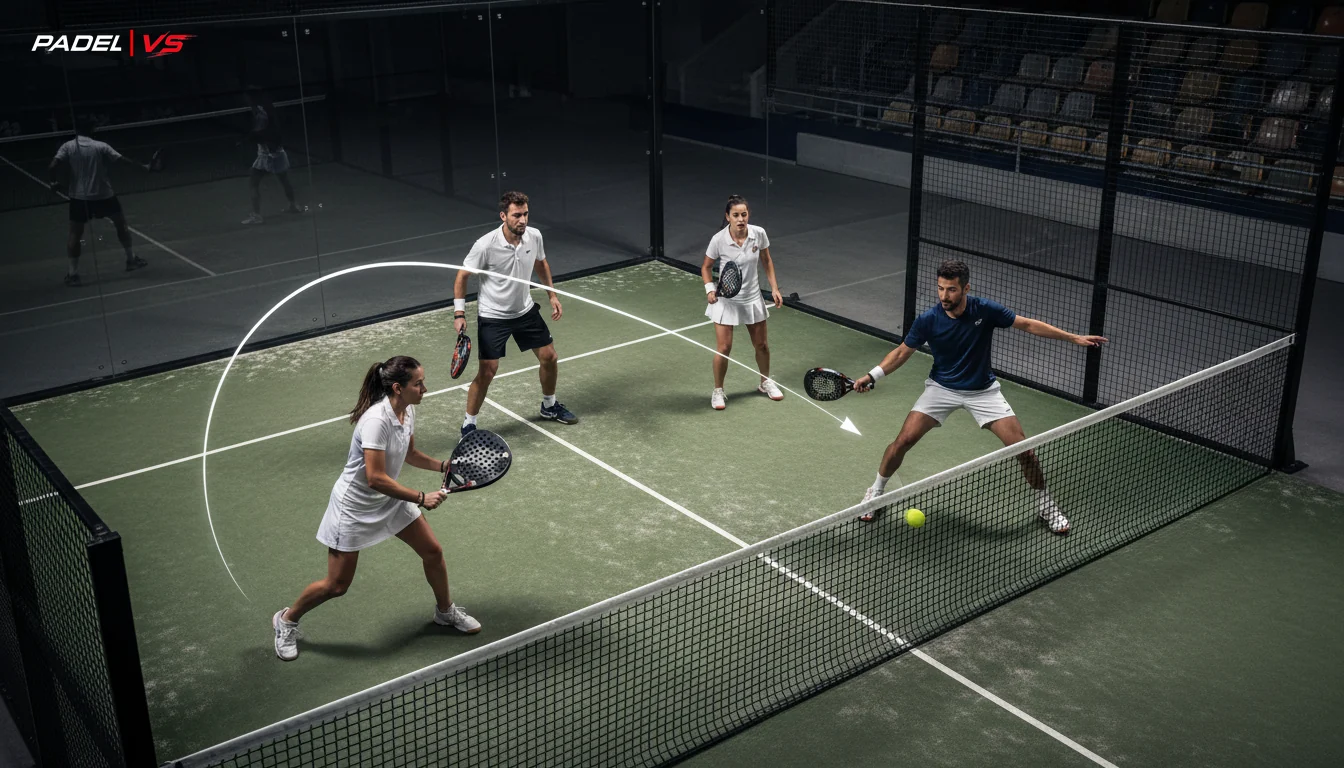

The lob is padel's most underestimated shot. Most players treat it as a panic button — something you hit when nothing else is working — but the best players on the court deploy it as a calculated tactical weapon that resets points, inverts pressure, and wins matches. Get comfortable with it and your game will visibly change within a few weeks.
What the lob actually does in padel
The lob is a high, arching shot designed to pass over opponents who are positioned at the net and push them back to the baseline. In practical terms, you're looking for a launch angle of roughly 45° or more relative to the horizontal, with the ball landing in the back third of the opponent's court — ideally near the back glass.
What makes padel fundamentally different from tennis when it comes to lobs is precisely that back glass. A ball that lands correctly near the baseline glass creates a completely different read for the opposing pair: do they intercept it before the wall? Do they let it bounce off the glass and give up court position? That split-second dilemma — imposed on your opponents at roughly 20 meters away — is exactly what a well-placed lob creates. It doesn't just move players; it forces decisions.
"The lob is not the shot of someone who doesn't know what to do — it's the shot of someone who knows exactly what they're doing." — Competitive padel philosophy
The three types of lob you need in your arsenal
Not all lobs serve the same purpose. Depending on the match situation, your position on the court, and what you're trying to achieve tactically, you'll be reaching for one of these three variants:
1. The defensive lob
This is the most common version and the one most recreational players already attempt — though often with poor execution. You use it when you're under maximum pressure: the opposing pair is at the net, a tough ball just arrived at your feet or body, and you need to buy time. The goal is not to win the point outright but to reset the rally and return to a neutral position. Trajectory should be high — 4 to 5 meters at the apex — and deep, landing close to the back glass of the opponent's side.
2. The offensive lob
This is the variant that separates Tercera-level players from Segunda and Primera. You throw it not because you're in trouble, but because you choose to as a winning move. It works best when opponents are at the net but out of position, when you notice one of them has limited mobility moving backward, or simply as a rhythm-breaking change-up. The trajectory is flatter and faster than the defensive version — less height, more depth, more aggressive intention.
3. The spin lob (topspin or slice)
The most technically demanding of the three. A topspin lob rises cleanly and then accelerates after bouncing, making it extremely difficult for opponents to read and time. A slice lob does the opposite — it slows down after the back glass bounce, creating a different time window that catches players off guard. These require deliberate wrist work, precise timing, and specific practice, but once mastered, they add a layer of complexity that very few amateur-level players can read consistently.
When to lob: the key moments
Here's where real game knowledge lives. Knowing how to hit a lob is technical; knowing when to use it is tactical, and it's what will determine whether you stay at Cuarta or climb toward Primera in PADEL VS rankings.
| Match situation | Recommended lob type | Goal |
|---|---|---|
| Tough ball at feet, opponents at net | High defensive | Buy time, reset the rally |
| Opponent poorly positioned, away from center | Offensive to weak side | Force an error or win the net |
| Long point, opponents on autopilot | Tactical variation | Break rhythm, displace them |
| Opponent with limited backward movement | Deep offensive | Force a ball in uncomfortable position |
| Headwind on an outdoor court | Defensive with added margin | Use wind to your advantage |
One of the most frequent mistakes among Quinta and Cuarta-level players is lobbing too short. If your lob doesn't clear the opponent's service line, you've essentially gifted them a comfortable bandeja or an easy overhead. The practical rule: if you're not confident it'll go deep, don't lob at all.
Mechanics: how to execute the lob correctly
Most articles get vague here. Let's be specific.
Body position and shoulder rotation
Even when you're scrambling under pressure, try to rotate your hitting shoulder toward the ball before making contact. The instinct under stress is to hit square — body facing the net, no rotation — which severely limits your range of motion and shot quality. Even a 30-45° trunk rotation improves the lob significantly. It doesn't have to be pretty; it has to be functional.
The contact point
Ideal contact for a lob is at hip height or slightly above — not at shoulder height like you'd swing for a smash. Striking too high creates an angle that sends the ball more forward than upward, killing the vertical component. The racket face should be open, roughly 30-45° from vertical at the moment of impact, to generate the upward trajectory you need.
Wrist mechanics
Your wrist is the difference between a flat lob (easier for opponents to read) and a spinning one. For a topspin lob, the wrist rolls from low to high through contact — brushing up the back of the ball. For a slice lob, the racket passes underneath the ball with an outside-in motion, creating backspin that changes the post-bounce behavior. Both require deliberate practice: we recommend 15-20 minutes of isolated lob drilling per session until the motion becomes automatic.
Direction: cross-court or down the line?
As a general rule, the cross-court lob is safer because you have more court to work with. The diagonal of a standard padel court (20m x 10m) is approximately 22.4 meters, versus 20 meters down the line — that extra distance is meaningful when you're lobbing under pressure. That said, the down-the-line lob is more direct and can surprise opponents who aren't expecting it. Primera and Open players alternate both depending on how their opponents are positioned.
The most common lob mistakes — and how to fix them
Across many matches at different levels — from Quinta to Open — the same mistakes come up repeatedly when players attempt lobs:
- Lobbing too short: The ball lands in the opponent's service zone, setting up a clean overhead. Fix: always aim for the back third of the court. When in doubt, add more height.
- Going too wide: The ball clips the side glass or goes out. Fix: visualize the center channel or the opposite diagonal before you swing.
- Poor timing: You make contact too late, when the ball has dropped too low, resulting in a lob with no height. Fix: read the incoming trajectory early, move your feet first, let the swing do the work.
- Telegraphing the shot: Your arm preparation is so obvious that opponents are already backpedaling. Fix: use the same backswing as your other baseline shots and change the racket angle late, just before contact.
- Pattern predictability: If you always lob from the left baseline, opponents will anticipate it and start positioning back before you swing. Fix: use the lob from comfortable positions too, not just defensive ones.
What happens after the lob — the move most players forget
The lob doesn't end when the ball leaves your racket. What you do in the 2-3 seconds that follow determines whether the shot was tactically useful or wasted.
After a good defensive lob, the correct move is to advance toward the net. It sounds counterintuitive, but it makes complete sense: if your lob was effective, your opponents are now running back to deal with a ball near their baseline. You now have the opportunity to own the net — the dominant court position in padel. If instead you stay plastered to your own back glass, you're accepting the worst position on the court.
The classic Quinta and Cuarta mistake: launch a lob and stay frozen against the back wall, waiting passively for whatever comes next. When you do that, you erase every tactical benefit the lob just created.
"A lob without movement is half a good shot. The other half is getting to the net before they get back."
A 4-week training plan to improve your lob
The lob improves faster through targeted drilling than through match play alone. Here's a structured 4-week progression applicable to any level:
- Week 1 — Height control: Partner feeds comfortable balls from mid-court while you practice lobs from the baseline. Every lob should clear at least 3.5 meters (use the court frame as a reference — most padel court structures stand between 4 and 6 meters depending on design). 3 sets of 10 lobs per side.
- Week 2 — Direction control: Practice alternating cross-court and down-the-line lobs, aiming at cones or marks placed in the back quarter of the opponent's court. Target: 70% land in the back quarter.
- Week 3 — Lobs under simulated pressure: Partner feeds difficult balls (to feet, at the body) and your only option is to convert them into effective lobs. This replicates real match conditions and trains your technique when it's hardest to apply.
- Week 4 — Tactical integration: Play short points (net vs. baseline setup) where the rule is that you must include at least one lob per point. This forces tactical decision-making in a live context without the cognitive overload of a full match.
Lob usage by PADEL VS category
In PADEL VS, we use an ELO-based system to assign players to categories from Quinta (below 850 ELO) up through Open (1550+). How players use the lob shifts dramatically across these levels:
| PADEL VS Category | ELO Range | Typical lob usage |
|---|---|---|
| Quinta | <850 | Almost exclusively defensive, usually poorly executed |
| Cuarta | 850–1000 | More consistent defensive lobs, first attempts at tactical use |
| Tercera | 1000–1180 | Mix of defensive and offensive, emerging as a deliberate option |
| Segunda | 1180–1350 | Intentional offensive lobs, basic spin variants starting to appear |
| Primera | 1350–1550 | Spin lobs, precise timing, integrated into pair tactical planning |
| Open | ≥1550 | Lob as a primary weapon, multiple variants, fully tactical deployment |
If you're competing in PADEL VS at Cuarta or Tercera, developing a consistent offensive lob is one of the highest-ROI improvements you can make. Not because it's the flashiest shot — clearly it isn't — but because it forces opponents to solve problems they rarely practice: reading spin off the back glass, moving backward quickly under pressure, and resetting their net position after being displaced.
You can track your matches and ELO progression through the PADEL VS platform at padelvs.com, or via the Telegram Mini App through @padelvsbot. As our match data grows, you'll be able to see patterns in your own game — including how your defensive lobs hold up in tight games versus players at your level or slightly above.
Racket considerations for the lob
A brief note on equipment, since it matters more than people think. Rackets with a more flexible frame and a softer core — typically EVA rubber at lower densities — give you more feel and control for touch shots like the lob. Heavier rackets (over 370g) tend to add power but reduce the fine motor control that a clean lob requires. If you find your lobs consistently lacking precision, try practicing with a lighter racket (350-365g range) to isolate whether it's your technique or your equipment creating the inconsistency.
Surface grip also matters: a worn grip reduces wrist stability during the lob's critical contact phase. Replace your overgrip every 8-10 hours of play — it's a $3-5 USD ($54-90 MXN aprox) fix that can meaningfully impact your feel on delicate shots.
Final thought: the lob as a mindset
Mastering the lob in padel is more than learning a stroke. It's embracing a competitive mindset that understands padel isn't won purely by attacking — sometimes the smartest play is making your opponent hit a difficult ball in an uncomfortable position and trusting that the error will come to you. That patience, that willingness to build a point rather than force it, is what separates players who plateau at Cuarta from those who eventually break into Primera.
The next time you're in a tough point and your instinct says "hit through it" — consider whether a well-placed lob might actually be the more dangerous play. More often than not, it will be.