
The three-wall smash is the most intimidating shot in padel — when it lands correctly, your opponents have zero chance of getting it back. But when it goes wrong, you've just handed them the point on a silver platter. This guide breaks down every phase of the shot so it stops being a gamble and becomes a calculated, repeatable weapon in your game.
What Exactly Is the Three-Wall Smash?
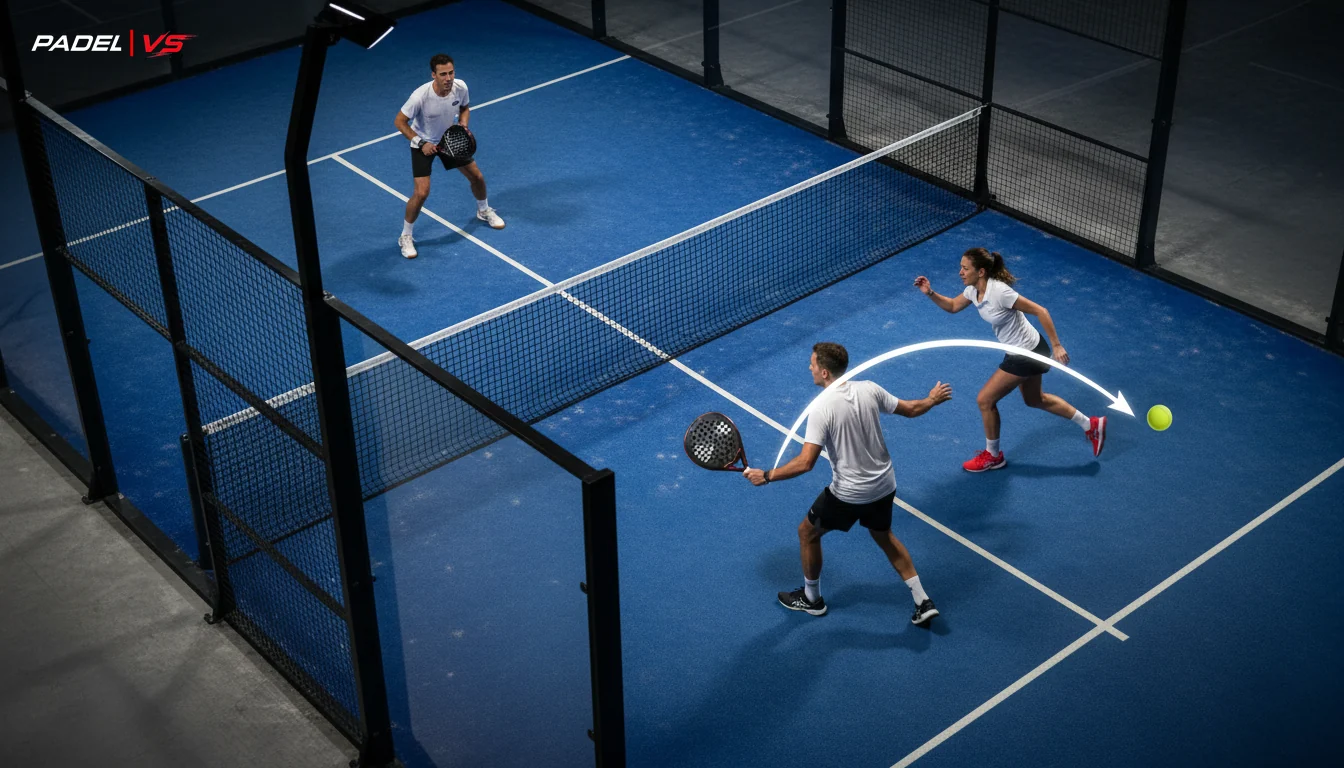
Before we get into mechanics, let's get the geometry straight. A padel court is 10 meters wide by 20 meters long, enclosed by glass walls and metal fencing at the sides and back. The three-wall smash — called remate por tres paredes or vibora de tres cristales in Spanish — is an offensive overhead hit executed near the back of your half of the court (generally within 3-4 meters of the back wall). The ball is directed toward the opponent's side wall, bounces across to the back glass, and exits from the opposite side at an angle that makes it physically impossible to retrieve.
What sets it apart from a conventional smash is the intent: you're not trying to blast the ball through the court — you're using the walls as accomplices to create an unplayable angle. It demands more tactical intelligence than raw power, which is exactly why most players either overuse it or execute it at the wrong moment.
"The three-wall smash isn't hit with your arm — it's hit with your brain two seconds before you make contact."
When to Attempt It: Reading the Situation
The most common mistake among players in the Cuarta and Tercera categories (850-1000 and 1000-1180 ELO in PADEL VS) is going for the three-wall smash when conditions aren't right. Before committing to the shot, you need to confirm three variables:
- Ball height: The shot works when the ball is falling between shoulder height and roughly 30-40 cm above your head. Too high (more than half a meter above your head) and the exit angle becomes unpredictable. Too low and you won't generate the lateral projection you need.
- Your court position: You need to be within the last 4 meters of your side of the court. Attempting the three-wall smash from mid-court simply doesn't give you the geometry.
- Opponents' positioning: If both opponents are well set at the net, the ball may exit the walls right into their rackets. The shot is most lethal when at least one opponent is displaced or both are caught in the back of the court.
Phase 1: Footwork and Hip Rotation
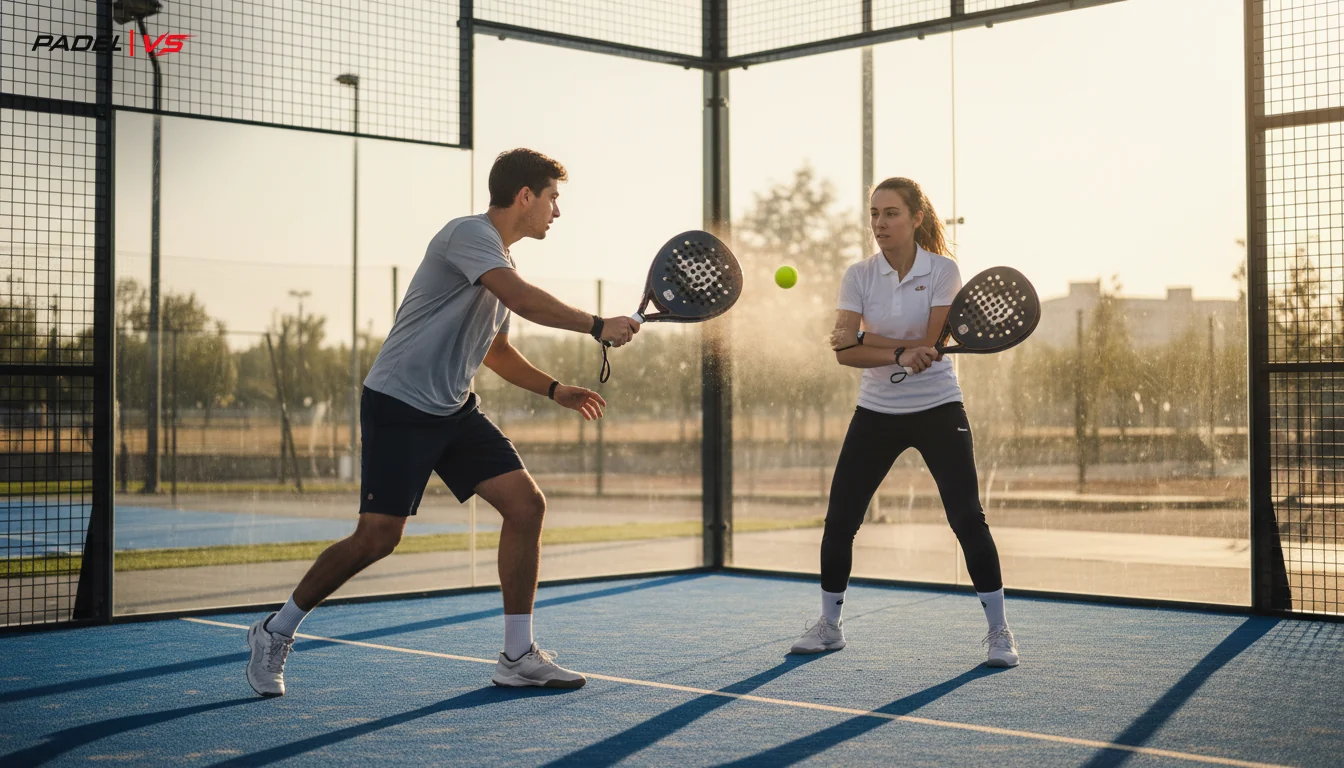
The three-wall smash starts at your feet, not your racket arm. The moment you identify a high ball and have the opportunity, your first movement is a 45-degree rotation toward your dominant side, pulling the right shoulder back (for right-handed players). This hip turn is what generates the rotational energy that will later produce both power and directional control without sacrificing accuracy.
Your feet should be parallel to the side wall, with the back foot slightly further behind than the front. A very common mistake is staying square to the net throughout the entire shot — that flat stance produces a linear swing that sends the ball straight, not angled toward the side wall where you need it.
At this stage your body weight should be loaded onto the back foot. The transfer of weight forward happens during the swing, and that transfer is a critical component of the kinetic chain that makes this shot work.
Phase 2: Racket Preparation — The High "Loop"
Unlike the bandeja (which uses a flatter, more horizontal swing plane), the three-wall smash requires a slightly more vertical swing plane at the point of contact. The preparation phase, however, is similar: the elbow rises to shoulder height and the racket points back and upward, forming roughly a 90-100 degree angle between the upper arm and forearm.
The grip should be continental or slightly shifted toward the backhand side — what padel players call the "neutral" or continental grip. This allows the racket face to arrive at impact with a slight tilt that projects the ball toward the side wall with far more precision than a closed forehand grip would allow.
One detail that makes an enormous difference: the elbow leads the swing, not the wrist. The wrist only snaps in for the final burst of acceleration just before contact, generating the slice or topspin effect depending on your intent.
Phase 3: The Contact Point — The Most Critical Variable
If we had to identify the single element that separates players who master this shot from those who waste it, it would be the contact point. For the three-wall smash:
- The optimal contact point is 20 to 35 cm in front of your dominant shoulder — not beside your body, but out in front of it.
- The ideal height is 10 to 20 cm above eye level.
- The racket face should be slightly open (tilted upward roughly 10-15 degrees) so the ball exits with the correct trajectory toward the side wall.
The most common error is making contact too close to the body or too far behind. When that happens, the ball flies straight down the middle or into the back of the opponents' court — giving them an easy ball instead of an impossible angle.
Phase 4: Direction — Choosing the Right Wall
This is where pure tactics enter the picture. The three-wall smash can go toward two different walls:
| Direction | When to Use It | Advantage | Risk |
|---|---|---|---|
| Toward the side wall on the opponent's backhand side | Opponent has a weak backhand or is shifted toward the center | Classic three-wall — produces the sharpest exit angle | A well-positioned opponent can volley the ball before it hits the second wall |
| Toward the side wall on the opponent's forehand side | Opponent's backhand is stronger, or partner is already covering that side | Tactical surprise — less anticipated | Technically harder — requires more hip rotation and body opening |
The general rule: in more than 70% of situations, the classic three-wall smash targets the backhand corner of the diagonally opposite opponent. If you're on the right side, the natural three-wall goes to the back-left corner. Reversing direction is a surprise weapon, not your default option.
Phase 5: Follow-Through and Recovery
Many players finish the shot and stand there watching it, admiring their work. That's a fatal mistake. Your follow-through should end with the racket pointing toward the side wall you aimed at, and your body naturally rotating to face the net. That rotation leaves you in perfect position to move forward toward the net immediately after the shot.
Here's the trap that few coaches explain clearly: the three-wall smash doesn't always end the point outright. At Segunda and Primera levels (1180-1350 and 1350-1550 ELO), opponents can read the ball's exit trajectory off the walls and counter with a well-placed lob or even an attacking return. If you freeze at the back of the court after your smash, you're vulnerable. The solution is simple: move forward to the net the moment you make contact.
Shot Effect: Slice vs. Topspin vs. Flat
The three-wall smash can be hit with three different effects, each producing different results:
- Slice (cut): The most common and most controlled version. The ball travels slower but hugs the walls tightly and dies quickly after exiting the third surface. This is the version to learn first.
- Flat: More pace, less margin for error. The ball exits fast and low after bouncing through the three surfaces, leaving opponents with minimal reaction time. For players with solid timing.
- Topspin: The hardest and most spectacular version. The ball kicks up unpredictably off the third wall, producing an exit that's nearly impossible to read. Used primarily by Open-level players (≥1550 ELO) as a destabilizing tool.
Common Mistakes by Category
| PADEL VS Category | Most Common Mistake | Priority Fix |
|---|---|---|
| Quinta (<850) | Attempting the shot on low or flat incoming balls | Master the flat bandeja first before adding the three-wall trajectory |
| Cuarta (850-1000) | Closed forehand grip — ball flies straight to the back | Drill continental grip mechanics against a single wall before adding court play |
| Tercera (1000-1180) | Contact point too far behind the body | Use a cone placed in front of the hitting shoulder as a visual contact-point target |
| Segunda (1180-1350) | Not advancing to the net after the shot | Mandatory drill: smash + immediate forward movement to net position |
| Primera / Open (1350+) | Misreading opponent positioning — shot converted into a lob | Video analysis: review opponent positioning in the 1-2 seconds before contact |
How to Train the Three-Wall Smash: Recommended Progression
- Solo shadow work (15 minutes): Stand in the back corner of the court and practice the full smash swing motion without a ball, focusing on hip rotation, the continental grip feel, and the forward contact point. Get the movement pattern into muscle memory before adding the ball.
- Hand-feed with a basket: A partner feeds balls to the correct height (shoulder-to-head level) while you execute the shot with full emphasis on directing it to the side wall. Target: 8 out of every 10 balls hit the side wall first as intended.
- Conditioned point play: The point always starts with a high lob to the back — the player receiving must attempt the three-wall smash. This builds the tactical context that makes the shot automatic in real match situations.
- Free play with a success count: During normal match play, track how many times you attempt the three-wall smash and how many successfully travel through all three surfaces correctly. A 60% success rate is a solid initial target for Tercera-category players.
At PADEL VS, we're building match tracking tools so you can measure your progress at this level of detail. As the platform grows, data from matches played through PADEL VS will help you identify exactly which situations you're converting and which ones you're gifting to your opponents — and that kind of granular feedback is invaluable for climbing from one category to the next.
The Detail Nobody Tells You: Reading the Incoming Lob
The three-wall smash almost always comes off a defensive lob from your opponent. And here's a secret that top players apply instinctively: the correct direction for the three-wall smash is decided while the lob is still climbing through the air, not as it's falling toward you.
While the ball rises and traces its arc overhead, you have between 1.5 and 2.5 seconds to read where your opponents are standing, decide between a three-wall smash and a bandeja, choose your direction, and get your body prepared. Players who think during the swing arrive late to the contact point. Players who arrive with the decision already made arrive calm, balanced, and with time to spare.
"High-level padel happens two seconds before the ball is struck. Everything after that is just mechanics."
Putting It All Together: From Lottery Shot to Tactical Weapon
The three-wall smash is one of those shots that can genuinely transform your padel game if you incorporate it correctly — or keep being that moment of pure adrenaline where you cross your fingers and hope for the best. The difference between those two realities is completely systematic: proper footwork, hip rotation, continental grip, forward contact point, a direction chosen before you swing, and a forward move to the net after you hit.
Train each phase in isolation before integrating them. Use the PADEL VS category structure — Quinta, Cuarta, Tercera, Segunda, Primera, and Open — as a real benchmark for where you are and which technical elements to prioritize at each stage. A Cuarta player who hits a consistent slice three-wall smash at 60% reliability already holds a major tactical edge over most opponents at that level. A Segunda player who executes it flat, advances to the net, and reads opponent positioning becomes genuinely hard to beat from the back of the court.
The glass is your ally. Learning to use it is the single biggest leap that separates a player who just hits the ball from a player who constructs points. Master this shot, and you'll start seeing the walls not as boundaries — but as your best partners on the court.