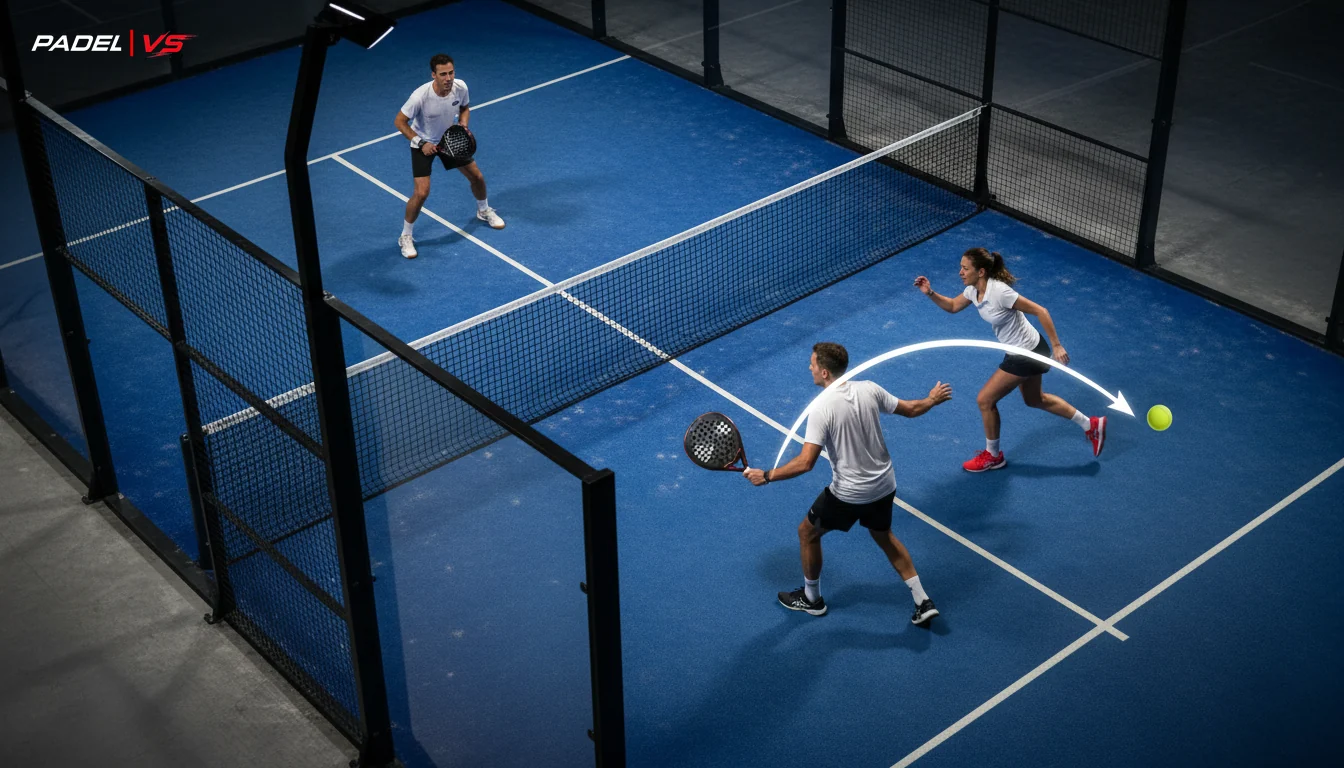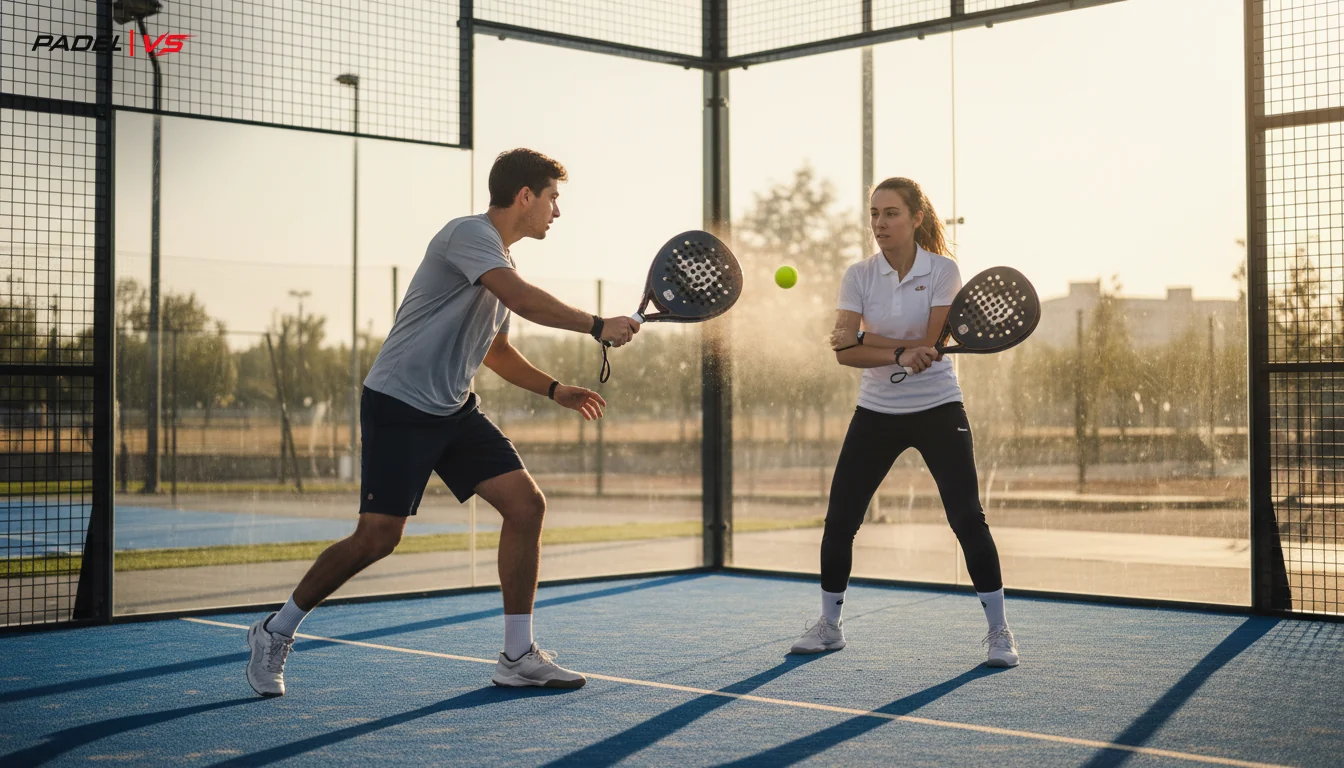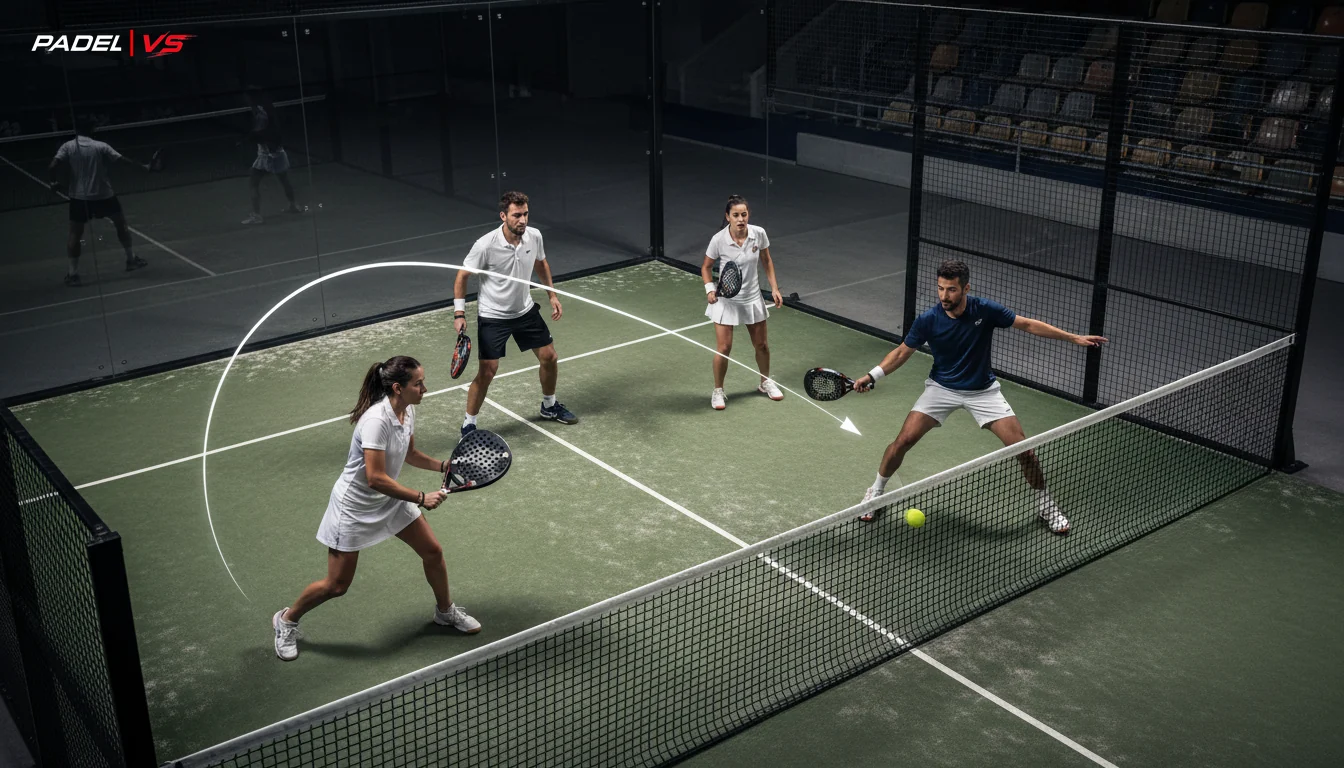

The side wall in padel is one of the sport's defining elements — the feature that makes padel impossible to compare with tennis, squash, or pickleball. Used correctly, it turns a defensive scramble into a winning rally; used poorly, it hands free points to your opponent every single time.
Understanding what the side wall actually does
Before we talk technique, let's talk physics. A standard padel court is 20 meters long by 10 meters wide. The side walls run the full length of the court, with glass panels rising 3 meters at the back section and wire mesh above. The back wall stands at 4 meters high. Every bounce off a side wall carries an inward component — meaning the ball always comes back toward the center of the court, never straight back.
This is the most fundamental concept that intermediate players miss: the side wall does not return the ball backward — it redirects it inward. If you're still positioning yourself as if the side wall behaves like a back wall, you'll keep mistiming shots, hitting frames, and sending balls into the net or out of bounds.
The angle of exit depends on three variables: the angle of entry, the speed of the ball, and how far up the glass the ball strikes. A ball hitting the bottom third of the side glass at high speed exits almost parallel to the back wall. A ball hitting at a steep angle near the top exits toward the middle of the court in a way that can completely wrong-foot an unprepared player.
The three scenarios where the side wall comes into play
Scenario 1: Defense — the ball hits the side wall before you strike it
This is the scenario you'll encounter most often at Cuarta and Tercera level (850–1180 ELO in PADEL VS). Your opponent hits a lob or a bandeja that lands near the side wall. The ball bounces on the floor, then hits the glass. Your job is to read the exit trajectory before the ball leaves the wall — not after.
The classic mistake is waiting for the ball to come off the glass before deciding what to do. By the time your visual system processes the exit angle, you're already half a step late. Early reading — which comes from watching your opponent's swing, not the ball — is what separates Cuarta players from Tercera players.
Scenario 2: Offense — you deliberately target the opponent's side wall
A well-directed bandeja or remate into the opponent's side wall creates angles that are extremely difficult to retrieve, especially when the ball exits toward the center or continues into the back corner. This is an offensive weapon, not an accident.
Scenario 3: Side wall + back wall combo — the hardest read in padel
When the ball touches both the side glass and the back glass in sequence (corner situation), the exit trajectory becomes the most unpredictable situation in the entire sport. We cover this at the end of the article.
The five technical pillars of a correct side wall shot
Pillar 1: Foot position — perpendicular to the wall, not parallel
The most widespread technical error among intermediate players is standing parallel to the side wall, the same way you'd stand at the back wall. When the ball exits a side wall, it travels inward and forward. If your body is parallel to the glass, your natural swing will push the ball right back into the wall or out of bounds.
The correct stance: dominant foot pointing toward the side wall, non-dominant foot pointing toward the net. This opens your hips toward the court and gives you a natural swing path toward the net or back glass.
Pillar 2: Distance from the wall — the 60-80 cm rule
Too many players crowd the glass when they're retrieving a side wall ball. They think staying close keeps them in control. The opposite is true. The ideal distance between your body and the wall at the moment of contact is 60 to 80 centimeters — enough space for your forearm to extend without truncating your swing.
If you're constantly hitting the frame, mishitting off the throat, or making unintentional slice shots, you're probably less than 40 cm from the glass. Step back, trust the ball to come to you.
Pillar 3: Contact point — waist to navel height
After leaving the side wall, the ball follows a descending arc. The optimal contact point is between hip and navel height, with the ball slightly in front of your body. Don't wait for it to drop lower (you'll end up digging it off the floor) and don't rush it above shoulder level (you lose directional control entirely).
A calibration drill you can do without a partner: stand near the side wall and toss the ball manually into the glass. Stop it with an open palm at the point where you should be striking it. If you can catch it comfortably at waist height with your arm extended, your positioning is correct.
Pillar 4: Racket face — semi-open, not flat
For a defensive side wall return, the racket face should be semi-open between 15° and 25° from vertical. This produces enough gentle topspin to carry the ball over the net with control without ballooning it upward.
Flat face: the ball goes fast and low, but you lose depth control. It often ends up in the net. Too open (more than 45°): the ball flies high and gives your opponent an easy overhead. Semi-open is the sweet spot that gives you both clearance and direction.
Pillar 5: Shot direction — don't hit where you're looking
When you're trapped near the left side wall looking toward the net, every instinct says hit it straight. That's exactly what your opponent expects. The two most effective options from the side wall are:
- Short cross-court: the ball crosses to the opposite side with an angle, landing near the far sideline. Your opponent, expecting a parallel ball, has to change direction at the last moment.
- Deep parallel: the ball runs along the opponent's side wall, forcing them to retreat. Especially effective when both opponents are at the net.
"The side wall isn't something that happens to you. At the highest levels, it's something you deliberately use against your opponent. The shift in mindset — from victim to orchestrator — is what defines your growth as a padel player."
The 6 mistakes that kill your rally from the side glass
| Mistake | Root Cause | What Happens | Fix |
|---|---|---|---|
| Waiting for the ball to exit before moving | Reactive rather than predictive reading | Late arrival, rushed swing, weak return | Read your opponent's swing, not the ball's bounce |
| Parallel stance to the wall | Back wall muscle memory | Swing directed into wall, ball exits court | Rotate hips 90° — foot toward wall, foot toward net |
| Standing too close to the glass | Fear of missing the ball | Frame hits, no power, no direction | Maintain 60-80 cm of clearance from the wall |
| Inadvertent lob (open face) | Racket face tilted too far back | Floaty ball, easy overhead for opponent | Keep face at 15-25° semi-open |
| Always returning to the same side | No tactical variation | Opponent reads you and pre-positions | Alternate cross-court and parallel deliberately |
| No communication with partner | Individualistic habit | Double chase, collision, double fault | Call every ball: "mine" or "yours" — loudly |
The hardest situation: side wall + back wall corner
When a ball touches the side glass and then the back glass in sequence — or vice versa — you're dealing with the most technically demanding situation in padel. The exit angle can be up to 135° from the original direction of the ball. It can exit toward the center of the court, toward the opposite side wall, or float up unexpectedly if the back-spin from the first bounce is significant.
The key positioning principle: when a corner ball is incoming, position yourself in the center of the court between both walls, not hugging either one. From that central position, you have time to react to any exit direction. If you commit to one wall, the ball will likely exit from the other.
Here's a specific number that most coaches don't mention: every contact with a glass wall reduces the ball's velocity by approximately 30-40%. A ball screaming into a corner at high speed can exit surprisingly slowly. Don't swing hard — swing controlled. The mistake here is always over-hitting, because the sudden slowdown in ball speed catches you at the worst moment of your backswing.
Three drills to improve your side wall game
Drill 1: Solo side wall rally
Stand near the center of the court. Hit the ball into your own side wall, let it bounce off the floor and the glass, then return it back. Aim for 20 consecutive controlled returns without letting the ball die. Focus is entirely on reading the exit angle and adjusting your foot position before you swing — not during.
Drill 2: Net feeder + side wall defender (pair)
One player stands at the net. The other is near the side wall. Net player feeds a soft ball toward the glass. Defender retrieves and sends it cross-court. Net player does not attack. This drill isolates timing, foot position, and racket face angle in a controlled environment without the pressure of real rally pace.
Drill 3: Forced direction point play (pair or four)
Play normal points, but add a rule: any player retrieving from the side wall must send the ball to the opposite half of the court from where the feed came. This trains deliberate cross-court returns under real match pressure — which is the highest-value skill you can develop from the side wall.
What level should you have mastered this at? (PADEL VS categories)
In PADEL VS, we use an ELO-based rating system to categorize players objectively. Side wall proficiency is one of the clearest progression markers across the six categories:
| Category | ELO Range | Expected Side Wall Proficiency |
|---|---|---|
| Quinta | <850 | Get the ball back somehow. No tactical expectation. |
| Cuarta | 850–1000 | Correct foot position, basic timing. Begin using cross-court intentionally. |
| Tercera | 1000–1180 | Alternate cross-court and parallel. Read corner combos reliably. |
| Segunda | 1180–1350 | Create offensive angles from the wall. Use lateral glass as a deliberate weapon. |
| Primera | 1350–1550 | Full control: corners, variable pace, directional fakes. |
| Open | ≥1550 | The side wall is a primary offensive tool, not a defensive scramble. |
If you're currently in Cuarta and the side wall still feels like an emergency rather than a tool, this is your single highest-leverage area to work on before moving up. In PADEL VS you can track your match data to identify whether glass situations are consistently costing you points — and use that as targeted feedback for your training sessions.
"You don't need pace to win a side wall rally. You need the right position before the ball arrives, the patience to let it come to you, and the clarity to place it where your opponent isn't standing."
Final takeaway: the wall is yours to use
Most intermediate padel players share the same blind spot: they see the side wall as a problem to manage rather than a resource to exploit. The moment a ball drifts toward the side glass, they tense up, crowd the wall, swing too early, and return predictably. That's a pattern your opponents can and will exploit.
Work through the five pillars in sequence — foot position, distance, contact point, racket face, shot direction. Don't try to fix everything at once. Spend two focused training sessions on each pillar before moving to the next. When the side wall becomes your comfort zone instead of your stress point, your ELO will follow automatically.
You can register your matches, follow your ELO progression, and find opponents at your exact level through padelvs.com or via the PADEL VS bot on Telegram. We're currently building the competitive padel community in Mexico, starting in Cancún and expanding to more cities — join while the rankings are still being shaped.