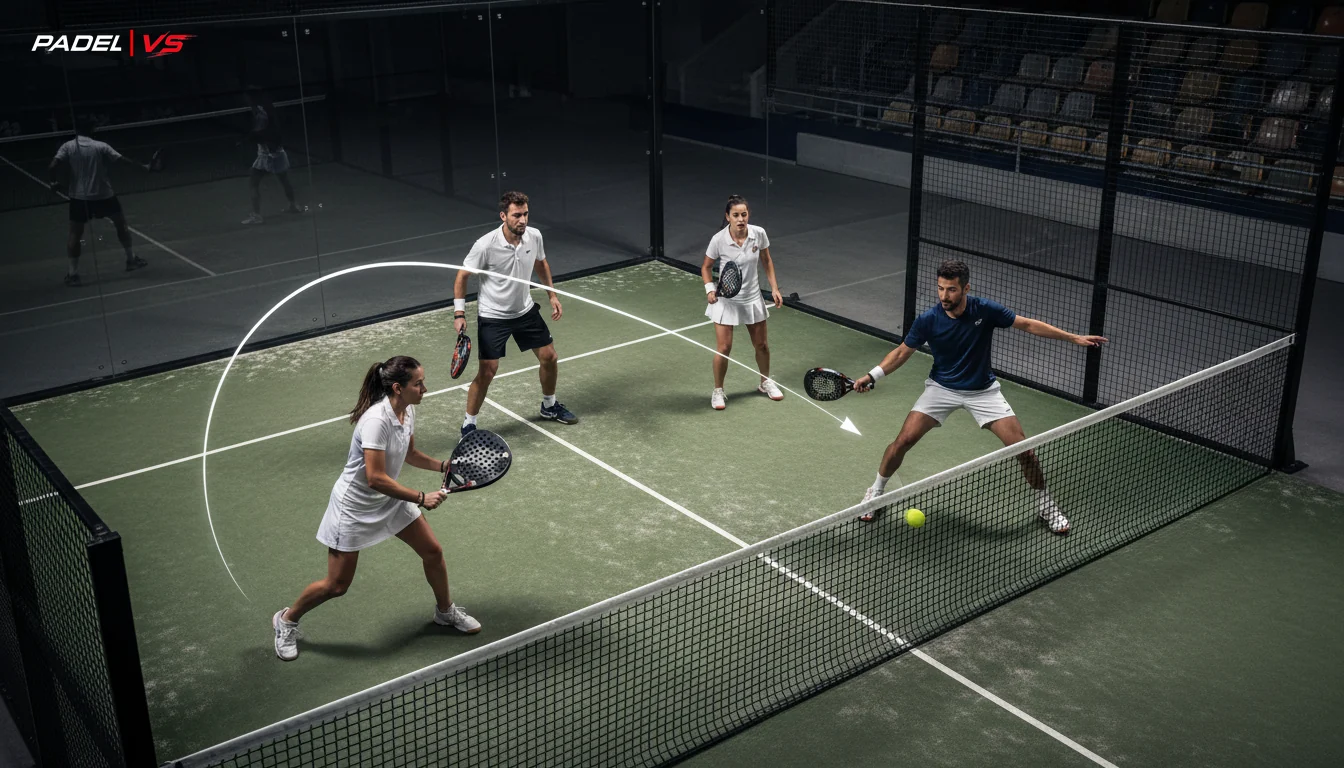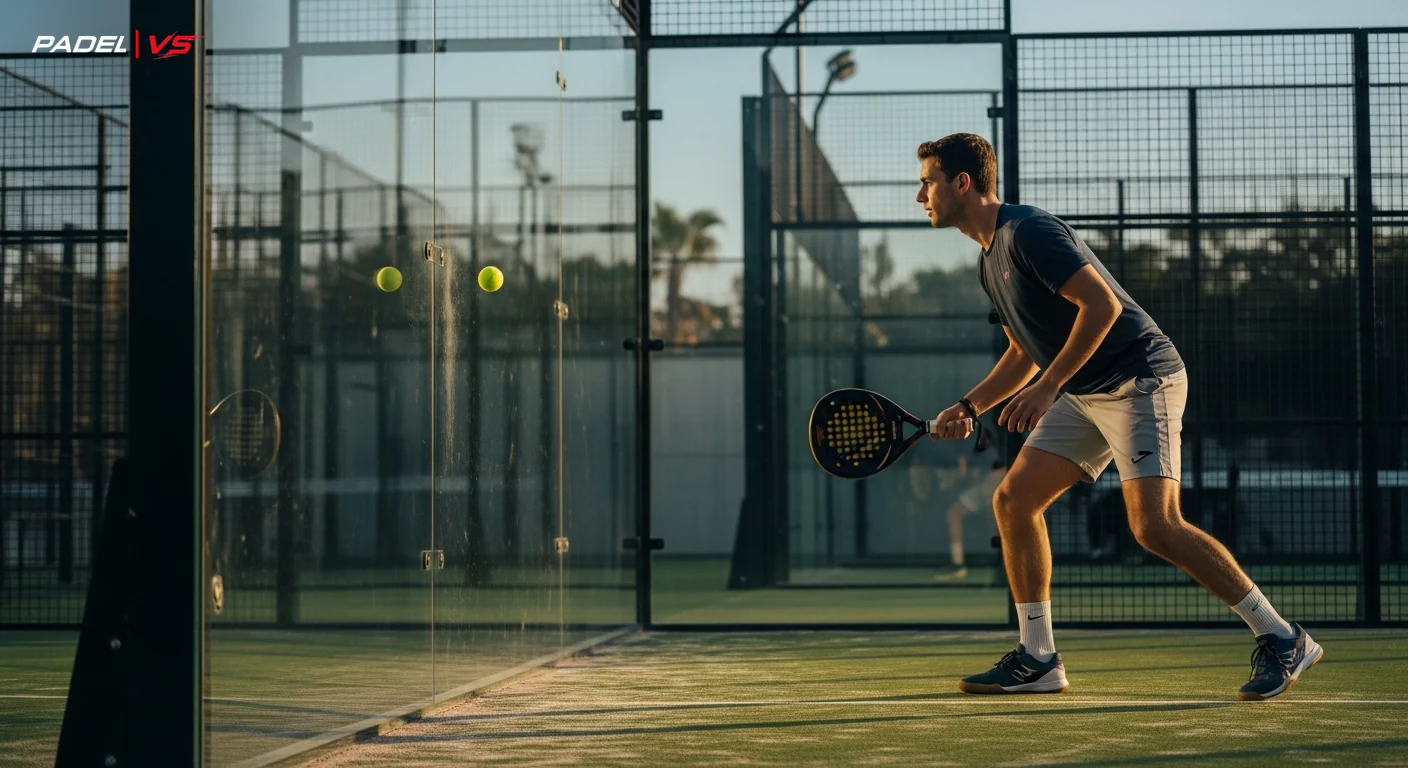

In padel, points aren't won by hitting hardest — they're won by getting there first. The gap between a Cuarta player and a Primera player isn't always about technique or power; it's about how many tenths of a second earlier they start moving in the right direction. Reading your opponent is a trainable skill, and this article gives you the framework to develop it systematically.
Why anticipation beats pure speed every time
A padel court measures 20 × 10 meters — significantly smaller than a tennis court. That compressed space means raw reaction time (between 150 and 250 milliseconds for the average human) sometimes simply isn't enough to cover certain angles, especially against a well-executed bandeja or víbora from the net position. What compensates for that biological limitation is predictive anticipation: using pre-contact information from your opponent's body to position yourself before the ball is struck.
Research in racket sports consistently shows that elite players fix their gaze on the opponent's hip and shoulder between 80 and 120 milliseconds before tracking the ball. Novice players watch the racket. That single shift in visual focus can give you up to 0.3 seconds of additional advantage — enough time to cover nearly two meters of court in any direction.
"The player who waits for the ball always arrives late. The player who waits for information always arrives first."
The five primary cues to read
1. Your opponent's foot position
Feet don't lie. Before executing any shot, your opponent's body needs to organize itself, and that organization starts from the ground up. Watch for:
- Lead foot crossed toward the center: Your opponent is setting up a cross-court shot. Their hip angle forces it.
- Foot parallel to the side wall: High probability of a down-the-line shot or a deep lob.
- Weight loaded on the back foot before contact: Classic sign of a defensive lob — the body needs to lean back to get the ball up.
- Short, stuttered steps right before the strike: Your opponent arrived late to the ball. They're improvising. Hold central position and wait for the error.
2. The dominant shoulder angle
The shoulder is the biggest giveaway in padel. Unlike tennis where hips rotate with relative freedom, in padel many shots near the glass walls force the body to open or close in much more visible ways. When your opponent's dominant shoulder points toward their own side wall, a down-the-line shot or a wall-exit toward that side is almost always coming. When the shoulder points toward the center of the net, the cross-court is the natural option.
This applies especially to the bandeja and the smash. Watch the degrees of shoulder rotation relative to the net plane — if the angle exceeds 45°, the smash is unlikely to go to the center of the court. Use that to anticipate your retreat path and the right defensive position.
3. Backswing height
The height at which your opponent takes their racket back tells you a great deal about the speed and trajectory of the incoming shot:
| Backswing height | Likely shot | Your response |
|---|---|---|
| Racket above the head | Smash, bandeja, or víbora | Step back 1-2 paces, cover the center |
| Racket at shoulder height | Offensive volley or drive | Hold position, prepare to block |
| Racket at waist height or lower | Defensive shot, low lob, drop shot | Advance toward net, apply pressure |
| No visible backswing (racket still) | Reflex block, emergency lob | Maximum offensive position, attack the lob |
4. The glass and brick wall contact point
This is a cue unique to padel — it doesn't exist in any other racket sport. The sound and angle of the ball's rebound off the back glass or brick walls gives you information about the trajectory your opponent is receiving, which in turn predicts their available shot options:
- High rebound off the back glass (above shoulder height): Your opponent is getting the ball above their shoulder. Their options narrow sharply — defensive lob or a wall-exit to the side. Position yourself for the counter-attack.
- Low rebound off the back glass (below 1.5 meters): They have to crouch and open the racket frame. A long lob or a very slow shot is almost certain. Move forward.
- Ball exiting off the side wall before reaching the back glass: Complex trajectory. Your opponent needs extra time to reorganize — their shot will arrive later than expected. Don't overcommit early.
5. Your opponent's eye direction
Yes, the eyes matter too. In doubles padel — which is the standard format — the player about to strike will almost always glance involuntarily toward their intended target. This eye-tell is almost universal in players below Segunda level (under 1,180 ELO). Learn to catch that micro-direction without making it obvious that you're watching your opponent rather than the ball.
Additionally, if your opponent looks at your partner instead of you, that's a direct tactical signal that they intend to play to the side you're not covering. This is freely available information — take it.
Integrating all the information in real time
The trap of teaching these cues separately is that in an actual match, everything happens simultaneously in fractions of a second. The solution is not to try to consciously process each cue in sequence — that would paralyze you. The goal is to train the reading until it becomes automatic.
One highly effective method is shadow padel training: practice moving in reaction to your training partner's body cues, without a ball. Your partner executes the full technical gesture of different shots — smash, lob, drop shot — and you react to the body movement alone. After 15-20 minutes of shadow work, when you return to playing with a real ball, your brain already has those movement patterns encoded and will apply them automatically.
Another high-value exercise: record your matches and replay them, pausing the video exactly at the moment of your opponent's preparation phase — before contact. Ask yourself: what do I see? What should I have done? Players who do this systematically improve their game-reading ability faster than those who simply accumulate match hours without reflection.
Applying tactical reading by category
Game-reading doesn't apply identically at every level. In PADEL VS we organize competition from Quinta (under 850 ELO) all the way to Open (1,550 ELO and above), and the cues worth prioritizing shift depending on your current level:
| PADEL VS Category | ELO | Most valuable cue to read |
|---|---|---|
| Quinta | <850 | Foot position — positioning mistakes are constant and readable |
| Cuarta | 850-1,000 | Backswing height — distinguishes lobs from drives reliably |
| Tercera | 1,000-1,180 | Shoulder angle — play becomes more intentional |
| Segunda | 1,180-1,350 | Combined shoulder + wall rebound reading |
| Primera | 1,350-1,550 | Micro eye-cues and pre-strike body pause |
| Open | ≥1,550 | Full-match tactical patterns and tendency history |
Reading the game as a pair: the doubles dimension
Padel is fundamentally a doubles sport, and that adds a fascinating layer of complexity: you need to read not just the opponent who's about to strike, but also anticipate the movement of the opponent who doesn't have the ball. That second player is already repositioning to attack the gap that will open after their partner hits.
A high-performance tactical rule: when you read that the striking opponent is going cross-court, immediately check the position of the non-striking opponent. If that second player is already closing toward the center, the cross-court shot is nearly confirmed. If they're staying wide, a deception play may be in preparation.
Communication with your own partner is also part of collective game-reading. Short cues like "deep" or "down the line" said half a second before the opponent strikes can change the outcome of a point. This isn't interference — it's collaborative tactical intelligence, and it's completely legal in padel.
"In doubles padel, the player who reads best isn't the one who watches most — it's the one who shares what they see fastest."
The most common mistake: watching the ball the entire time
This is the hardest habit to break and the one that most limits anticipation. Watching the ball constantly seems logical — it moves the fastest and most visibly. But in padel, once the ball is already traveling toward your opponent, it gives you no new actionable information. What does give you new information at that exact moment is your opponent's body organizing itself to strike.
The correct visual protocol: track the ball with peripheral vision while focusing your central gaze on your opponent's body. It's uncomfortable at first. Your brain is wired to track moving objects. But with deliberate practice it becomes automatic. A practical drill: during the first ten minutes of warm-up in every session, force your gaze to stay on the opponent's body 80% of the time. The game will feel strange initially. After three or four sessions, you'll start anticipating shots that used to surprise you completely.
Building the habit over time
Reading the game is a meta-skill — it compounds. Every match you play with deliberate attention to these cues builds a mental library of patterns. Over time, you start recognizing that a specific opponent always lobs when they receive a deep ball to the backhand. Or that a particular pairing always switches to defend the center after a hard cross. Those pattern recognitions happen faster and faster until they feel like instinct. They're not instinct — they're earned pattern-matching.
The important distinction is between passive experience and active learning. Two players can play 200 matches: one purely focused on hitting well, the other consistently tracking and noting opponent cues. The second player will develop game-reading that the first player never will, even with fewer total hours on court.
How PADEL VS helps you develop tactically
Improving your game-reading requires quality matches, varied opponents, and real data about your progress. At PADEL VS we're building exactly that: a competition system that matches you with opponents at your actual ELO level, not randomly. When you consistently compete against players in your own category, you can start working on tactical patterns — rather than simply surviving each point.
You can register at padelvs.com, find us on the Telegram Mini App (@padelvsbot), or message our AI agent directly on WhatsApp. We're in early stage in Cancún and growing — and the platform supports a full range of payment options including credit/debit card via Stripe, Mercado Pago (including OXXO and bank transfer), crypto via B4Bit (USDT, BTC, ETH), and cash payments at the club with QR-based registration. If your club isn't part of the network yet, that's a conversation worth starting.
Reading the game can't be learned in a single article — it's built point by point, with deliberate attention. But having the right map of cues to observe makes every match a learning session rather than just a scoreline. Start today: choose one single cue from this list and commit to tracking it for your entire next match. One at a time, the game becomes more legible — and you become harder to beat.