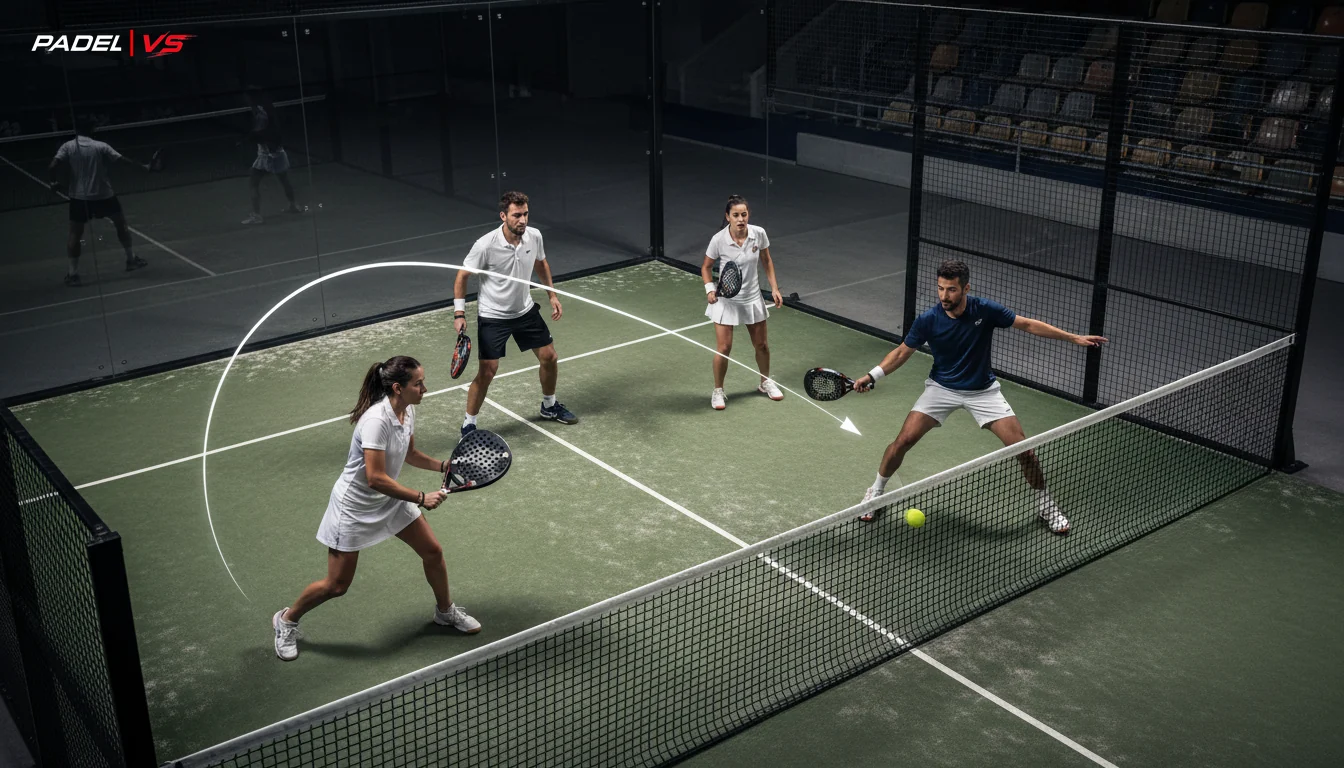

In padel, the question of who plays the forehand side and who plays the backhand side is not a coin flip or a matter of habit — it's one of the most consequential tactical decisions a pair will make, and getting it wrong can cost you sets against opponents you should beat comfortably. If your team still plays wherever you happened to stand the first time you walked onto the court together, this article will change how you think about positioning.
Why the side matters more in padel than in any other racket sport
Padel is played on a 10-meter-wide, 20-meter-long court enclosed by glass walls and metal fencing that are active parts of the playing surface. That changes everything. Unlike tennis, where the court is open and a ball that goes past you is simply out, in padel a ball that passes you hits the glass and comes back — and your positioning determines whether you can retrieve it or you're caught flat-footed.
The forehand side (right side for right-handed players) and the backhand side (left side for right-handed players) are not mirror images of each other. They create different geometric challenges, different attack windows, and very different defensive demands. A player who thrives on one side might genuinely struggle on the other, not because of skill, but because of how the glass angles and court geometry interact with their natural swing patterns.
"The pair that decides their sides before stepping on court has already won the first point of the match." — Core principle of competitive padel tactics
The key factors in deciding who goes where
1. Dominant shot quality and direction
This is criterion number one, full stop. A player with an exceptional forehand — powerful, directional, and capable of constructing points — belongs on the right side. A player whose greatest weapons are a reliable backhand slice, a precise backhand bandeja (defensive tray shot), or a sharp backhand vibora will find the left side gives them far more opportunities to be dangerous.
But here's the nuance most recreational players miss: the question isn't simply "which groundstroke do you prefer?" It's "on which side of the court do you generate the most offensive pressure and commit the fewest defensive errors?" Those two answers sometimes point to different sides, and you need to reconcile them honestly.
2. Left-handedness as a tactical weapon
If one player in the pair is left-handed, the strategic equation shifts dramatically in your favor. A right-handed/left-handed partnership, with the right-hander on the right and the left-hander on the left, creates a formation where both players have their forehand facing the center of the court. The result is crushing pressure from the net and serious difficulty for opponents trying to read which shots are covered.
This is one of the structural reasons historically dominant pairs in padel have often featured one ambidextrous or naturally left-dominant player. When both forehands point to the middle, the smash-through-center play becomes one of the most lethal weapons in the game. If you have a left-handed partner, use this to your advantage — it's a built-in tactical edge most teams don't have.
3. Glass wall reading under pressure
Padel's defining defensive challenge is reading and recovering balls off the glass. The back-left glass corner and the back-right glass corner produce different ball trajectories because of how the walls meet at angles and how the ball's spin interacts with each surface. Most players have a natural affinity for reading the glass on one side before they develop ambidextrous wall fluency.
Ask yourself: who handles the back-right corner more naturally, picking up low balls off the side glass and responding with a forehand lob or controlled drive? Who reads the back-left corner more intuitively, taking the ball off the back wall with a backhand and placing a high defensive lob cross-court? These tendencies should heavily influence the decision.
4. Net coverage and the center zone
At the net — particularly when both players are positioned within 2-3 meters of the net — the center strip of the court is contested territory. There must be a clear, pre-agreed rule about who takes balls that come down the middle. Generally, the right-side player (forehand toward center) has tactical priority on central balls, but this needs to be explicitly trained and communicated, not assumed.
How level affects the decision
The right approach to side selection varies meaningfully by competitive level. In PADEL VS, we use a structured ELO system with named categories, and the tactical logic for side assignment is genuinely different at each tier:
| Category | ELO Range | Side selection logic |
|---|---|---|
| Quinta | <850 | Prioritize comfort. Play where you feel most secure. Consistency beats tactics at this stage. |
| Cuarta | 850–1000 | Start defining clear roles. Identify who has the better bandeja or vibora for net play. |
| Tercera | 1000–1180 | Side should be fixed. Begin training glass-reading and defense specifically for your assigned side. |
| Segunda | 1180–1350 | True specialization begins. Train exits, smashes, and defensive patterns exclusively from your position. |
| Primera | 1350–1550 | Your side is sacred. Switching is a deliberate tactical surprise, never a moment of confusion. |
| Open | ≥1550 | Full fluency on both sides, but each player has a deeply differentiated and specialized role. |
At Quinta and Cuarta, the most important thing is that both players feel settled and aren't getting in each other's way. From Tercera onward, specialization starts producing real, measurable results in match outcomes.
Debunking the myth: "the stronger player always plays the backhand side"
You'll hear this in clubs across Mexico and throughout Latin America: the dominant player in the pair should always play the left (backhand) side because it controls the center and creates the most natural bandeja opportunities. It's a reasonable guideline, but it's not a universal law.
The reality is more nuanced. If the dominant player's biggest weapon is their forehand — a heavy, directional drive or a brutal forehand smash — forcing them to play backhand to satisfy a convention actively weakens the pair. The correct side is the one where each player generates maximum offensive pressure and minimum defensive vulnerability, not the one tradition dictates.
That said, there is some truth behind the guideline: the left side does tend to receive more balls in competitive matches, particularly when opponents attack cross-court from their right. So the player on the backhand side needs to be rock solid — not necessarily the flashiest player, but the most reliable one under sustained pressure.
When switching sides makes tactical sense
The general rule is: keep your sides fixed throughout the match. But there are legitimate tactical moments to rotate:
- When opponents are systematically exploiting the same corner: If you're consistently losing points from one specific corner, a temporary switch can break their pattern and buy time to reassess.
- After a defensive lob that resets the point: Coming back from deep defense with a high lob, you have a brief window to redistribute positions and catch opponents off guard.
- Planned server/receiver switches: Some pairs use different side assignments based on who's serving, but this requires heavy practice — done poorly, it creates confusion that opponents can exploit.
- Protecting a physically compromised partner: If your teammate has a shoulder twinge or a knee issue that limits them on their natural side, rotating is valid tactical adaptation, even if it costs you some positional efficiency.
Side-specific training drills
Choosing your side is step one. What actually creates a competitive edge is training specifically for that side — not just playing matches from that position, but building isolated muscle memory and glass-reading instincts for your assigned zone.
For the forehand side (right) player
- Right corner glass exits: Feed ball into the back-right corner at medium pace, player exits with a parallel forehand drive or a high cross-court lob. Aim for 20 clean repetitions per session.
- Forehand smash placement: Position at the net, receive a lob, and practice directing the smash into the opponent's back-left corner (cross) or the back-right corner (parallel). Focus on disguise, not just power.
- Center voley control: Forehand volleys from net position that close the center without leaving the left side exposed. Work with your partner to build a feel for the coverage boundary.
For the backhand side (left) player
- Cross-court bandeja and vibora: The left-side smash directed into the opponent's right corner is one of the highest-percentage winners in padel. Practice it with lateral movement — you'll rarely be perfectly stationary when you execute it.
- Back-left glass reading: The ball comes off the back wall in the left corner at a different angle than the right. Feed balls into that corner at varying speeds and spins. Reading this correctly requires repetition — there's no shortcut.
- Defensive lobs from the back-left: The lob from the back-left position should be high, long, and cross-court. This is your primary reset tool when pinned deep. Practice the footwork positioning that lets you execute it under pressure.
Communication: the layer that makes it all work
No tactical decision about sides functions without active in-match communication. Before each point, even just a word or a look: who covers center on a mid-court ball? Who goes to the net first after a good lob? Who covers the lob if both of you are at the net?
Pairs that communicate well don't just cover the court better — they play with more confidence because there's no hesitation when an ambiguous ball comes down the middle. That split-second of certainty, knowing exactly whose ball it is, often determines whether you play an offensive shot or a defensive flick.
In PADEL VS, match history tracking allows pairs to see patterns over time — which zones of the court they concede most frequently, which score situations tend to destabilize them, and which opponent formations give them trouble. That kind of data is tactical gold that very few platforms offer in the market. You can access your pair's stats and manage your matches at padelvs.com, through the Telegram Mini App (@padelvsbot), or via the WhatsApp bot with AI agent.
"A padel court is 10 meters wide. Each player owns 5. But only communication decides who covers the 2 meters in between."
Final takeaway: the pair that knows itself wins more
Deciding who plays the forehand side and who plays the backhand side is not a detail — it's the structural foundation on which everything else is built: attack patterns, defensive routines, center coverage, and even the emotional rhythm of the match. A pair that has genuine clarity on their positioning plays with more assurance, communicates faster, and makes better decisions when the match gets tight.
Before your next competitive match — whether it's in a PADEL VS event or any organized tournament — take five minutes to define sides using real criteria: Who has the sharper bandeja? Who reads the back-left glass more naturally? Who generates more net pressure from the right? Don't decide by habit. Decide by tactics.
The glass walls will tell you soon enough if you got it right.