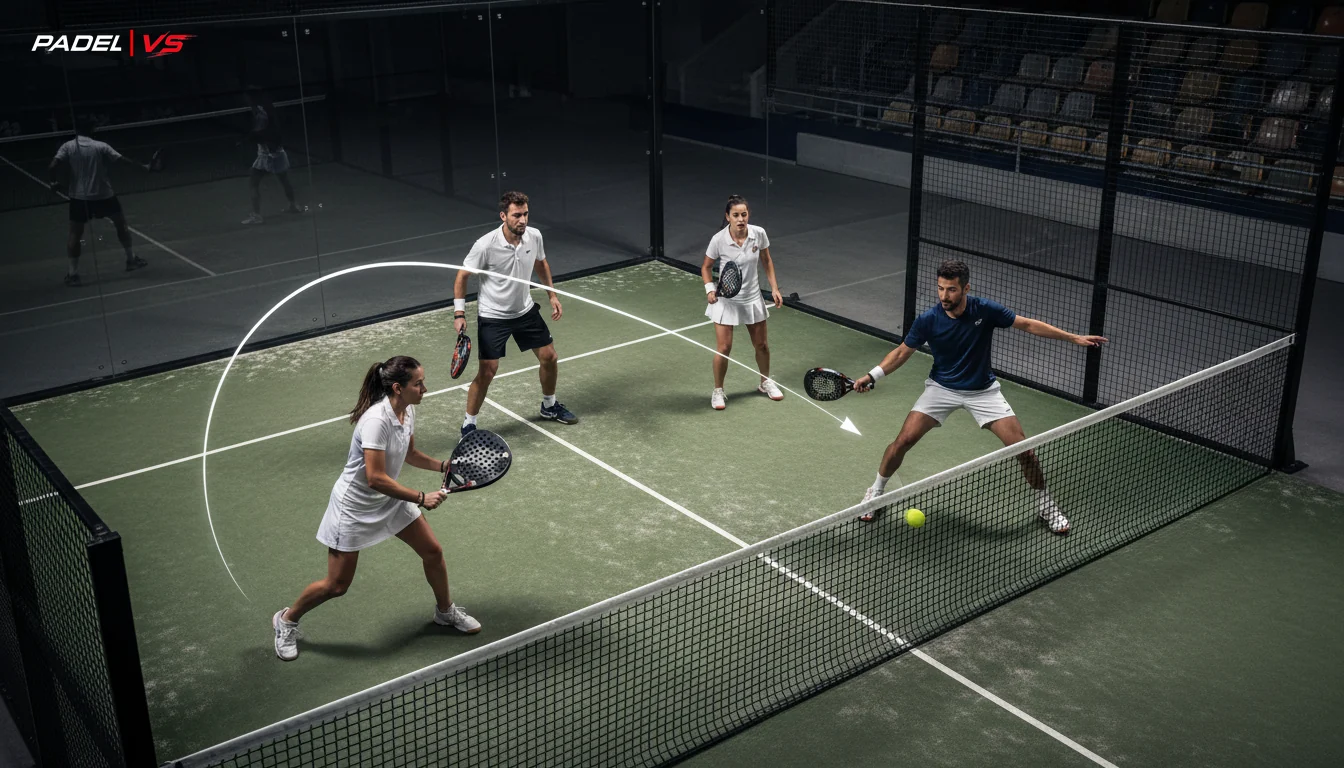

The net is the most coveted — and most punishing — real estate in padel. Rush to it without structure and you'll spend the match scooping up balls from your ankles; command it with intelligence and every rally becomes a statement. This guide breaks down the real mechanics of holding the net: exact positioning, the split step most club players skip, and how to read a feet attack before it leaves your opponent's racket.
Why the net decides padel matches
Padel's geometry is unlike any other racket sport. The court measures just 20 × 10 meters — less than half the area of a tennis court — and the glass walls at 3 meters high compress rally time dramatically. That compression rewards the net position structurally. At competitive levels, roughly from Tercera (1000–1180 ELO) upward, the vast majority of points are decided with at least one pair at the net, and most winning shots are volleys, overheads, or forced errors provoked by net pressure.
The challenge is not getting to the net. The challenge is staying there intelligently when your opponents decide to attack your feet instead of lobbing over your head.
"The net doesn't belong to the bravest player — it belongs to the most prepared one."
The optimal net position: stop gluing yourself to the glass
One of the most consistent mistakes among Cuarta (850–1000 ELO) and Tercera players is standing too close to the net — sometimes as little as 60 to 70 centimeters from the mesh. It looks and feels aggressive, but it leaves you with almost zero reaction time to a ball directed at your feet, and it eliminates your angle for cross-court volleys.
The ideal waiting position in most situations is between 1.5 and 2 meters from the net, with your weight slightly forward on the balls of your feet. From here you can move forward to intercept a high or mid ball, step back to retreat against a lob, and drop your body quickly against a low attack.
The three net zones in padel
- Aggressive zone (0.8–1.2 m): Reserve this only for finishing shots — overheads, bandeja, or putaway volleys. This is not your waiting position between shots.
- Control zone (1.5–2 m): Your default position during most rallies. It gives you reaction time in all directions and maintains offensive pressure.
- Reactive zone (2.5–3 m): Step here when your opponent has a clear attacking opportunity. You buy time but sacrifice pressure.
Your position should flow between these zones based on where the ball is, who is hitting it, and what shot is most likely. An opponent receiving a deep bandeja at the back wall is not going to attack your feet; one picking up a short lob at mid-court almost certainly will.
The feet attack: anatomy of padel's most effective net-breaker
The golpe a los pies — literally "shot to the feet" — is a ball directed into the zone between your knees and the mesh, typically bouncing 20 to 50 centimeters in front of you. Its purpose is not to make you run. Its purpose is to force you to volley from below the net tape height, converting whatever you send back into a weak, attackable ball.
Why it's so hard to defend
- Flight angle: The ball travels flat or with moderate topspin and bounces directly in front of your feet, requiring a deep knee bend that many players haven't trained for.
- Reaction window: Depending on court position and shot speed, you have between 0.4 and 0.6 seconds from contact to the bounce. That margin punishes any foot position that isn't already loaded.
- Tension reflex: Most players tense up when standing at the net, which slows the ability to drop the body quickly. Staying loose is a physical discipline, not just a mental one.
Anticipation: reading the shot before it happens
Anticipation at the net is not instinct — it is pattern recognition trained through deliberate repetition. Your brain processes a stack of cues in milliseconds: your opponent's stance, racket face angle, contact point height, and their tendencies in that specific situation. This is where Segunda (1180–1350 ELO) and Primera (1350–1550 ELO) players separate from lower categories most visibly — not in technique, but in how early they read the shot.
Key signals and what they predict
| Opponent signal | Likely shot | Your immediate response |
|---|---|---|
| Open shoulders, high contact point | Lob | Retreat immediately — don't wait for the ball to pass over you |
| Dropped wrist, low contact point | Feet attack | Bend knees, racket down and forward, open face |
| Weight forward, open stance | Cross or down-the-line passing | Close the middle, anticipate with lateral step |
| Tight grip, short swing | Short defensive lob | Hold position, prepare bajada or smash |
| Slow preparation rhythm | Slow ball to disrupt your timing | Don't rush — control the slow volley deliberately |
Training this anticipation system requires deliberate feed drills — not just point play. Have a coach or partner feed specific shots without telling you which one is coming next. The lack of pre-information is the entire point: your brain has to read the body language, not the verbal cue.
Footwork at the net: the foundation nobody teaches properly
You can read the shot perfectly and still lose the point if your feet aren't loaded correctly when your opponent makes contact. Net position requires three physical conditions:
- Width: Feet slightly wider than shoulder-width apart — roughly 55 to 65 centimeters between the inside of each foot.
- Flexion: Knees semi-bent at all times. Never stand fully upright at the net. A lower center of gravity lets you drop quickly for the low ball.
- Weight distribution: Approximately 60% on the balls of the feet, 40% on the heels. No weight back when waiting at the net.
The split step: the most underused tool at club level
As your opponent reaches the ball and is about to make contact, execute the split step: a small, synchronized hop timed to the moment of their contact that lands you in the air for a fraction of a second and reloads your legs for movement in any direction. This micro-jump resets your weight distribution and eliminates the inertia of standing still.
Most Quinta (<850 ELO) and Cuarta players skip this entirely and react from a static stance — which costs them 0.1 to 0.15 seconds of reaction time. That may sound trivial, but at 1.5 meters from the net with a ball coming at your feet, it's the difference between a controlled low volley and a stumbled defensive flick.
Executing the low volley correctly
When your opponent does get the ball to your feet, the match isn't over — provided your response is technically sound. The low volley in padel has specific requirements different from a standard high volley:
- Drop your body, not just your arm. Bending only the elbow to lower the racket produces a poor contact angle. Flex your hips and knees so your whole body descends into the shot.
- Open racket face. The surface needs a slight backward tilt to produce enough elevation over the net tape. Aim for approximately 10 to 15 degrees open relative to vertical.
- Direction: deep and central. Under a low volley you are not in a position to go for angles. A deep ball to the center of the opponent's court resets the point to neutral conditions.
- Absorb, don't hit. The low volley is a control shot. Grip pressure should be moderate — think 5 out of 10 — to absorb the incoming pace and redirect rather than counterattack.
"The mark of a great net player isn't avoiding the feet attack — it's returning it without surrendering the rally."
Partner synchronization: net coverage is a two-player system
You never hold the net alone in padel. Net coverage is a coordinated system where your position directly defines your partner's, and vice versa. The most expensive positional errors happen when one player is at 0.8 meters and the other is at 2.5 meters — that gap in lateral alignment creates a central corridor that any Tercera-level or above player will find and exploit with a passing ball.
Synchronization principles at the net
- The ball dictates both positions: When the ball moves toward the right side, both players shift slightly right. Never leave the near-side corridor open to cover the far side.
- Maintain consistent lateral separation: Keep 2 to 2.5 meters between you and your partner at all times to cover the 10-meter court width effectively.
- Pre-point center agreements: On the serve, decide before the point who covers the center on a cross-court passing shot. This prevents the double-hesitation moment that gifts free points to the opposition.
- When one retreats for a lob, the other moves back too: If your partner is chasing a lob to the back wall, do not stay glued to the net alone. Drop to a mid-court position (3 to 4 meters back) to cover the diagonal return.
Three drills to build real net stability
1. The ghost feet drill (20 minutes)
A coach or partner feeds balls from the baseline alternating randomly between feet attacks and standard mid-height volleys without announcing which is coming. Your goal: execute a split step on every feed and resolve each situation correctly. Progress by increasing pace and varying the landing zone of the low balls.
2. Dynamic lob-and-low circuit (15 minutes)
Both players at the net. Feeder at the baseline alternates lobs and low balls. You must retreat cleanly on the lob and advance to volley the low ball. This trains the full positional cycle — backward retreat, reset, forward move — under mild time pressure.
3. Restricted net points (short sets to 7)
Both pairs start at the net. Point begins with a central drop feed. No lobs allowed in the first three shots. This constraint forces everyone to work the low volley, the passing ball, and net coverage under real competitive pressure. It's uncomfortable — which is exactly the point.
What your ELO tells you about your net problems
In PADEL VS we apply a live ELO system that tracks performance across every registered match. When we look at rating patterns by category, net errors show distinct profiles at each level.
At Quinta and Cuarta, the dominant issue is standing too close to the net and skipping the split step entirely. At Tercera, players have learned to occupy the net but lose partner synchronization the moment the opponent changes pace or direction. At Segunda and Primera, errors become subtler — a half-second delay in anticipation, or a center coverage responsibility that wasn't clearly assigned before the point began.
If your ELO fluctuates significantly on PADEL VS and you're not sure why, ask your coach to review specifically the points where you were at the net. More often than not, the answer isn't in your baseline technique — it's in those two seconds where you were standing in the wrong zone, with your weight back, waiting instead of reading.
Conclusion: the net rewards the prepared, not the fearless
Holding the net in padel is a system — not a personality trait. The 1.5-to-2-meter default position, the systematic split step, active reading of your opponent's body cues, a technically correct low volley, and tight partner synchronization are the five pillars that transform the net from a liability into your greatest competitive asset. Work on one element per training session, test it in real match conditions, and let your ELO tell you honestly whether it's landing. The glass walls will amplify every mistake and every improvement equally — that's the beauty of the sport.