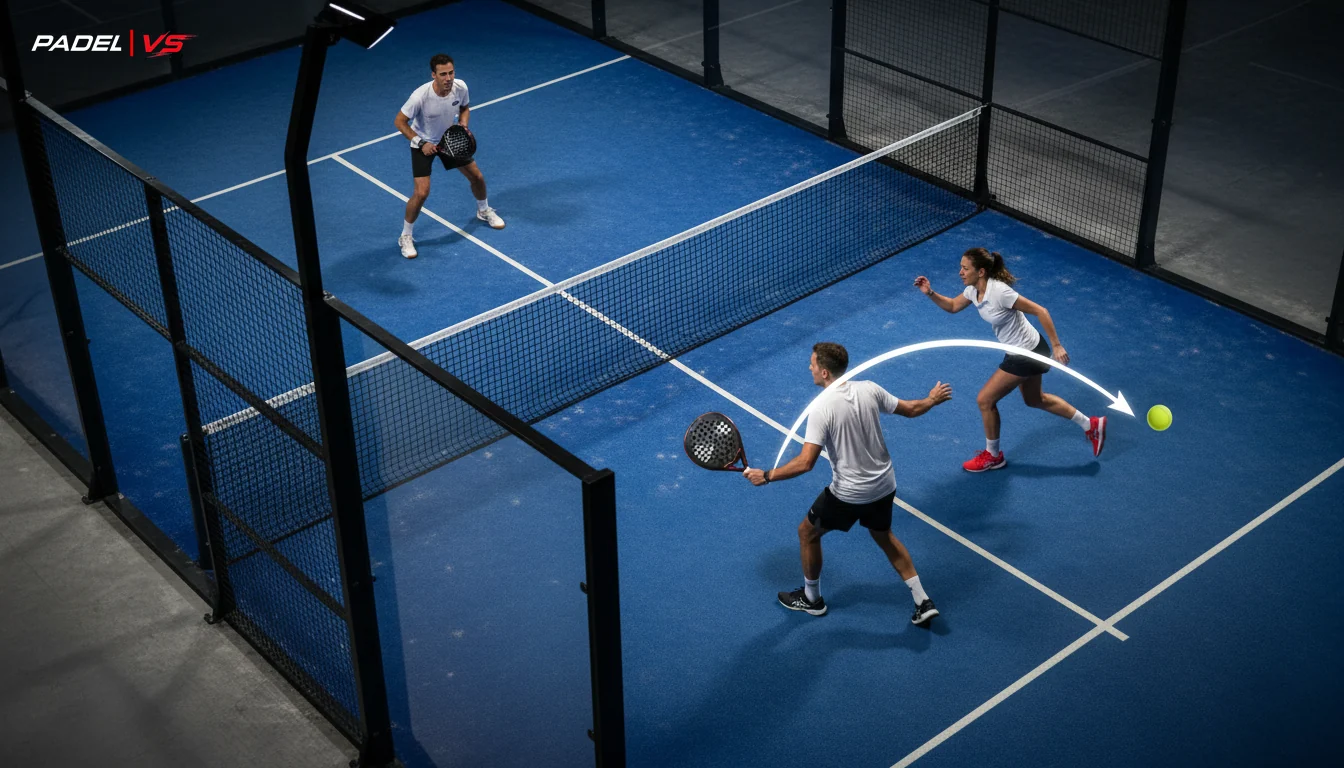

Coming to the net in padel is supposed to mean you're in control — so why does it so often end with a point going the other way? Most players stuck in the Cuarta-to-Tercera range (850-1180 ELO at PADEL VS) know that net play is essential, but they arrive out of position, racket low, and with no plan. This article breaks down exactly why you're giving away those points and how to stop doing it.
The "Net = Winning" Myth That's Hurting Your Game
Here's a belief that causes more damage than almost any technical flaw: if I get to the net, the point is mine. It's partially true — the net is the premier offensive position in padel. From there you control the geometry of a 10 × 20-meter court, you compress your opponents' reaction time, and you impose constant pressure. But the problem isn't going to the net. The problem is when, how, and from where you get there.
A player who rushes the net after their own defensive lob fell short, arrives flat-footed with the racket hanging at waist height, and has no idea what they'll do with the next ball — that player isn't dominating the net. They're waiting to be punished.
"The net doesn't give you points. It multiplies the quality of what you did before you got there."
Mistake #1: Wrong Position — You're Either Too Close or Too Far
This is the most measurable error and the most common one at intermediate level. Most players park themselves 80-100 cm from the net. That's too close. Here's why it kills you:
- Any decent lob forces you into a panicked retreat that destroys your stance and your partnership positioning.
- You have no room to execute a proper smash or drop volley — the angles simply don't exist from there.
- Your opponents can chip a ball at your feet or play a short lob and you have zero recovery time.
The correct attacking net position is 1.5 to 2 meters from the net (the metal mesh that divides the two halves of the court). From that distance you can angle your volleys downward, you have time to read the lob, and you can move laterally with your partner to cover the middle.
Practical drill: in your next training session, place two cones or water bottles 1.7 meters from the net as visual anchors. Use them until the distance becomes automatic. Most players internalize it within three sessions and never need the cones again.
Mistake #2: Racket Low — The Cardinal Sin of Net Play
Watch any intermediate player who keeps gifting points at the net. Freeze the mental image right before the opponent strikes. Where is their racket? Nine times out of ten: hanging near the hip, relaxed, almost resting.
The correct ready position at the net demands the racket at chest height, slightly forward, with the elbow semi-flexed. It's not comfortable — it's not supposed to be. It's a preparation stance. When your racket is already up, your effective reaction time improves dramatically because you eliminate the preliminary movement of lifting the arm before contact.
The math is unforgiving: the average flight time of a ball struck from the baseline to the net on an offensive shot is roughly 0.6 to 0.9 seconds. If you need to raise your racket 40 cm from hip height, that movement alone costs you 0.15 to 0.25 seconds. You've burned 25-40% of your available reaction window before the rally even begins.
Grip Pressure at the Net
Directly connected: many players wait at the net with a loose or open grip. The correct ready-position grip pressure is firm but not tense — think 6 out of 10 — so you can fire instantly into a forehand or backhand volley without any grip adjustment. Every millisecond you spend resettling your grip is a millisecond your opponents are using to place the ball exactly where you aren't.
Mistake #3: Attacking When You Should Be Containing
Not every ball that arrives at the net deserves a winner attempt. This is the over-attack error: you arrive at the net in good position, the incoming ball is difficult — low at your feet, into your body, with heavy spin — and you attack anyway. The result is the net, a wide miss, or a short volley your opponents punish immediately.
Volleys in padel serve three completely different functions depending on the situation:
| Situation | Volley Type | Goal |
|---|---|---|
| High ball in your zone, enough time | Offensive volley / drop shot | End the point or force the error |
| Ball at feet, body shot, or heavy spin | Control / containment volley | Hold net position, don't gift the point |
| Mid-zone ball under moderate pressure | Exchange volley | Continue the rally from net, wait for better opportunity |
The intermediate player mistake is applying the offensive volley logic to all three situations. The decision about which type to execute must happen in under 0.3 seconds based on ball height, speed, and trajectory. Train that read deliberately — don't improvise it during match play and then wonder why you kept missing.
Mistake #4: Not Communicating With Your Partner at the Net
Padel is a doubles sport. When both you and your partner are at the net — the ideal attacking formation — there are three critical zones to cover: right-side forehand volley, left-side backhand volley (for right-handers), and the middle. The middle is where the majority of gifted net points actually originate, and it almost always comes down to lack of communication.
The general rule: the middle ball belongs to the backhand-side player (typically the left court player hitting a forehand toward the center). But this rule only works when both players know it and have practiced it together. In PADEL VS we consistently see Cuarta and Tercera pairs who've never discussed this before stepping onto the court.
Minimum pre-match protocol that takes two minutes but prevents serious damage:
- Who takes the middle ball when we're both at the net?
- When do we call for a lob from the net position?
- What's our signal for switching sides on a crossed volley?
Three questions, two minutes, and you eliminate a significant chunk of the net confusion errors that plague intermediate pairs every single match.
Mistake #5: Going to the Net at the Wrong Moment
There are situations where rushing the net is correct and situations where it's tactical suicide. Intermediate players frequently confuse the two — and the confusion is expensive.
Correct moments to go to the net:
- After a well-executed offensive lob that forces your opponents to defend from deep.
- After a smash or drop that bounces near or past your opponents' baseline.
- When your opponents are clearly in a defensive situation — pressed against the glass, limited time.
- To press after an effective serve that has pushed the returner back.
Incorrect moments (and very common at intermediate level):
- After your own defensive lob that fell short and sits up for your opponents.
- When your opponents have time and position to execute a passing shot or a precise lob.
- Going alone to the net (without your partner) when the opponents have the ball and the angle.
- After a neutral exchange where you have no clear advantage.
"It's not how many times you go to the net. It's how many times you go when you should."
Mistake #6: The Weak Backhand Volley — the Shot Your Opponents Are Targeting
Be honest with yourself: your backhand volley is your most vulnerable shot at the net. You're not alone — it's the technically most demanding volley for the majority of right-handed padel players. The reason is biomechanical: it requires forearm and wrist rotation in the direction opposite to the natural swing, in minimal space and time, with very little room for error.
Opponents who understand the game know this. At Tercera and Segunda level (1000-1350 ELO), one of the most systematically applied strategies is to hammer the backhand volley of the weaker net player — forcing the error or the short, spinless volley that opens the court wide open.
Three specific fixes for the backhand volley:
- Fix the contact point: it must be in front of your body, not beside it. If you're making contact at left-shoulder height (for right-handers), you've already lost directional control before the ball leaves your strings.
- Eliminate the backswing: there is no full swing in a proper volley. Your preparation should never take the racket past shoulder line. Anything beyond that and you lose both control and the ability to redirect the ball.
- Use the glass wall: in training, execute 50 backhand volleys against the lateral glass wall from 1.5 meters. The wall's proximity forces clean contact — you can't get away with a sloppy swing when you have 150 cm and glass behind you.
The Right Mentality at the Net: Dominant But Patient
One of the most damaging mental patterns at the net is urgency. The player arrives there feeling like I need to finish this point right now. That pressure generates rushed shots, impossible angle attempts, and unforced errors on balls they could have easily neutralized.
High-level padel net play doesn't always end in a single winner. Often it's a sequence of three or four pressure volleys that gradually compress your opponents' space, push them toward the glass, and ultimately force them into the error. Players operating at Primera and Open level (1350+ ELO) maintain that pressure without rushing. Intermediate players break it after the second volley because they can't tolerate the tension of not finishing the point.
Mental training drill: in your next training session, set yourself the rule that you must execute at least three volleys before attempting the decisive shot. Even if the opportunity seems to appear on the second volley, hold back. Build the habit of offensive patience — it's one of the clearest markers that separates Tercera from Segunda players.
How to Structure Your Net Training
The problem for many intermediate players is that they train at the net casually — they knock a few balls, do a handful of smashes, and call it net practice. It isn't. Net play requires structured training with specific objectives tied to the exact mistakes we've outlined here.
Recommended structure for a 60-minute net-focused training session:
- 10 min — Technical volleys: 50 forehand + 50 backhand volleys from static position. Focus exclusively on contact point and racket height.
- 10 min — Volleys in movement: lateral, diagonal, central close-out. Simulating actual match movement patterns.
- 15 min — Low ball situations: coach or partner feeds balls at your feet from the baseline. Practice making the containment vs. attack decision under realistic pressure.
- 15 min — 2v2 volleys only: both pairs at the net, only volleys allowed. Forces communication, positioning, and patience simultaneously.
- 10 min — Match situations: full points with net approach after a lob, predefined tactical sequences.
Which PADEL VS Category Are You Making These Mistakes In?
Net errors follow a clear pattern by ELO level. In Quinta (<850 ELO), the primary problem is not knowing that net play is even necessary — many points are lost simply by not going forward. In Cuarta (850-1000), players approach the net but without position or partnership coordination. In Tercera (1000-1180), the approach is better but decision-making breaks down — they attack when they should contain, they rush when they should be patient. In Segunda (1180-1350), net play is largely solid but leaks remain in the backhand volley under pressure and in middle-ball ownership on tight rallies.
If you're playing in PADEL VS, take a look at your match history and identify the specific net situations where points are slipping away. It's not a feeling — it's a pattern. Patterns are fixable. You can access your match data directly at padelvs.com or through the Telegram Mini App via @padelvsbot — no app download required, it runs straight in your browser or Telegram.
Conclusion: Net Dominance Starts Before You Get There
Improving at the net doesn't begin when you're standing two meters from the mesh. It begins with the shot you hit three seconds earlier — the one that gives you position, time, and advantage to arrive properly. Fix your position (1.5-2 meters), keep the racket up, decide before the ball arrives, communicate with your partner, and be patient enough to build the point rather than force it. Those five adjustments, applied consistently across matches, transform the net from your biggest risk zone into your primary weapon.