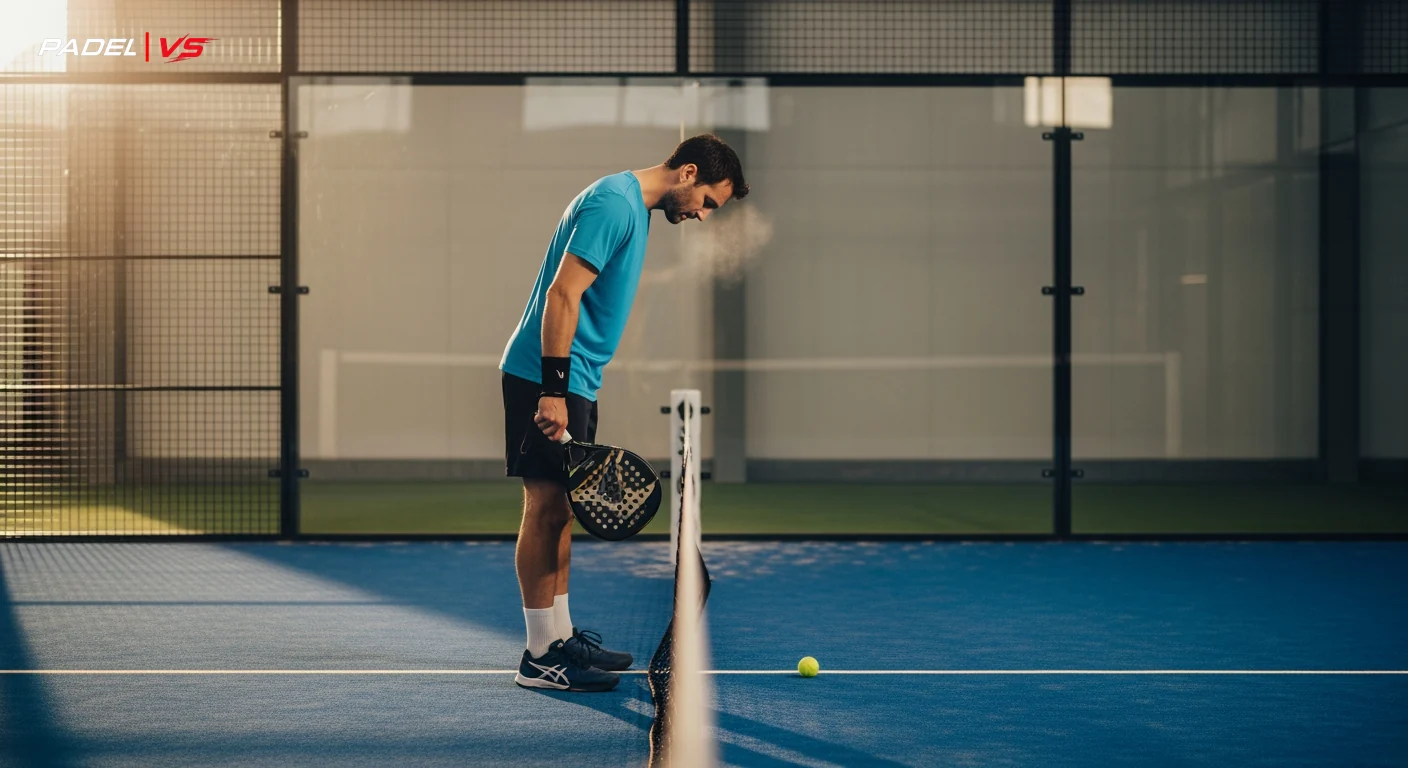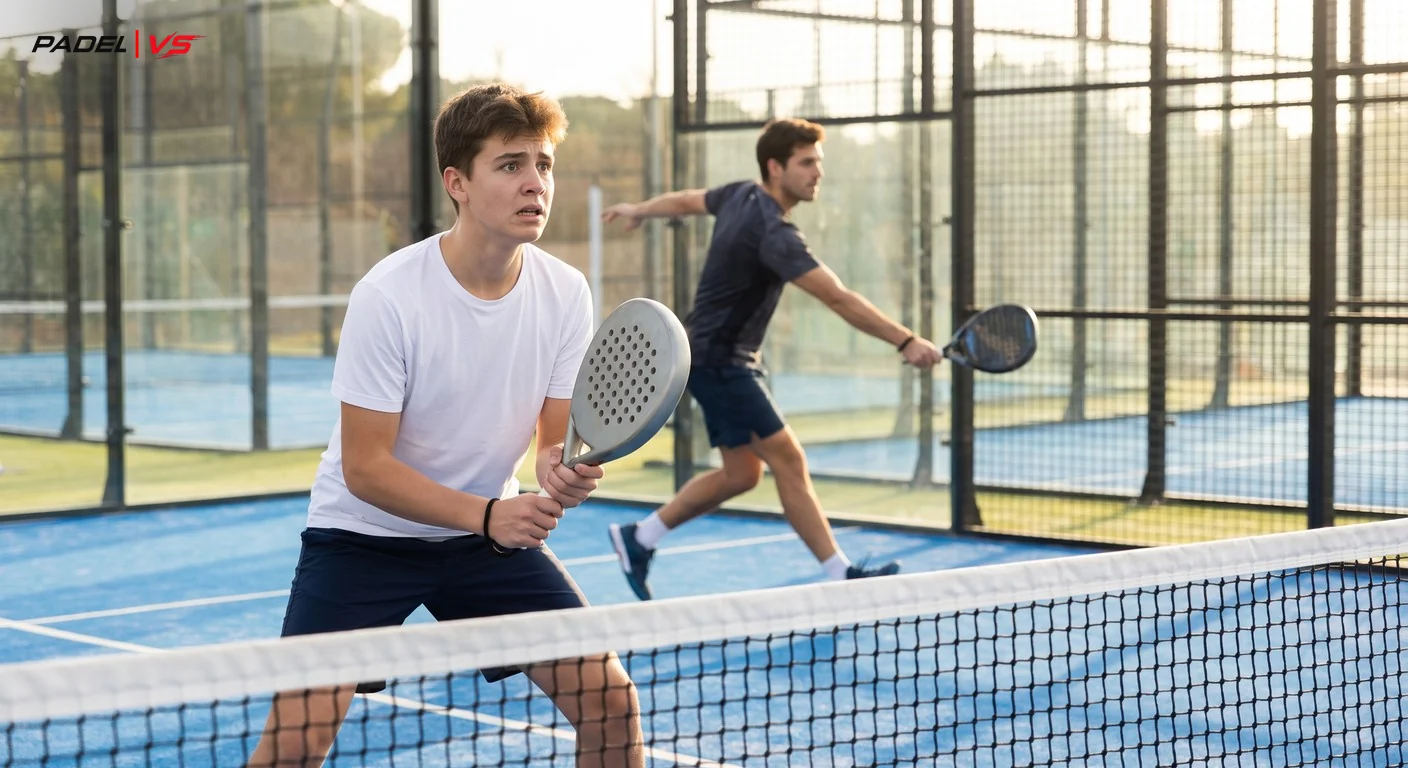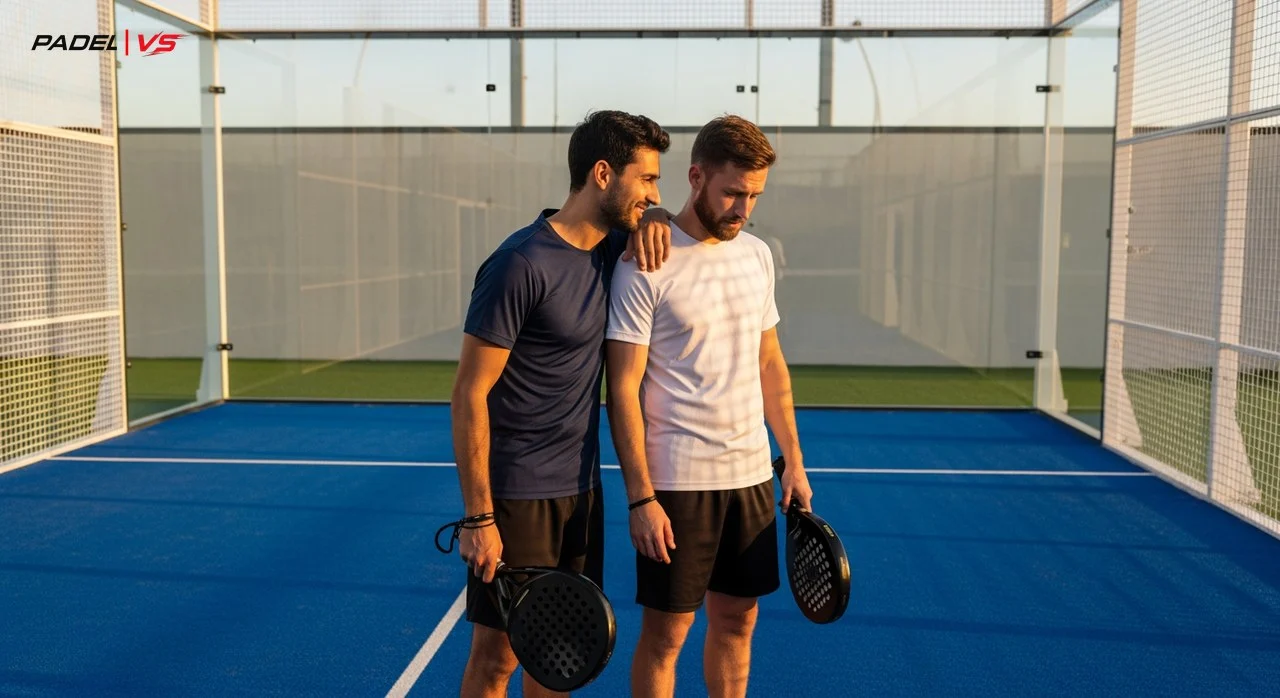

You just walked off the court. The score reads 3-6, 2-6. Your partner missed three smashes in the second set, you hit two lobbed balls straight to the back wall, and that long serve at the worst possible moment was yours too. But your brain is only replaying their mistakes. That mental loop isn't just an emotional problem — it's the single biggest obstacle to getting better at padel.
Why padel triggers blame more than other sports
Padel is, by design, a doubles sport. There is no official singles format — every single point is played as a team, every error has a witness, and the glass walls of a 20 x 10-meter court are brutally honest: everyone sees exactly who missed. That constant exposure activates a deeply human psychological mechanism called the attribution bias. When we win, we credit our own skill; when we lose, we search for external causes. In padel, the most visible external cause is standing three feet away from you.
The court's intimacy makes it worse. Unlike doubles tennis, where players have meaningful physical distance between them, in padel you are within arm's reach of your partner for roughly 90% of the point. You hear their breathing, read their body language, feel their frustration. That physical closeness amplifies every bit of tension between you.
The result: pairs who have been playing together for months — with solid technical levels — quietly destroy their partnership after each significant loss because no one learned to process defeat in a healthy way.
The real cost of blaming your partner
Before we talk solutions, let's be clear about what you lose every time you point the finger:
- Mutual trust: A partner who feels blamed — even without a word being said — starts playing scared. And fear produces exactly the errors you're trying to avoid.
- Tactical communication: Tension kills in-game talk. No communication means no net coordination, no "mine" or "yours" calls, and no tactical adjustments between games.
- ELO progression: At PADEL VS we use an ELO rating system where both players move up or down together on team results. A toxic dynamic with your partner doesn't just affect the mood — it directly affects both of your ratings.
- Enjoyment: This sounds obvious but gets forgotten fast. Padel is one of the fastest-growing racket sports because it's genuinely fun. A blame dynamic turns that fun into a burden.
"The best padel team is not the one that never makes mistakes. It's the one that knows how to respond after they do."
Anatomy of a typical loss: who actually missed?
Let's do a concrete exercise. Imagine a match you lost 4-6, 3-6. Honest point analysis looks something like this:
| Error type | Example | Whose fault? |
|---|---|---|
| Unforced individual error | Volley that flies long | The one who hit it |
| Positioning error | Both players go for the same ball | Both — failure to communicate |
| Tactical pair error | Staying at the back when you should have moved up | Both — joint decision or lack of a call |
| Error under opponent pressure | Defensive lob that cuts short | The hitter, but the situation was created together |
| Glass-reading error | Ball off the side wall that neither player picks up | Both — shared court space responsibility |
If you're honest with this breakdown, you'll typically find that at least 50-60% of the points you lost carry shared responsibility or were directly your own errors. The narrative of "my partner made us lose" rarely survives actual numbers.
The first words after the match matter more than you think
The first 90 seconds after a loss are critical. Cortisol is high, frustration is fresh, and ego is bruised. What you say — or don't say — gets stored.
Here's a practical breakdown of what works and what breaks things:
| Avoid this | Say this instead |
|---|---|
| "Those three smashes you missed cost us the set" | "We had some good moments out there. Want to talk through it in a bit?" |
| Complete silence with closed-off body language | "Tough match. Give me five minutes and let's debrief." |
| "This always happens when we play together" | "There's something specific we can adjust for next time." |
| Venting about your partner's errors to other players at the club | Seeking technical feedback from a coach or a neutral third party with real padel knowledge |
The 20-minute protocol
One concrete tool we recommend to pairs in PADEL VS tournaments is what we call the 20-minute protocol. Here's how it works:
- Minutes 0-5: active silence. No analysis. Put your racket away, drink water, breathe. Your brain doesn't process well on adrenaline.
- Minutes 5-15: facts, not emotions. "We dropped nine straight points in the fourth game. What happened there tactically?" — no judgment, just observable facts.
- Minutes 15-20: one learning, one agreement. Leave with exactly one concrete thing to work on. Just one. "Next time we're both at the back, the player on the left side decides whether we move up or not." Something actionable.
This protocol feels simple because it is. Most conflicts in padel partnerships happen because one or both players skip straight from minute 0 into intense emotional analysis. Your nervous system isn't ready for that yet.
Understanding levels helps calibrate expectations
Another less obvious but very real source of conflict is the expectation gap across skill levels. In PADEL VS, categories range from Quinta (under 850 ELO) all the way up to Open (1550 ELO and above), through Cuarta, Tercera, Segunda, and Primera.
A pair playing in Tercera (1000-1180 ELO) that just lost to a strong Segunda pair (1180-1350 ELO) ran into a real technical and tactical gap. Nobody "failed" — they faced players who will systematically force errors regardless of who you're partnered with. If you don't calibrate that expectation, any error your partner makes feels like a betrayal when it was actually a predictable outcome.
Knowing your real ELO and your partner's isn't about comparison — it's about understanding where you're building from. A pair that climbs together from Cuarta to Tercera over six months of tournament play is doing something genuinely impressive, regardless of how many matches they lose along the way.
In-game tactical communication: the preventive antidote
The best way to avoid blame after the match is to communicate better during it. Here are specific in-court communication habits that reduce tension before it builds:
- The early call: Say "mine" or "yours" before the ball arrives, not while it's already falling. On a court that's only 10 meters wide, a 0.3-second ambiguity window is the difference between a clean winner and a collision.
- The baseline agreement: Before the match starts, agree on who covers which lane when you're both at the back. It sounds basic — very few pairs ever make it explicit.
- The reset phrase: Agree on a short reset phrase to use between points. It can be as simple as "let's go" or "focus up." It works as a behavioral anchor that interrupts the negative loop.
- Positive body language: A fist pump after a point won, a pat on the shoulder after your partner's error. These gestures have real neurological impact — they're not just good manners.
"In padel, the partner's errors that sting the most are usually a mirror of something we also need to work on ourselves."
When your partner genuinely has a technical problem
None of the above means you should ignore real, consistent patterns in your partner's game. If someone is systematically sending the backhand along the side glass long on every third shot, that does need to be addressed. The key is the frame:
- Private, not public: Never in front of opponents or other players at the club.
- After the match, not during: The point is already gone. Mid-game, only quick and positive adjustments belong.
- Data, not emotion: "I noticed your cross-court backhand off the glass has been going long — want to work on that in the next session?" is very different from "you always miss that shot."
- Offer a solution, not just the problem: If you name the error, come with a proposal. That transforms criticism into collaboration.
The long view: the best pairs lose a lot
The pairs who reach Primera or Open in PADEL VS — or in any serious competitive circuit — didn't get there without losing. A lot. They lost, processed each defeat with honesty, and chose to keep showing up together. Partnership consistency over time is one of the strongest predictors of ELO progression in padel.
There are pairs who have been playing tournaments together for over a year — they've dropped a category, come back up, dropped again, and are climbing once more. That zigzag isn't failure. It's what the actual learning curve of competitive padel looks like. The problem isn't the rollercoaster; it's riding the rollercoaster without talking to each other.
If you're in an early stage of competing together, log your matches, keep a record of what you're working on, and review it together once a month. Not to judge, but to see the pattern. In many cases, players are genuinely surprised by how much they've improved in areas that used to cost them points — and that realization rebuilds mutual confidence.
Change partners or work with what you have?
This question comes up earlier than it should. The general rule: if you've been playing tournaments together for fewer than three months, the answer is almost always to work with what you have. Partnership chemistry in padel takes time to build. Changing partners every time you hit a rough patch is the equivalent of switching rackets every time you miss a smash — the problem isn't there.
Seriously consider a partner change when: there's a structural scheduling incompatibility, the ELO gap has grown to the point where you can no longer compete in the same category, or — most importantly — when you've genuinely tried to improve communication and the environment remains toxic for both of you. Not one of you. Both.
How PADEL VS supports partnership growth
At PADEL VS, we're building tools that let pairs track their joint match history, see result patterns by category, and log who they compete with. When you register for tournaments at app.padelvs.com / padelvs.com or through the Telegram Mini App via @padelvsbot, you build a real record of matches with your partner — not just the score, but the context: who the opponents were, which court, which category. That objective history is the best antidote to the distorted narrative that blame constructs in your head.
Payments are flexible: we accept card, bank transfer, cash and crypto (USDT/BTC/ETH), with QR registration at the club — you can pay in USDT, BTC, or ETH. No friction between you and your next match.
The next time you walk off the court with the score against you, remember: a loss is data. Blame is noise. The teams that learn to separate those two things are the ones that eventually win.