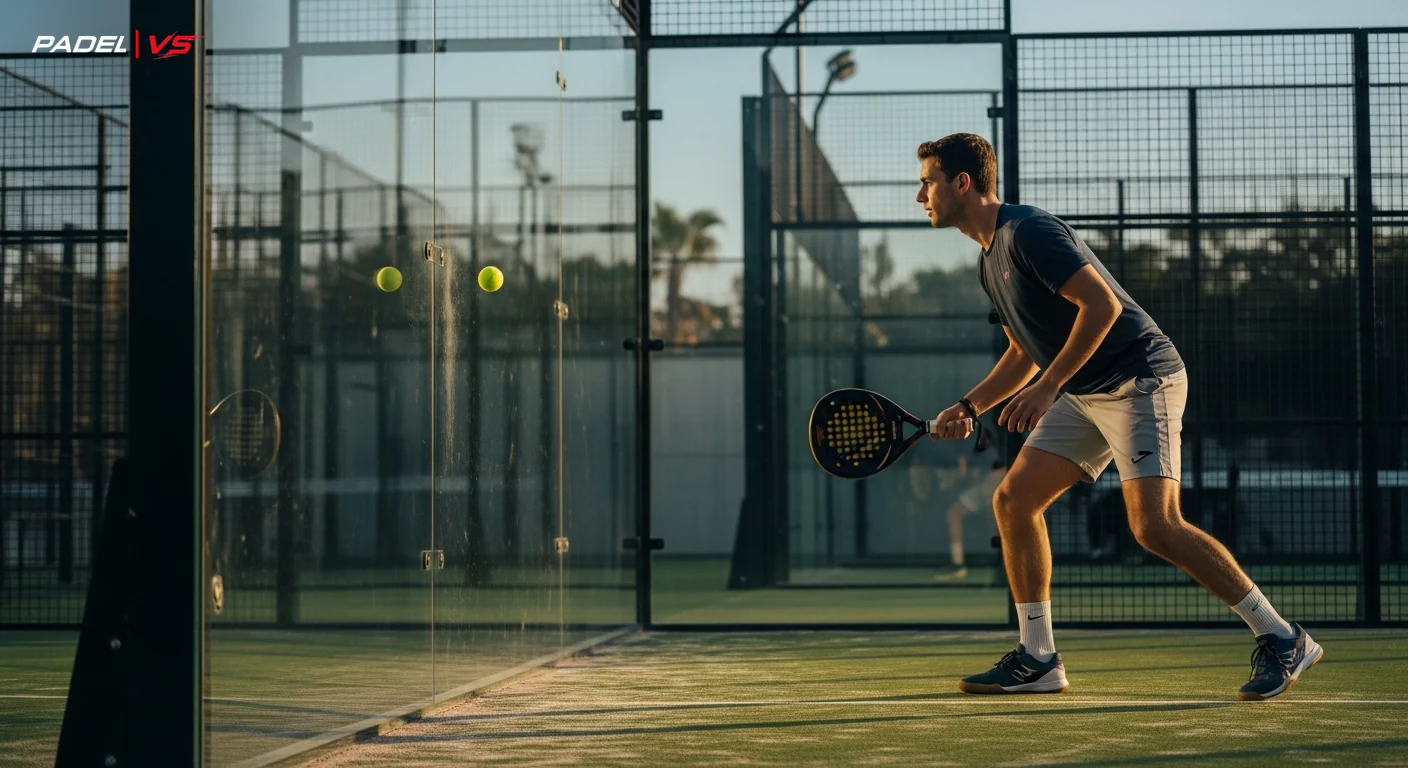

In padel, players spend hours researching racket carbon fiber layers, EVA foam density, and frame geometry — then completely ignore the thin strip of tape wrapped around the handle that is literally the only part of the racket touching their body. The overgrip, a piece of tape 60 to 80 cm long and barely 0.6 mm thick, has a direct and measurable impact on your control, power generation, and even your injury risk. And yet most players only think about changing it when it's already peeling off the racket mid-match.
Overgrip vs. Base Grip: Understanding the Difference
Before discussing when to replace an overgrip, it's important to clarify what it actually is — because many players, especially those coming from tennis, confuse the two layers on a padel racket handle.
Every padel racket comes with a base grip (also called the original grip or replacement grip) already installed at the factory. This is a thicker tape — typically 1.5 to 2 mm — made of synthetic leather or polyurethane that gives the handle its shape, cushioning, and the subtle octagonal profile your fingers use to orient the racket face. On top of this, players wrap an overgrip: a thinner consumable tape (0.5–0.7 mm) designed to absorb sweat, enhance friction, and add a layer of personalized feel.
The logic is practical: the base grip lasts one to two years with regular use; the overgrip is a disposable layer that should be replaced frequently. It's far cheaper and faster to swap an overgrip than to re-grip the entire handle from scratch.
"The grip is the only part of your racket that touches your body. Every piece of feedback you get — balance, weight, vibration — is filtered through those few millimeters of tape."
How the Overgrip Actually Affects Your Control
Grip texture as a sensory interface
A fresh overgrip functions as a high-resolution sensory interface between your hand and the racket. The microtexture of a new grip allows you to feel subtle impact vibrations, detect ball contact point, and register the racket's orientation in your palm — all within fractions of a second. This tactile feedback is what lets experienced players adjust their wrist angle mid-swing for slice or topspin effects on the glass walls.
When the overgrip degrades and becomes smooth and hard, that sensory signal weakens. To compensate, your nervous system does something automatic and counterproductive: it tightens your grip force. This phenomenon, known in biomechanics as excessive grip tension, stiffens the wrist and forearm, reducing the range of pronation and supination that generates spin and directional precision. In practical terms, you lose flexibility in exactly the movements that make padel shots like the viboreig, angled volleys, and wall-read lobs effective.
The power paradox
Here's the counterintuitive part: a worn-down overgrip actually makes you generate less power, even though you might feel like you're swinging harder. The reason is biomechanical timing. Quality padel technique involves a partial relaxation of grip pressure during the backswing and a quick activation at the moment of contact — this whipping effect is what accelerates the racket head through the ball.
With a slippery, worn overgrip, players unconsciously pre-tension their grip before contact to avoid the racket slipping. This pre-tension eliminates the relaxation-activation sequence, reducing racket head speed by an estimated 8–12% compared to the same swing with a fresh grip. That directly translates to a slower ball off the face.
Clear Signs It's Time to Replace Your Overgrip
There's no single universal answer in hours of play — sweat rate, ambient temperature, and play intensity all vary. But there are unmistakable signals:
- Smooth texture to the touch: Run your thumb across the grip. A fresh overgrip has perceptible micro-texture. If it feels like smooth plastic, it's finished.
- Discoloration and staining: A white or yellow overgrip turning gray, brown, or dark is saturated with sweat and dirt — the fibers can no longer absorb moisture.
- Lifting edges: When the tape begins peeling at the ends, it creates uneven pressure points on the palm and can catch during a swing at the worst moment.
- Persistent odor: Bacteria from sweat accumulate in the foam. Beyond hygiene, bacterial moisture adds slipperiness to an already degraded surface.
- Racket rotating in your hand on hard shots: If you feel the racket twisting slightly on a smash or bandeja, the grip is no longer providing adequate friction.
Recommended change frequency by level
| Level (PADEL VS Category) | Typical weekly hours | Recommended overgrip change |
|---|---|---|
| Quinta (<850 ELO) | 1–2 hrs | Every 4–6 weeks |
| Cuarta (850–1000 ELO) | 2–4 hrs | Every 3–4 weeks |
| Tercera (1000–1180 ELO) | 4–6 hrs | Every 2–3 weeks |
| Segunda (1180–1350 ELO) | 6–10 hrs | Weekly or every 8–10 hours |
| Primera / Open (≥1350 ELO) | 10+ hrs | Before each important match or every 5–6 hours |
Players competing at the Primera and Open level in PADEL VS often carry two or three overgrips in their bag and change between rounds in tournaments when heat and sweating are intense — particularly in outdoor or semi-outdoor courts in warm climates where temperatures can push well above 35°C (95°F). This isn't excessive; it's standard practice at that level.
Types of Overgrip: Which One Should You Choose?
By material and moisture behavior
- Tacky (absorbent) overgrip: The most common type. Made from polyurethane foam with a slightly sticky, spongy surface. Excellent for players with dry hands or for indoor courts with climate control. Wilson Pro Overgrip and Tecnifibre Overgrip Pro are widely used benchmarks. Price: $2.20–6.70 USD per unit ($40–120 MXN aprox), cheaper when bought in 3-packs.
- Dry overgrip: Less sticky surface, engineered to wick moisture rather than absorb it, making it more resistant to heavy sweating. Best for players with very sweaty palms or outdoor courts in hot climates. Babolat VS Grip is a classic in this category.
- Hybrid overgrip: Combines properties of both. Head Xtreme Soft and Dunlop Gecko Tac are popular options for players who want versatility across different conditions.
By thickness
| Thickness | Feel | Best for |
|---|---|---|
| Ultra-thin (0.45–0.5 mm) | Maximum direct feedback | Players who want minimal handle change, strong wrist players |
| Standard (0.6–0.7 mm) | Balanced feel and absorption | Most players — the safe default choice |
| Thick (0.8–1.0 mm) | More cushion, less vibration | Large hands, players with arm sensitivity or early elbow issues |
The handle diameter factor
Standard padel racket handles have a circumference of approximately 10 cm (classified as L1 in European sizing). Each overgrip layer adds roughly 0.5–0.7 mm to the total diameter. Stacking two or three overgrips is common among players who prefer a thicker grip, but it changes the ergonomics of your hold significantly. A handle that's too thick for your hand size forces your forearm flexors to overwork, increasing fatigue during long matches. A handle too thin makes the grip unstable and causes compensatory squeezing.
How to Wrap an Overgrip Correctly
Wrapping technique matters more than most players realize. A badly wrapped overgrip with uneven tension or overlapping folds creates irregular pressure points on the palm that lead to blisters during extended play. Here's the correct method:
- Remove the old overgrip completely and wipe the base grip with a dry cloth if there's sweat residue.
- Start from the bottom of the handle (the butt cap end), angling the tapered end of the overgrip at approximately 30–45 degrees to the handle axis.
- Wrap upward with consistent, even tension — too loose creates folds, too tight reduces comfort and elasticity.
- Overlap each revolution by 3–5 mm to avoid gaps. Gaps create dead spots where the underlying base grip is exposed and the pressure changes abruptly.
- Continue spiraling upward to the top shoulder of the handle.
- Secure the end with the finishing tape included in the pack. Never use electrical tape or adhesive tape — they don't flex properly and can unravel mid-match.
A proper wrap takes 3–5 minutes the first few times, and under 2 minutes with practice. It's worth doing right: a correctly wrapped overgrip provides uniform grip surface across the entire palm, which is the foundation of consistent shot-making.
Overgrip and Injury Prevention: The Underrated Connection
Lateral epicondylitis — commonly called tennis elbow — is one of the most frequent overuse injuries in padel, second only to ankle sprains in frequency. While it has multiple contributing causes including technique flaws and overtraining, grip-related mechanics play a documented role. When a player compensates for poor overgrip friction by gripping too hard, the extensor muscles of the forearm sustain prolonged isometric contraction. Over time, this creates micro-tears at the tendon insertion point on the lateral epicondyle.
If you're experiencing early elbow discomfort and haven't changed your overgrip in weeks, start there before adjusting your swing mechanics or shopping for a new racket. It's a $3 USD fix that might save you months of rehab.
"There's no universally perfect overgrip. There's the right overgrip for your hand size, your sweat level, and the climate where you play."
When to Also Check Your Base Grip
Players who diligently change their overgrip often neglect the base grip underneath — and this is a mistake. The base grip, despite lasting longer, eventually compresses and loses its structure. When this happens, the handle's octagonal cross-section flattens toward a circular shape. This matters because padel technique relies on being able to quickly locate grip positions (continental, western, or panhandle) by feel alone, using those eight flat faces as orientation guides. When they're gone, grip consistency during fast exchanges at the net breaks down.
Signs the base grip needs replacement:
- The handle feels perfectly round — no perceptible flat faces
- Uneven density zones or bumps under the overgrip
- The base grip is 18–24+ months old with regular use
A full base grip replacement costs $4.50–11 USD ($80–200 MXN aprox) as a DIY job, or $8.50–17 USD ($150–300 MXN aprox) at a specialty shop.
Cost Reality: Overgrip Is the Best ROI in Your Equipment Budget
Quality overgrip packs (Wilson, Babolat, Head, Tecnifibre — 3-unit packs) run $6.70–16.70 USD ($120–300 MXN aprox) in specialty stores or online. Bulk packs of 12 or 24 units drop the per-unit cost to $1.70–2.80 USD ($30–50 MXN aprox) each — the smart buy for Tercera-level and above players who change frequently.
Generic budget overgrips cost $0.85–1.70 USD ($15–30 MXN aprox) per unit, but absorption and durability quality is notably lower. Even for players just starting in Quinta who are still developing their game, quality overgrip is worth the marginal extra cost: it's the cheapest thing you can buy with the most immediate impact on how a racket feels in your hand.
Annual cost for keeping a fresh overgrip as a Tercera or Segunda player: roughly $33–67 USD ($600–1,200 MXN aprox). Compared to the price of a new racket — anywhere from $85 to $450+ USD ($1,500–8,000+ MXN aprox) — it's the highest return-on-investment maintenance item in padel, and it's not close.
Building the Habit
The best players treat overgrip replacement as a preparation ritual, not a reactive task. If you play casually (1–2 hours per week), set a monthly calendar reminder. If you're logging 4+ hours weekly, inspect the grip texture every time you take the racket out of your bag. Make it as automatic as checking your strings.
At PADEL VS, we're building a growing competitive community starting in Cancún and expanding to other cities in Mexico. Whether you're accessing the platform at padelvs.com, through the Telegram Mini App at @padelvsbot, or via our WhatsApp AI agent, we're working on equipment guides tailored to each ELO category so players get practical, level-specific recommendations — not generic advice. Equipment matters more as your ELO climbs, and overgrip is the best place to start paying attention.
Your racket might cost $200 USD. But the tape connecting it to your hand costs less than a coffee. Don't let 50 cents of worn-out grip tape be the weakest link in your game.