
Padel players spend hours perfecting the bandeja, the vibora, and cross-court exchanges, but the variable that decides more matches than any single shot — the mind — remains the most neglected element in most training programs. Mental coaching in padel isn't motivational fluff: it's a specific discipline with concrete, repeatable tools that separates players who freeze under pressure from those who perform best when the stakes are highest.
Why padel demands a different mental game than other racket sports
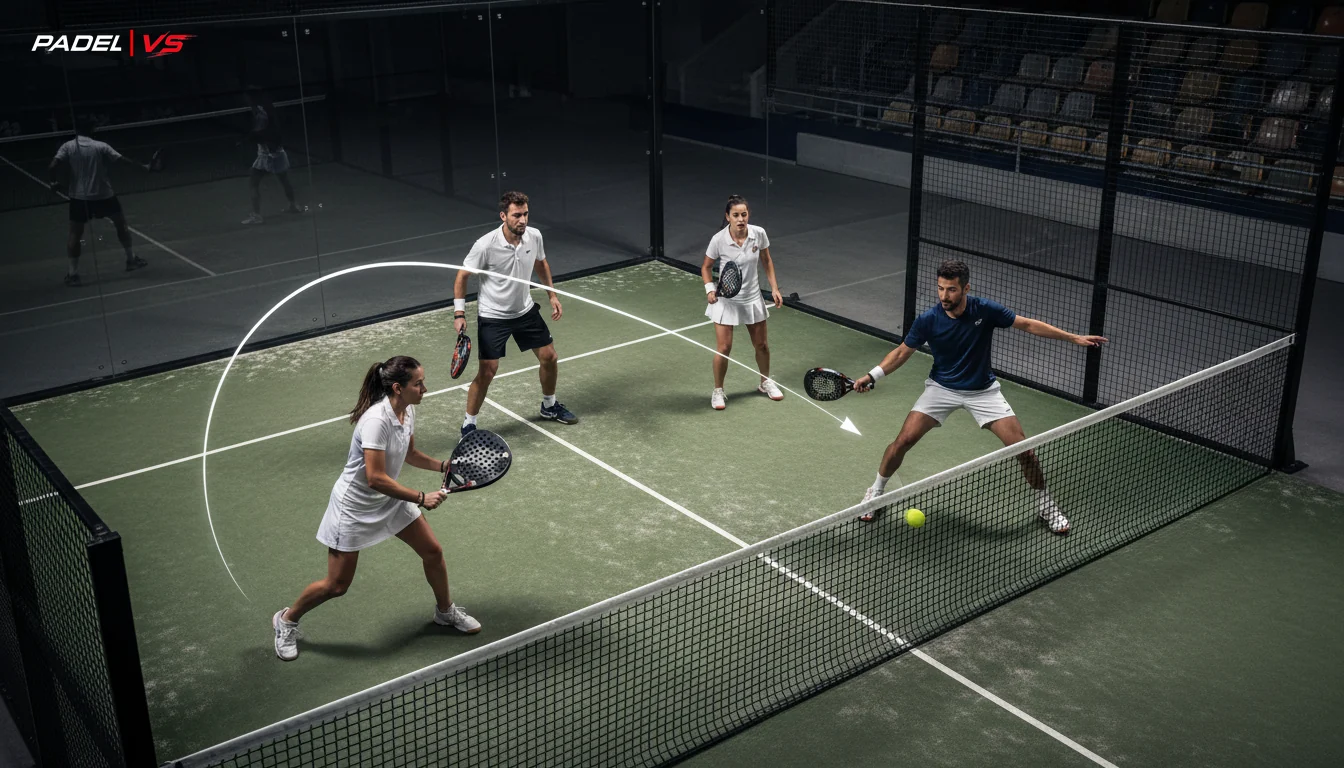
Before jumping into tools, it's worth understanding what makes padel psychologically unique. The court measures 20 x 10 meters, enclosed by glass walls and metallic mesh on all sides — considerably more confined than a tennis singles court (23.77 x 8.23 m). There's nowhere for a mistake to disappear: the glass amplifies it, your partner sees it, and you feel it in your chest before the ball even settles.
Then there's the partner dynamic. Padel is a doubles-only sport — you're not just managing your own mental state, you're reading your partner's body language in real time, communicating tactical decisions mid-point, and sharing responsibility for specific zones of the court. That social pressure layer simply doesn't exist in singles tennis or squash. Hitting a loose smash at 4-4 in the third set with your partner staring at you from three meters away activates completely different psychological mechanisms than any solo sport error.
"In padel, you don't lose because you miss more shots. You lose because you lose your head first." — Core principle of mental coaching applied to competitive padel.
The glass wall shots themselves add another cognitive layer: you need reading time, trust in your trajectory predictions, and genuine tolerance for uncertainty. A player who mentally demands total control will consistently struggle with complex back-wall rebounds, low salidas de cristal, and any situation that requires accepting the ball's unpredictability. Padel rewards the mind that can stay relaxed in chaos.
The four psychological zones of a padel player

Sports psychologist James Loehr developed the concept of performance zones — mental-emotional states that directly influence physical output. Applied specifically to padel, these four zones explain most of what you see on court:
| Zone | Emotional State | What It Looks Like on Court | When It Typically Appears |
|---|---|---|---|
| Flow Zone | High energy, low tension | Fast decisions, confident lob, aggressive bandeja positioning | 10-20% of total playing time |
| Survival Zone | High anxiety | Forced defensive play, cross-court errors, paralysis by analysis | 30-40% in deciding sets |
| Burnout Zone | Low energy, apathy | Reduced movement, negative self-talk, mentally dropping key points | Common in sets being lost 6-1 |
| Ideal Performance Zone | Controlled activation | Present-focused, fluid partner communication, fast error recovery | The goal of mental coaching |
Mental coaching in padel is fundamentally about two things: learning to recognize which zone you're in, and having specific, pre-rehearsed protocols for returning to the Ideal Performance Zone. Not magic — deliberate cognitive training with repetition.
Tool 1: The between-points routine (the 20-second reset)

Padel rules allow approximately 20-25 seconds between points. For most club players — from Quinta (under 850 ELO) through Tercera (1,000-1,180 ELO) — that time gets used in the worst possible way: mentally replaying the error in slow motion, exchanging loaded glances with their partner, or running internal commentary so harsh they'd never say it to anyone else out loud.
A structured between-points routine has three phases:
- Release (0-5 seconds): A controlled physical reaction — a fist pump, a light tap on the mesh — that discharges emotional energy without broadcasting it to your partner or your opponents. Don't suppress the emotion; channel it through a brief, contained physical outlet.
- Reset (5-15 seconds): Walk toward the back or side of the court. Adjust your grip, your strings, your visor. The physical movement interrupts the mental loop. This window is not for tactics.
- Focus (15-25 seconds): A single keyword or image: "ball," "legs," "wall." Something that anchors attention to the next point, not the last one. Choose yours in training, not in the middle of a tie-break.
Watch players competing at the Primera (1,350-1,550 ELO) or Open (≥1,550 ELO) level in any serious tournament. Their between-points routine looks effortlessly natural. It isn't — it was built deliberately through hundreds of repetitions, ideally including video review of their own behavior between points.
Tool 2: Structured self-talk
A significant portion of club-level players run catastrophic self-talk during competition. Phrases like "I always miss this shot," "my partner is going to hate me," or "I don't belong at this level" aren't dramatic exaggerations — they're documented cognitive patterns that activate the sympathetic nervous system, elevate cortisol, and directly deteriorate fine motor coordination. The exact coordination you need to execute a clean backhand bandeja under pressure.
Mental coaching works on three levels of self-talk:
- Instructional: "Knees bent, contact out front." Useful in practice, counterproductive in competition if it becomes obsessive micro-managing.
- Motivational: "Come on, I've got this." Effective during low-energy moments but only when it feels genuine — the brain rejects forced positivity it doesn't believe.
- Neutral-evaluative: "That point's gone. Next." The most powerful in competition. This isn't false positivity — it's strategic indifference toward past errors combined with forward attention.
A padel-specific technique: after every unforced error, immediately generate an internal process phrase related to future execution, not past failure. "Next ball: back wall, be patient." This redirects cognitive resources toward controllable variables instead of what you can't change.
Tool 3: Managing the partner pressure dynamic
This is the most padel-specific element of mental coaching and the most underrepresented in general sports psychology literature. The partner dynamic creates what psychologists call emotional contagion — your partner's mental state literally modifies yours through non-verbal signals: body posture, movement speed, eye contact patterns.
Research in high-performance team sports consistently shows that pairs who establish positive communication protocols before competition make significantly fewer coordination errors — those points where both players fail simultaneously due to miscommunication — in high-pressure sets compared to pairs who rely on improvised communication.
Practical partner communication protocols:
- Before the match: 90 seconds of tactical alignment, without referencing past results or projecting anxiety about the opponents' reputation.
- On changeovers: One specific tactical observation + one emotional support phrase. In that order. Tactical first anchors the conversation to the concrete and practical.
- After your partner's error: Active silence — a brief shoulder touch or neutral eye contact — communicates more than any forced reassurance phrase.
- After your own error: Own it briefly ("mine") and propose a micro-adjustment ("next one down the middle"). No extended mid-game explanations, ever.
Managing the lost set: the most critical psychological moment
In standard competitive padel format — best of three sets — the most psychologically decisive moment is not match point. It's the first two games of the second set when you've just dropped the first 6-2 or 6-3.
The brain does something predictable and dangerous at this moment: it interprets the set loss as evidence of inferiority, activates ego-protection mechanisms, and starts generating external attributions ("the glass bounced weird on their side," "the wind was worse for us"). Each of those narratives consumes cognitive resources that should be reading the game, anticipating the opponent's patterns, and executing your tactics.
A set-reset protocol — the kind of structured approach we encourage players in the PADEL VS competitive community to develop — involves answering three specific questions on the changeover before set two:
- What was working tactically even though we lost the set? (Find at least one thing.)
- What is one simple, specific adjustment we can make in the first three games?
- What is our emotional lever? (Do we play better with high tempo or with patience and construction?)
This exercise doesn't guarantee comebacks — padel is also lost when the opponents are simply better that day. But it converts dead time into active process instead of passive rumination, which is the meaningful difference between competing in the second set and just occupying the court.
Mental coaching by ELO level: where does it impact most?
A common question: is mental coaching worth investing in at Cuarta (850-1,000 ELO) or even Quinta level? The answer is yes — but the focus is different at each stage:
| PADEL VS Category | ELO Range | Priority Mental Focus |
|---|---|---|
| Quinta | <850 | Reduce destructive self-criticism, build process enjoyment, develop error tolerance |
| Cuarta | 850-1,000 | Install between-points routine, frustration management, initial partner protocols |
| Tercera | 1,000-1,180 | Structured self-talk, lost-set management, tactical concentration blocks |
| Segunda | 1,180-1,350 | Pre-match activation control, pressure management in ranking tournaments |
| Primera / Open | 1,350+ | Mental periodization, hot-streak management, finals and break-point mindset |
How to start: an 8-week practical plan
You don't need to hire a sports psychologist from day one — though if you have access to one specialized in racket sports, typical rates in Mexico run $44-83 USD ($800-1,500 MXN aprox) per session and they're worth every peso. You can start with this structured self-coaching plan:
- Weeks 1-2: Observation mode. Keep a 3-minute post-match journal. Log your emotional state at key moments: 4-4 in the third set, first double error, set point against you. No judgment — just data collection.
- Weeks 3-4: Install the 20-second between-points routine. That's it. Don't try to change multiple habits simultaneously — behavioral change research is clear that single-habit focus dramatically outperforms multi-change attempts.
- Weeks 5-6: Work on self-talk. Identify your most frequent catastrophic phrase and prepare a process-oriented replacement. Write it on your gear bag if necessary.
- Weeks 7-8: Partner communication protocol. A 10-minute pre-tournament conversation where you align on the three protocols: changeovers, your own errors, partner's errors. Make it explicit and specific.
"Mental training isn't what you do when something goes wrong on court. It's the daily habit that determines how you respond when it does."
How PADEL VS supports your competitive mental development
At PADEL VS, we're building a competitive padel community where your ELO doesn't just measure results — it creates a dataset that reveals patterns. Do you perform better in even matches or when you have a comfortable lead? Does your level drop in elimination brackets versus round-robin leagues? These kinds of insights, which we're developing for players in our network, are exactly the raw material a good mental coach needs to personalize work with you.
Whether you're just starting your competitive journey in Quinta or already competing in Tercera, the tools in this article work — but only if you apply them with the same intentionality you'd apply to drilling your bandeja technique. Carry them into your next training session as concrete protocols with timed phases, pre-written phrases, and explicit agreements with your regular partner.
You can explore PADEL VS at app.padelvs.com / padelvs.com, through the Telegram Mini App by searching for @padelvsbot, or by messaging our AI-powered WhatsApp bot. Register, find your real competitive level, and start training — technique, tactics, and mindset — with real data informing every decision you make on the glass-walled court.