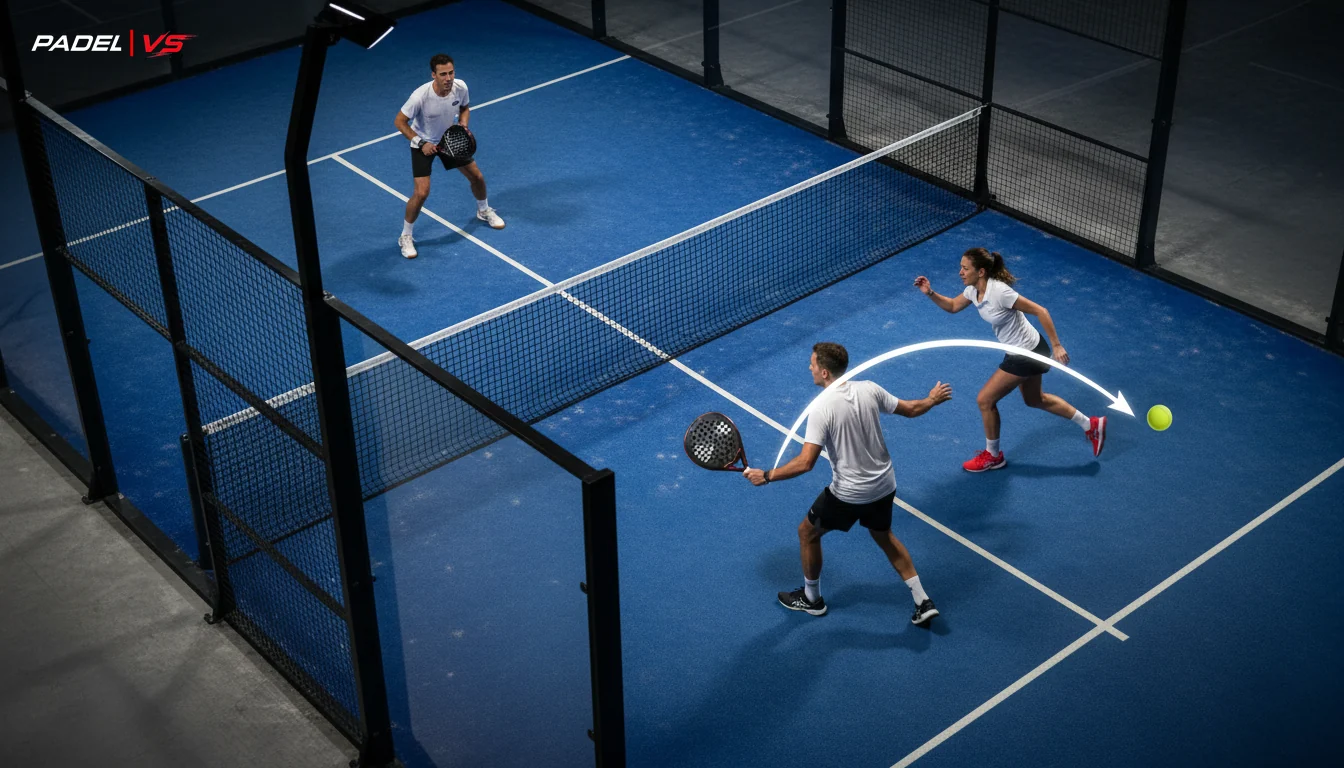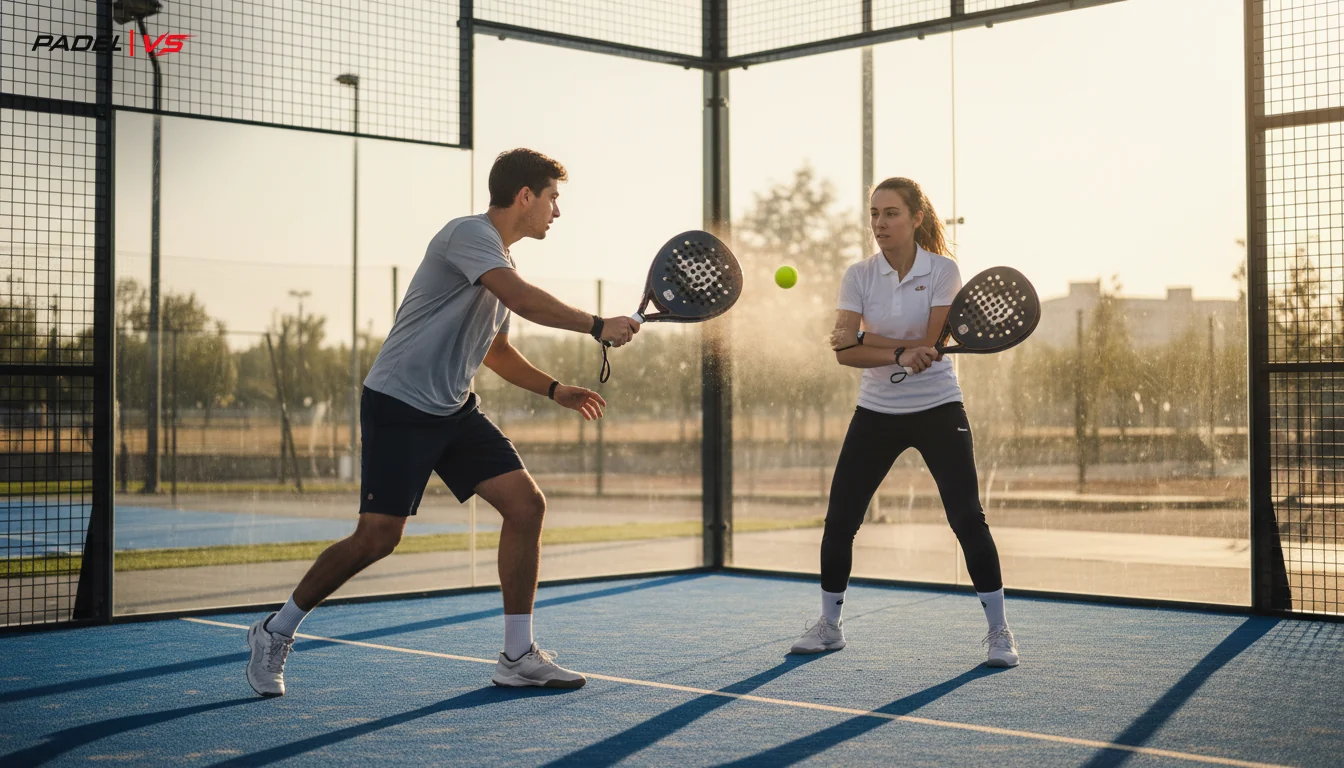

The bandeja is padel's most iconic shot and arguably the defining technique that separates our sport from tennis. Whether you're just starting in padel or have been playing for a while but feel your bandeja lacks effectiveness, this guide will take you from fundamentals to the advanced variations used by professionals.
What is the bandeja and why is it so important?
The bandeja is an attacking shot executed overhead, similar in position to a smash but with completely different mechanics. While the smash seeks power and definition, the bandeja prioritizes control, placement, and sustained pressure. It's the shot that keeps you at the net, controlling the point without taking unnecessary risks.
At PADEL VS, when we analyze player profiles from Quinta to Primera categories, we notice a clear pattern: the difference between a Cuarta player (850-1000 ELO) and a Tercera player (1000-1180 ELO) almost always comes down to bandeja effectiveness. Players who master this shot maintain net pressure longer and commit fewer unforced errors.
Anatomy of the perfect bandeja
Before diving into drills and progressions, you need to understand the fundamental components of a well-executed bandeja:
1. Preparation and grip
The bandeja is executed with a continental grip, the same one you use for serving and volleying. If you're unfamiliar, imagine you're holding a hammer: racket perpendicular to the ground, handle at the base of your index finger forming a V between thumb and index.
Preparation begins when you identify the ball is coming high. Your movement should be quick but fluid:
- Turn shoulders toward your dominant hand side
- Bring the racket behind your head, as if scratching your back
- Elbow should be at ear height, not too low or excessively high
- Your non-dominant hand points toward the ball (this maintains balance)
2. Contact point
This is where most players make mistakes. The ideal contact point is slightly forward of your head and approximately 8-12 inches above it. Not as far forward as a smash (where you'd seek downward angle), but not completely vertical over your head either.
The racket face at contact should be slightly open (facing upward) between 15-30 degrees. This is critical for generating the characteristic slice effect of the bandeja.
3. Wrist movement and follow-through
The bandeja is NOT a full arm swing like the smash. The primary movement comes from a controlled top-to-bottom wrist motion, similar to hammering a nail or serving in tennis but more contained.
The follow-through is fundamental: your racket should cross toward the opposite side of your body, finishing near your opposite hip. This movement generates the slice effect that makes the ball come off the glass low and complicates your opponent's response.
"The bandeja is like signing your name in the air: every player develops their personal style, but the fundamentals are always the same. Consistency over spectacle."
Learning progression: From zero to consistent bandeja
Learning the bandeja requires patience and structured practice. Here's a 4-phase progression that has worked with hundreds of players:
Phase 1: Mechanizing the motion without ball (Week 1-2)
Before touching a single ball, you need to engrain the correct motor pattern. Practice in front of a mirror or record yourself:
- Starting position: Stand in ready position at net, racket in front
- Preparation: Turn shoulders, bring racket back, elbow up
- Swing: Controlled wrist movement, imaginary contact forward-up
- Follow-through: Racket crosses to opposite hip
Repeat this movement 50 times daily. Sounds monotonous, but you're creating muscle memory. Focus on fluidity, not speed.
Phase 2: Static bandejas with easy feed (Week 2-4)
Now you need a partner or coach to feed you soft balls:
- Position yourself 2 meters behind the service line
- Your partner, from the back, lobs high, slow balls to you
- Your goal: NOT power, but control and placement
- Aim for the ball to bounce in the opposite service box and come off the glass low
Initial target: 7 out of 10 bandejas inside the court with low glass exit. At PADEL VS we've seen that players reaching this consistency are typically ready to advance to Tercera category if the rest of their game supports it.
Phase 3: Bandejas in motion (Week 4-8)
The bandeja in real situations is almost never static. Now add movement:
- Bandeja from closed position: Lob feed, but you must take two lateral steps before executing
- Bandeja moving backward: Deeper lob, retreat 2-3 steps maintaining lateral position
- Bandeja after volley: Sequence volley-lob-bandeja to simulate real point
In this phase it's normal for your consistency to drop temporarily (from 70% to 50-60%). Don't get frustrated, you're adding complexity. Maintain focus on technique.
Phase 4: Variations and match situations (Week 8+)
Once you have the basic bandeja controlled (6-7 out of 10 in motion), it's time to develop variations:
| Bandeja type | When to use it | Desired effect |
|---|---|---|
| Slice bandeja | Controlled situation, want to maintain net | Maximum spin, very low glass exit |
| Flat bandeja | Lower ball, less preparation time | More speed, less spin |
| Power bandeja | Opponent very deep or out of position | Seeking definition or forced error |
| Cross-court bandeja | Take opponent out of position | Rhythm and angle change |
The 7 most common mistakes (and how to fix them)
Mistake 1: Late preparation
Symptom: You feel rushed, shot comes out uncontrolled
Cause: Not identifying early enough that ball is coming high
Solution: Improve trajectory reading. When opponent hits from back, anticipate possible lob. Early preparation is key.
Mistake 2: Contact point too far back
Symptom: Ball goes long or lacks power
Cause: You're contacting the ball behind your head
Solution: Practice forward contact point. Useful drill: place a cone 20 inches in front of where you stand. Ball should pass over that cone at contact.
Mistake 3: Full arm swing (like smash)
Symptom: Inconsistency, many unforced errors
Cause: Using entire arm instead of wrist motion
Solution: "Fixed elbow" drill: Rest your non-dominant hand on your dominant elbow during swing. This forces you to use only wrist and forearm.
Mistake 4: Closed racket face at contact
Symptom: Ball goes into net or too hard into glass
Cause: Racket face pointing to ground (closed) instead of slightly open
Solution: Consciously open racket face before contact. Think about "putting the ball in the sky" before bringing it down.
Mistake 5: Not using legs
Symptom: Loss of power, imbalance
Cause: All the shot comes from the arm
Solution: Slightly flex knees in preparation, extend them at contact. Legs are your power base.
Mistake 6: Abrupt or non-existent follow-through
Symptom: Loss of control, inconsistent spin
Cause: You stop movement abruptly after contact
Solution: Follow-through is as important as contact. Let the racket complete natural movement to opposite hip.
Mistake 7: Choosing bandeja when you should smash
Symptom: Missing definition opportunities
Cause: Not properly evaluating tactical situation
Solution: Rule of thumb: If ball is at shoulder height or lower, bandeja. If significantly higher and opponent is poorly positioned, consider smash.
Specific drills to improve your bandeja
Drill 1: "Bandeja to cone"
Objective: Placement precision
Setup: Place 3 cones in opposite service box (one in each corner, one center)
Execution: 30 bandejas trying to hit each cone rotationally. Count hits.
Progressive target: Beginner 5/30, Intermediate 10/30, Advanced 15/30
Drill 2: "Deep vs. short bandeja"
Objective: Depth control
Setup: Mark with tape a line at mid-service box
Execution: Alternate 10 bandejas trying to bounce before the line (short) and 10 after (deep)
Benefit: Develops touch and ability to vary your game according to situation
Drill 3: "Bandeja under pressure"
Objective: Consistency under fatigue
Setup: Circuit: 10 bandejas, 10 squats, 10 bandejas, 10 burpees, 10 bandejas
Execution: Complete circuit without stopping. Count unforced errors in bandejas.
Target: Maximum 5 errors in total 30 bandejas
Drill 4: "Real point sequence"
Objective: Tactical application
Setup: With partner, fixed sequence: cross-court volley → lob → bandeja → response volley → bandeja → definition
Execution: Repeat sequence 20 times, maintaining point until definition
Benefit: Train bandeja in real point context, not isolated
"There's no such thing as the perfect bandeja, only the bandeja that keeps the point under control. I prefer 10 safe, placed bandejas over 5 spectacular attempts with 3 unforced errors."
Adaptation based on your level and category
The bandeja you need to execute varies significantly according to your level:
Quinta players (<850 ELO): Fundamentals above all
At this initial stage, your absolute priority is not giving away points. A basic, safe bandeja is worth more than attempting spectacular bandejas:
- Focus on classic slice bandeja with maximum safety
- Goal: bounce inside and come off glass low
- Don't worry about power or variations yet
- Consistency target: 6-7 out of 10 in practice situation
Cuarta players (850-1000 ELO): Developing consistency
You already understand the game and are ready to polish your bandeja:
- Add flat bandeja to your repertoire for faster balls
- Work on footwork: positioning before executing
- Start varying depth (short vs. deep)
- Consistency target: 7-8 out of 10 in real match
Tercera players (1000-1180 ELO): Tactical variation
At this level the bandeja becomes a real tactical weapon:
- You master three variants: slice, flat, power
- Use cross-court bandeja to take opponents out of position
- Alternate rhythms: slow-fast-slow to break opponent's timing
- Integrate bandeja into tactical sequences of 4-5 shots
Segunda and Primera players (1180+ ELO): Mastery and creativity
Here the bandeja is a natural extension of your game:
- Execute bandejas in extreme situations (very wide, backing up)
- Use subtle spin variations to generate specific responses
- Bandeja is your sustained pressure shot par excellence
- Expected consistency: 9 out of 10 even under pressure
Equipment and gear: Does the racket matter?
Yes, but less than you think. Good technique works with any decent racket. That said, some characteristics help:
Ideal characteristics for bandeja
- Balance: Medium or medium-high facilitates controlled swing
- Surface: Rough (3D type or with relief) helps generate slice effect
- Shape: Diamond or hybrid give power; round gives control (choose according to your style)
- Weight: 12.7-13.2oz is ideal range for most players
In Mexico, you'll find suitable rackets in the $80-165 USD ($1,500-3,000 MXN aprox) range for intermediate level, and $195-360 USD ($3,500-6,500 MXN aprox) for advanced models with better materials and specific technologies for generating spin.
Integration with PADEL VS and your development
At PADEL VS we understand the bandeja is a shot that separates levels. Our ranking and matchmaking system considers not just victories, but quality of play. A player with consistent bandeja will naturally progress from Cuarta to Tercera faster because:
- Maintains long points without committing unforced errors
- Pressures opponent consistently from the net
- Generates definition opportunities for their partner
When you play matches on our platform, pay attention to post-match statistics (coming soon in full version). You'll see metrics like "% bandejas inside" and "% points won after effective bandeja." This data will help you identify specific improvement areas.
8-week practice plan
Here's a structured program if you want to systematically improve your bandeja:
Weeks 1-2: Fundamentals
- 3 sessions/week, 20 minutes bandeja only
- 100 repetitions without ball (mechanization)
- 50 bandejas with easy feed
- Focus: perfect technique, forget outcome
Weeks 3-4: Consistency
- 3 sessions/week, 30 minutes
- Cone drill (30 repetitions)
- Bandejas in motion (40 repetitions)
- Focus: increase hit % to 60-70%
Weeks 5-6: Variation
- 4 sessions/week, 30 minutes
- Introduce flat and power bandeja
- Depth drill (40 repetitions)
- Focus: adaptability to different situations
Weeks 7-8: Application
- 4 sessions/week, 45 minutes
- Real point sequences (30 minutes)
- Matches with specific focus on using bandeja correctly
- Focus: tactical integration in real game
After this cycle, evaluate your progress playing 5-10 matches on PADEL VS and analyze your consistency in real situations. If you reach 70%+ effectiveness in bandejas during competitive matches, you're ready to advance to the next technical level.
Conclusion: The bandeja as cornerstone
The bandeja isn't just another shot in your padel arsenal; it's the backbone of your offensive game. Mastering it means:
- More time in dominant net positions
- Fewer unforced errors given away
- Ability to pressure opponent consistently
- Better tactical point reading (when to attack, when to maintain)
The path from basic bandeja to advanced-level bandeja takes months, not weeks. It requires patience, deliberate practice, and willingness to fail many times in the process. But every hour invested in this shot translates directly to better on-court performance.
At PADEL VS we're building a community where players of all levels can find appropriate competition and keep improving. Whether you're in Quinta category just learning basic bandeja, or in Segunda refining advanced variations, there's a place for you on our platform. We'll soon expand from Cancún to other cities, bringing structured competition and detailed data to more players.
Remember: the best bandeja isn't the most powerful or most spectacular. It's the one that keeps the point under control while generating constant pressure. Practice with purpose, be patient with your progress, and you'll see how this shot transforms your level of play.