
Ask any padel player to name the five most important shots in the game and you'll hear bandeja, smash, volley, lob, and maybe the víbora. Almost nobody mentions the counter-wall — the shot played off the lateral glass after it bounces in your court. That omission is costly, because the counter-wall is quietly responsible for more lost points, more broken rallies, and more missed level-ups than almost any other technical deficiency in the game.
What Is the Counter-Wall Shot, Exactly?
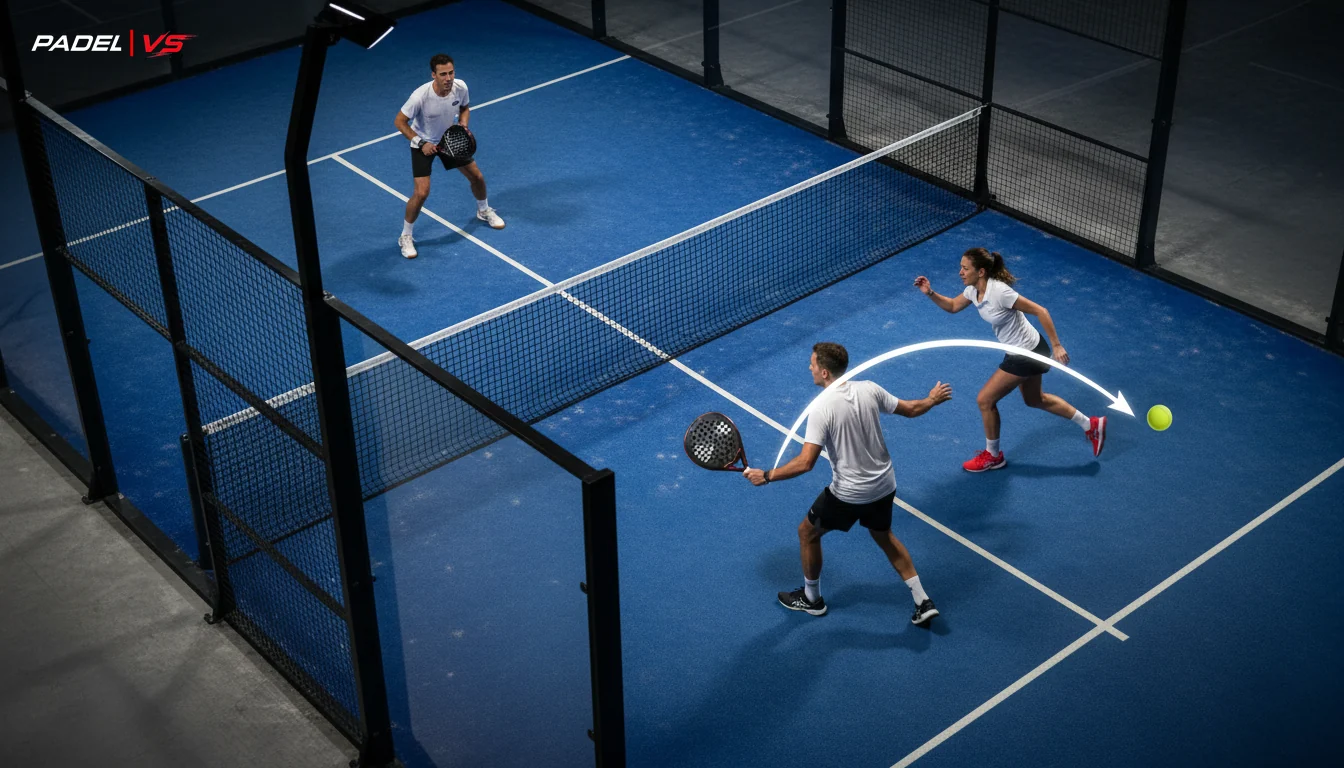
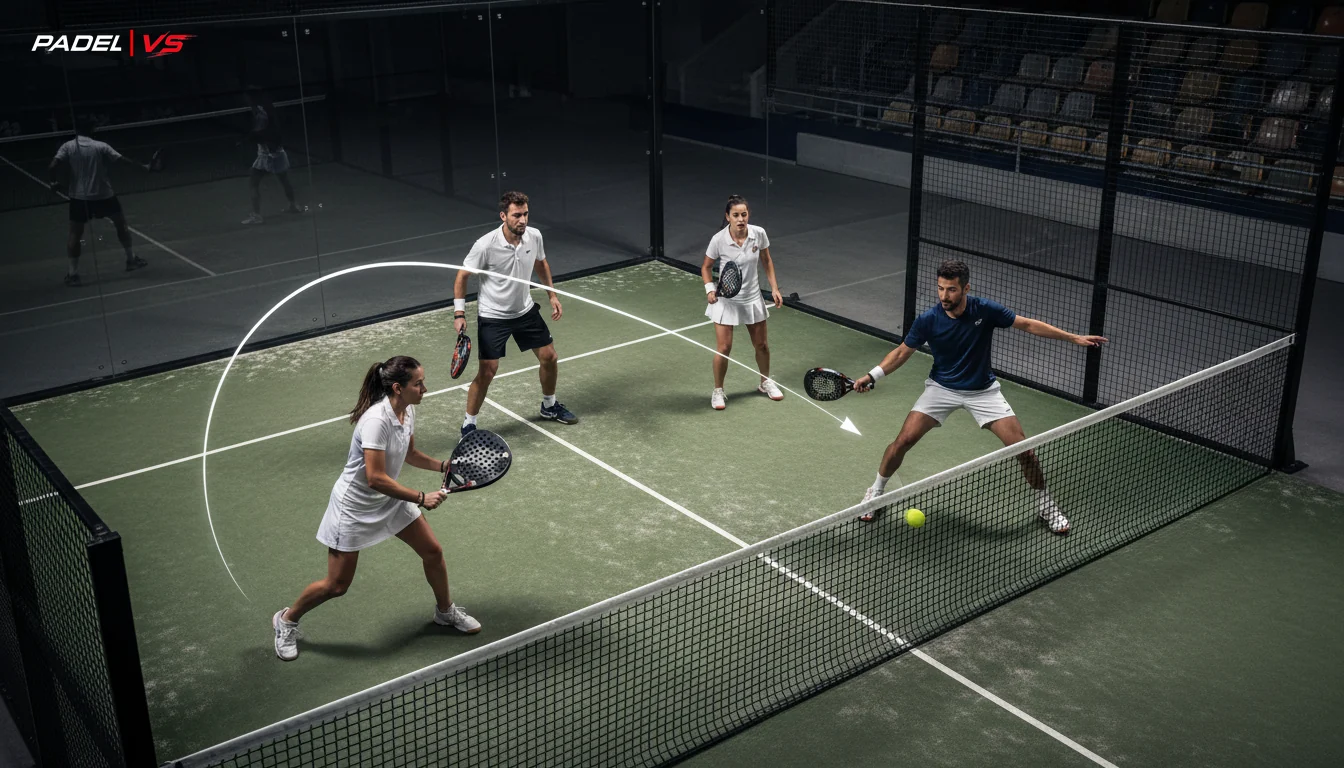
In padel, a standard court measures 10 meters wide by 20 meters long. The back section of each side is enclosed by glass panels that rise 3 meters high. When a ball bounces in your half of the court and then hits one of those lateral glass panels before you can play it, the shot you hit off that rebound is the counter-wall — or contrapared in Spanish.
What makes this stroke genuinely different from any other shot in the game is the geometry. The ball doesn't come back to you in a predictable straight line. Depending on the angle it hit the glass, the pace of the original shot, and the spin applied by your opponent, that ball can come back at anywhere from a shallow 10-degree angle to a sharp 60-degree cut across the court. Your brain has to process incoming angle, predict exit angle, and get your feet to the right position — all in under a second, often while moving backward.
"The counter-wall doesn't punish your technique as much as it punishes your positioning. Get the feet wrong and even a technically perfect swing will send the ball into the net." — National-level padel coach with 12+ years on court.
Why This Shot Gets Ignored
The counter-wall gets neglected for a very human reason: it feels like a defensive shot, and nobody wants to spend practice time on defense. Players at every level from Quinta (below 850 ELO) through Tercera (1,000–1,180 ELO) instinctively gravitate toward drilling the offensive weapons — the overhead smashes, the aggressive volleys, the spinning winners. The counter-wall gets practiced only by accident, when a drilling exercise happens to produce a wall rebound.
The problem with this approach is that in competitive padel — the kind you play in organized leagues, in PADEL VS tournaments, or any environment where points actually matter — the defense-to-offense transition happens constantly. A team that cannot reliably control the counter-wall gives opponents free points every time they push the ball into the back corner. At the Tercera and Segunda levels (1,000–1,350 ELO), good opponents exploit that weakness deliberately.
Understanding the Physics First
Before you can master the technique, you need to understand what the glass is actually doing to the ball. There are three variables that determine how the ball comes off the lateral wall.
Entry Angle
A ball traveling parallel to the side glass will rebound back into the center of the court — roughly parallel to its original path. A ball arriving at a sharp cross-court angle will rebound forward, sometimes nearly toward the net. This sounds obvious until you're running backward in a real match and have to apply it in real time. Most players at the Cuarta level (850–1,000 ELO) know this intellectually but haven't drilled it enough to read it automatically.
Spin and Pace
A heavily topspin ball will bounce high off the court, then drop sharply after hitting the glass — often catching players who positioned themselves for a mid-height shot. A flat or slice ball will stay low and fast after the rebound, giving you less reaction time but more predictable geometry. Opponents at the Segunda and Primera levels (1,180–1,550 ELO) mix spins precisely to make the counter-wall harder to read. If you haven't trained against varied spin deliberately, you'll misread the exit angle on a significant percentage of balls.
Glass Conditions
This is the variable nobody talks about in technique guides: the glass itself behaves differently depending on conditions. Outdoor courts in Mexico — in cities like Cancún, Monterrey, or Mexico City — can have glass that plays slightly slower when cold in the early morning or during cooler months. Indoor, climate-controlled courts tend to be more consistent. Neither is better; both require a brief calibration period at the start of each match. Experienced players always spend the warm-up hitting a few deliberate balls into the lateral glass precisely for this reason.
The Technique: Breaking It Down Step by Step
Here is where generic guides fail you. Let's be specific.
Step 1: Early Reading — Before the Ball Hits the Glass
The moment you recognize that the opponent's shot is going to reach the lateral glass before you can intercept it, your first movement should not be toward the corner. It should be toward the center of the court, perpendicular to the expected exit trajectory. This is the single most important positional adjustment in the counter-wall, and it's the one most commonly skipped. Players who run into the corner box themselves in. Players who move to the center give themselves room and angle to actually play the shot.
Step 2: Foot Placement and Body Orientation
For right-handed players: when the counter-wall comes off your backhand side (left), your right foot is the pivot, and your left shoulder should point toward the net. When it comes off your forehand side (right), your left foot is the pivot, right shoulder toward the net. This is standard groundstroke mechanics, but the execution window here is much tighter — you have less space and less time than in tennis or any other racket sport.
Step 3: Grip
The continental grip is strongly preferred for counter-wall shots. This is the same grip you'd use for volleys — handle oriented so the base knuckle of your index finger sits on the first bevel of the handle. The reason is adaptability: continental allows you to make last-millisecond wrist adjustments for balls that arrive lower or higher than expected without rotating your grip. If you're playing with a western or semi-western grip (common among players transitioning from tennis), the counter-wall will punish you consistently.
Step 4: The Contact Point
Ideal contact is at hip height or slightly above, with the arm extended but not rigid. If you're consistently making contact below the knee, you're late — move earlier. If the ball is passing above shoulder height, you've over-committed forward and the ball has overtaken you. Both errors send the ball into the net or the back fence. The sweet spot is that hip-to-chest zone where you still have racket head control.
Step 5: The Tactical Decision
Once the mechanics are reliable, the counter-wall becomes a tactical weapon. Your three main options from the back-wall rebound:
- Down the middle (safest): Reduces your error margin and forces opponents to decide who takes the ball. Use this when you're late or off-balance.
- Long parallel: Hard to execute cleanly from a counter-wall position, but if the ball comes back with pace, a parallel winner down the same side is devastating.
- Cross-court with spin: The advanced option. Requires a late wrist rotation to redirect the ball. Only attempt this consistently after the first four steps are fully automated.
Common Errors by Level
| PADEL VS Category | Most Common Counter-Wall Error | How to Fix It |
|---|---|---|
| Quinta (<850 ELO) | Running into the corner, losing all shot angle | Shadow drill: practice moving to center before ball hits glass, no racket needed |
| Cuarta (850–1,000 ELO) | Using a western grip, losing control on off-speed balls | Switch to continental grip for all wall shots — drill it separately first |
| Tercera (1,000–1,180 ELO) | Always returning to center, zero variation | Introduce parallel and cross-court targets in training; add cones for precision |
| Segunda (1,180–1,350 ELO) | Failing to read spin before the rebound | Partner drill: partner hits with varied spin, you call the spin type before ball hits glass |
Three Drills You Can Run This Week
Theory matters. Practice wins matches. Here are three specific drills you can implement immediately, requiring minimal setup.
Drill 1: Solo Wall Feed
Stand approximately 2 to 3 meters from the lateral glass in the back half of the court. Toss the ball against the glass with your free hand — not your racket — and play the rebound. Start with gentle tosses that produce predictable angles. Then increase the pace and vary the toss angle to create different exit trajectories. Target: 15 consecutive controlled shots, all landing in the opponent's service box or deeper.
Drill 2: The 2-vs-1 Back Court Drill
One player defends alone in the back half. Two players on the other side of the net alternate feeding balls that force the defender to play the side glass — mix parallels and cross-courts deliberately. The defender must return all balls to the center or execute a cross-court. This drill is excellent because it replicates the time pressure and positional stress of a real match without being a full point situation.
Drill 3: Directed Counter-Wall
Place two cones in the opponent's court — one in the center, one in the corner. A feeder at the net or from the opposite baseline sends balls that rebound off your lateral glass. Your task is to alternate targets: center cone, corner cone, center cone. No pace requirement — precision only. This builds the wrist-and-angle awareness needed for the cross-court variation at higher levels.
Equipment: What Helps, What Doesn't
No racket will fix bad positioning. But certain technical characteristics do make the counter-wall more manageable, especially when you're still building the stroke.
- Round or low-teardrop shape: A larger sweet spot gives you more forgiveness on off-center contact — which happens constantly in counter-wall situations where the ball arrives with unexpected angle.
- Weight between 355–370g: Light enough for rapid last-moment adjustments, heavy enough to generate controlled pace on the return.
- Rough surface texture: Adds natural spin to your output, making your counter-wall returns harder for opponents to read.
- Carbon fiber frame: Absorbs vibration better on eccentric hits, reducing arm fatigue over a full match.
In the Mexican market, rackets with these characteristics range from $80–165 USD ($1,500–3,000 MXN approx) in the mid-range tier. High-end control-oriented padel rackets with advanced carbon layering can reach $390–560 USD ($7,000–10,000 MXN approx). For building counter-wall technique from the ground up, a solid mid-range option is genuinely sufficient — save the premium investment for when your positioning is already reliable.
The Competitive Angle: Counter-Wall and Your ELO
In PADEL VS, we use an adapted ELO system to track performance and assign you to the right category — from Quinta at the entry level to Open for elite players at 1,550+ ELO. One pattern that's consistent across competitive padel everywhere: players who have deliberately trained the counter-wall hold their ground in defensive situations far more effectively than those who haven't.
This translates directly to rating. When you can neutralize a back-corner attack — taking a ball that was designed to win the point against you and returning it to a safe position — you extend rallies, reduce unforced errors from defensive positions, and put psychological pressure on opponents who expected a free point. That compound effect shows up in match outcomes, and match outcomes are what move your ELO.
If you're competing in PADEL VS, open padelvs.com in your browser or jump into the Telegram Mini App via @padelvsbot to review your match history. If you notice a pattern of point losses when you're deep in the back court, you now know exactly what to work on.
"The player who has made the glass wall their ally is never truly on defense. That's the line between recreational padel and competitive padel."
Building This Into Your Game Starting Now
You don't need to rebuild your entire game to benefit from counter-wall work. The recommended approach is focused and low-friction: for the next four weeks, dedicate 15–20 minutes of every practice session exclusively to wall rebound work. Don't worry about the point outcome during this phase. Focus entirely on the contact quality — grip, footwork, contact point. When those three elements are automatic, the tactical layer (where you send the ball) will develop naturally.
The counter-wall is not a flashy shot. It won't appear in highlight reels. Your opponents in casual matches won't even notice you've improved it — until they push the ball into your back corner expecting a free point and you redirect it back with purpose. Then they notice.
In competitive padel, matches are decided by the shots everyone underestimates. The counter-wall is exactly that shot. Start working on it this week, and the scoreboard will tell the story over the next few months.