
In padel, matches aren't won only with racket technique — they're won with your head, your feet, and above all, with your partner. When one half of a doubles team is having an off day — chaining errors, losing timing, bailing on volleys — the entire pair can unravel in two or three games if there's no plan in place. This article is that plan.
First: Recognize What's Happening Without Catastrophizing
The most common mistake doubles partners make is either denying reality or dramatically overreacting to it. Your partner has double-faulted three times, is hitting the back glass when they should be angling to the side wall, and their volleys are dumping into the net. It happens. Padel is a streaky sport; even players at the Primera level (1350-1550 ELO in PADEL VS) have sets where nothing clicks.
The key is identifying early — ideally before two games have slipped away — what kind of problem your partner is dealing with:
- Physical: Fatigue, a nagging shoulder, tight hamstrings. The game needs to get shorter and more conservative.
- Mental/confidence: Errors are snowballing emotionally. They need easy points to rebuild rhythm.
- Technical: The forehand isn't loading today, or the bandeja is landing short. These can be routed around.
- Environmental: Sun glare, wind, a glass wall with different rebound than their home club. This calls for tactical adaptation, not emotional management.
Getting the diagnosis right completely changes the fix. Managing a partner with ankle discomfort is nothing like managing someone who's been staring at the floor after every error for the past five minutes.
Communication That Actually Works on Court
There's a golden rule in padel doubles that very few players truly follow: what you say on court should build, not explain. You're not in a lesson; you're in a match. Long technical explanations between points destroy momentum and pile pressure onto the player who's already struggling.
"The best doubles partner isn't the one who tells you what you did wrong. It's the one who makes you believe you're winning the next point together."
What should you actually say? Short, forward-looking, team-oriented phrases:
- "Let's go, next one." — Closes the error, opens the next point.
- "I've got the middle." — Signals coverage without making them feel redundant.
- "Lob when you're not sure." — A simple instruction that shrinks their decision menu.
- "Their guy on your right is struggling with pace." — Useful tactical info, not criticism.
What you absolutely avoid: "What happened there?", "That was yours", "You need to go deeper", or the classic awkward silence after a double fault. Silence in padel communicates more than words ever will.
Tactical Adjustments: Redistributing the Game Without Exposing Anyone
Here's where it gets genuinely interesting: concrete tactics. If your partner is off, you need to restructure the match without letting the opponents detect the shift — or at least delay their discovery as long as possible.
1. Centralize the Game Toward Your Side
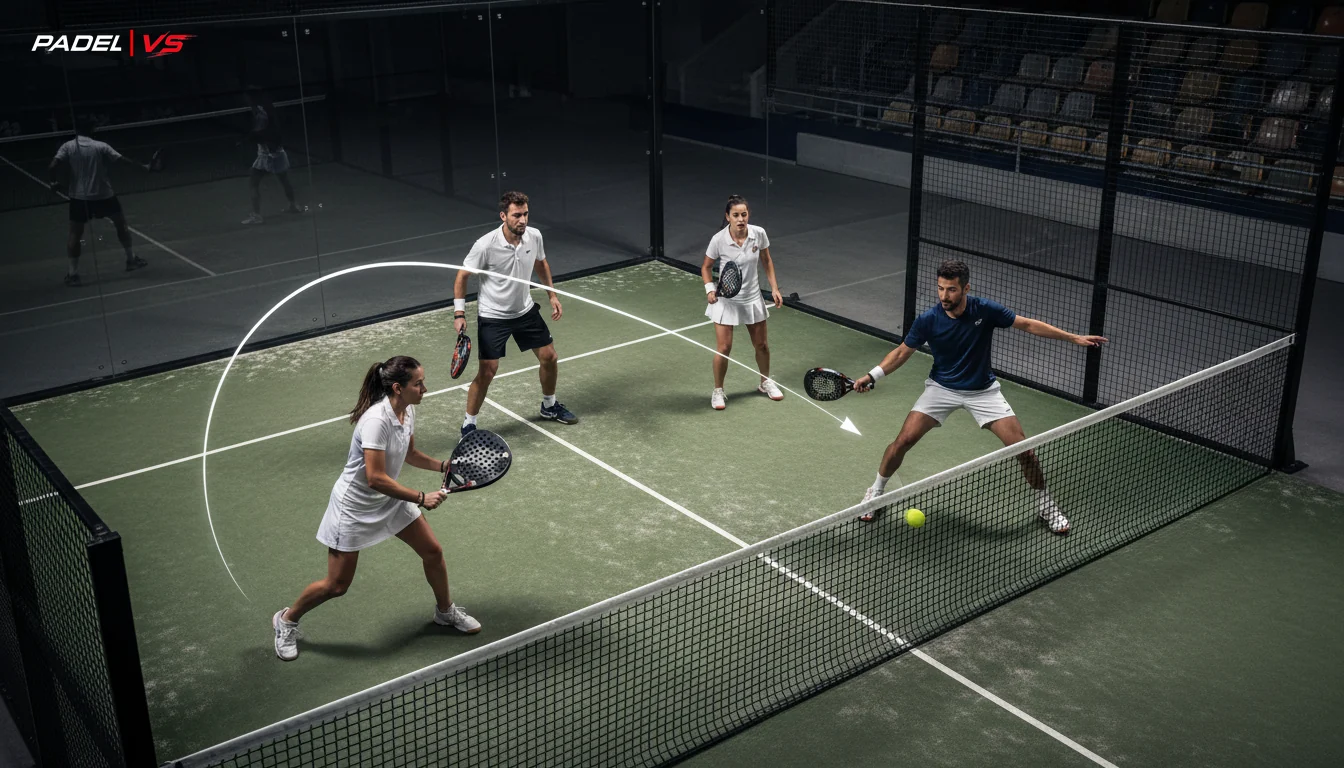
The most direct way to protect a struggling partner is to take more balls yourself. This is done through positioning: slide 30-40 centimeters toward the center of the court (without fully leaving your lane) to intercept more balls through the middle corridor. On a standard padel court that is 10 meters wide, that subtle shift can mean the difference between your partner having to execute a compromised high volley and the ball being cleanly yours.
Watch out: don't become the "hoarder". Move too far to center and you leave your sideline exposed — opponents will exploit that with a cross-court lob or a passing shot down the line.
2. Simplify Their Role: Give Them One Clear Coverage Zone
An effective tactic is creating a clear division of responsibilities where your partner has fewer real-time decisions to make. Assign them a predictable coverage zone: the deep diagonal, the back of their side. You take on more of the net game. Fewer decisions equals fewer errors born from uncertainty.
3. Use the Lob as a Reset Tool, Not a Surrender Signal
The lob gets a bad reputation among intermediate players — Tercera through Segunda level, roughly 1000-1350 ELO. Players at those categories treat it as a sign of weakness. That's a conceptual mistake. When your partner is off, the lob is your best friend: it resets the point, gives both of you time to reposition, and immediately reduces pressure on the partner in crisis. A well-executed lob landing close to the back glass — bouncing at around 1.8 meters of height near the baseline — can save an entire game.
4. Attack Toward the Opponent Away From Your Partner's Problems
If your partner is struggling with high volleys, organize your offensive direction so you're not generating situations where they have to put away overheads. Drive play toward the feet of the opponent on your side, force slow balls into the side glass on the weaker rival's side, and let them manage the difficulty — not your partner.
5. Serve: Simplify to Win Percentage
If your partner is serving erratically, the first tactical correction is to reduce ambition on the first serve. A flat serve to the receiver's body, no spin, no extreme angles, moderate pace — it has a significantly higher first-serve percentage. Winning 85% of first serves with a conservative serve beats winning 50% with an aggressive one when the mind isn't clear.
The Ego Trap: The Most Common Pitfall
There's something that doesn't get discussed enough in padel strategy articles: the ego of the partner who is struggling. The player having an off day usually knows they're misfiring — and the last thing they want is to feel like the weak link. If they sense their partner is "protecting" them, they may react in one of two ways: accept it gratefully (ideal) or rebel tactically, overreaching to prove themselves, which produces even more errors.
The way to handle this is being brief and direct during the changeover: "Hey, the rebound off your back glass feels weird today. I'll slide more central, you cover my lob, deal?" Externalize the problem (wind, glass, whatever fits) and propose a team solution. Nobody is positioned as the weak one.
"In padel doubles, there's no strong player and weak player. There's a partnership that works or one that doesn't. Smart tactics erase that distinction."
Set Management: When to Absorb Risk and When to Play Safe
If you're losing the first set and your partner still hasn't found their game, there's a bigger tactical decision to make: how much risk do you personally absorb to compensate?
The answer depends on the scoreboard:
| Situation | Recommended Strategy |
|---|---|
| Down 0-2 in the set | Still early. Play your normal game, don't force anything. |
| Down 1-4 in the set | Change the rhythm. Move more to the net, look for the short point. |
| Down 2-5 in the set | Play point by point, forget the set. Minimize your own unforced errors. |
| Start of the second set | Full reset. New dynamic, consider switching sides. |
| Third and final set | Maximum focus. Fatigue levels the physical gap; mental toughness decides. |
Switching Sides: An Underused Tool
In padel, unless tournament rules dictate otherwise, switching sides mid-match is optional and agreed upon by the pair. If your partner is on the side with direct sun exposure, a glass wall with condensation, or an irregular bounce they're not reading well, suggesting a side switch at the start of the second set can be transformative. Don't frame it as "you're playing badly"; frame it as "I think that back-wall bounce is messing with your timing — try my side and I'll see if I can handle yours."
This seemingly small adjustment can mentally reset a partner who was locked up by an external factor they hadn't even consciously identified.
Making the Most of Changeover Time
In a competitive padel match — standard format of sets to 6 games — there are changeovers whenever the total game count is odd. That minute (or 90 seconds in regulated tournament play) is gold. Don't waste it reviewing past mistakes.
A productive structure for that time:
- First 20 seconds: Water, breathe, lower your heart rate. Say nothing important yet.
- Next 30 seconds: One single tactical idea for the next games. Not three ideas — one.
- Last 10 seconds: A short, specific motivational cue. Not "we've got this", but "their returns in the middle keep coming up short — let's step in on those."
The Role of the Player Who's On: Leadership Without Arrogance
If you're the one playing well today, you carry enormous responsibility. Your energy, your body language, and your own reaction to your mistakes will set the emotional tone of the entire match. If you show frustration when something goes wrong on your side, your partner will read that as confirmation that everything is lost. If you stay calm and solution-focused, you give your partner implicit permission to treat errors as part of the game — something to move past, not dwell on.
At PADEL VS, when we analyze match dynamics in Tercera and Segunda categories, one of the most consistent patterns among teams that come back from deficits is that the in-form partner maintains steady body language throughout: they don't over-celebrate their own winners, they don't gesture when their partner misses, and they make brief eye contact between points that communicates support. Small details. Massive impact.
Pre-Match Preparation: The Best Tactic for the Bad Day That Hasn't Happened Yet
The most effective tactic for off days is agreeing on it before one ever hits. Doubles pairs who play regular tournaments — like the competitive formats organized through PADEL VS, currently building our network in Cancún and expanding to more cities — should have a quick conversation before each match about their "crisis protocols":
- Who moves more to the net if one of us is missing volleys?
- Do we switch sides at the second set if the score is very unfavorable?
- What signal do we use to say "send me more balls" without the opponents hearing?
- Do we talk during changeovers or do we stay quiet and just execute?
Having these answers defined in advance turns one player's bad day into a manageable team challenge — not an identity crisis for the partnership.
You can track your team's ELO progression, schedule practice matches, and register for category-appropriate tournaments directly at padelvs.com or through the Telegram Mini App via @padelvsbot. Seeing your numbers between matches helps both partners understand where their individual game needs to go — and that context makes conversations about coverage and responsibility much easier to have without ego getting in the way.
A Quick Note on Categories and Off Days
It's worth noting that off days look different depending on where you sit in the ELO ladder. A Quinta player (under 850 ELO) having an off day and a Segunda player (1180-1350 ELO) having an off day are completely different problems. At Quinta, off days often mean basic consistency breaks down entirely — serves land out, returns are mis-hit. The tactic there is pure simplification: slow balls to the middle, let the opponents make errors. At Segunda, an off day is more subtle — decision-making slows by half a second, and that's enough for top players to exploit. The tactic there is strategic: protect specific shots, adjust serve direction, and keep the match tight until the sharpness comes back.
Understanding your partner's level and what specifically fails during their off days is something you develop over dozens of matches together — and it's one of the underrated advantages of committed doubles partnerships over pickup pairs.
Conclusion: Doubles Padel Is an Emotional Contract
Padel is technique, tactics, and physicality. But in doubles, there's a layer that defines everything: the emotional management of the partnership as a unit. A team that knows how to navigate one member's off day doesn't just win more matches — it builds mutual trust that becomes their greatest competitive advantage over time. The next time your partner is struggling, remember: you're not there to rescue them. You're there to make sure both of you reach the finish line together.