Almost every padel player learns the lob as a last resort: that desperate shot you throw up when the opposing pair has you pinned against the back glass with no angle for a drop shot. But at the levels where padel starts getting serious — Tercera and up, roughly 1000 ELO and above in the PADEL VS system — the lob stops being a patch and becomes the shot that decides the point in your favor.
The lob is not a panic shot
The mental image we all have of the lob is the same: a player cornered at the back glass, no angle, no time, launching the ball upward just to buy another second of life. That lob exists and it's legitimate, but it's just one of three functions this shot can serve. The second function is to neutralize: resetting the point to a 4x4 position (both pairs at the back) when you're at a net disadvantage. The third — and the one almost nobody trains on purpose — is the pressure lob: an offensive shot executed from a comfortable position, with the intention of winning the point outright or forcing a serious error from your opponents.
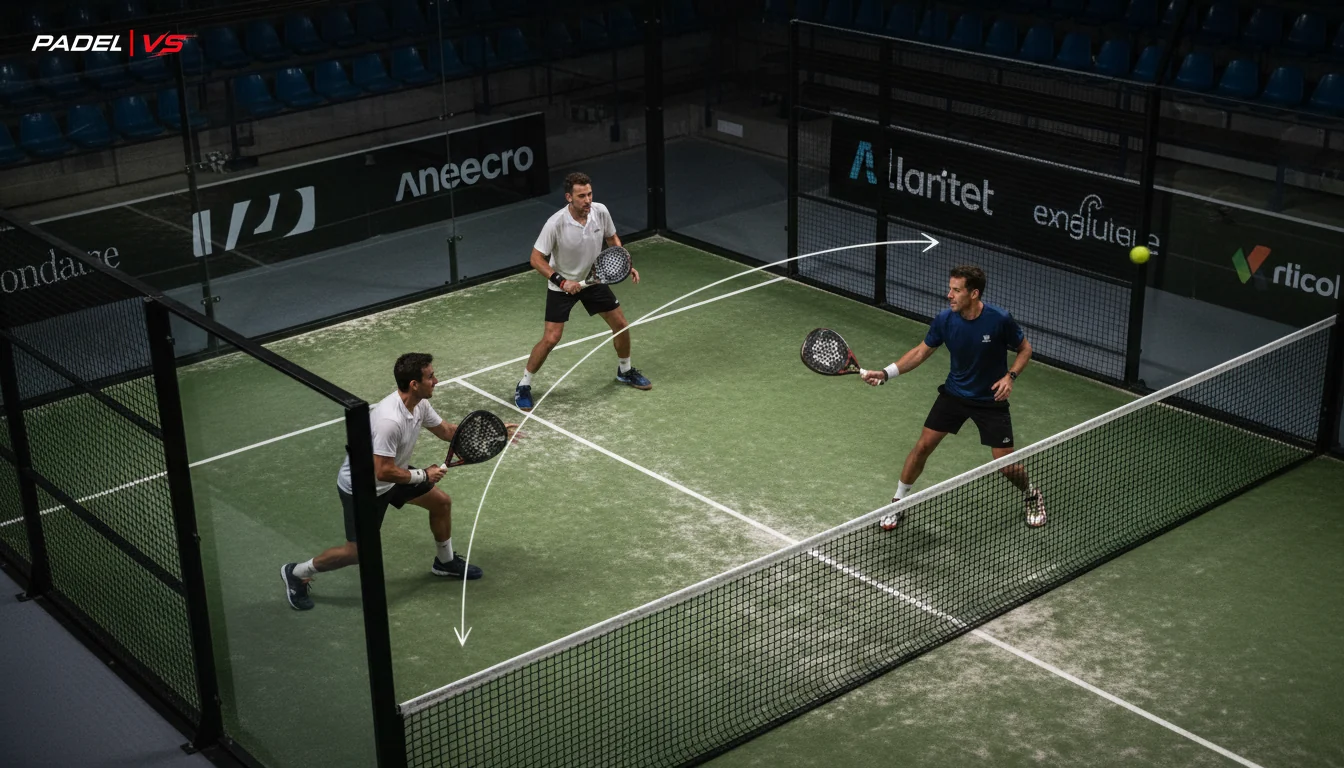
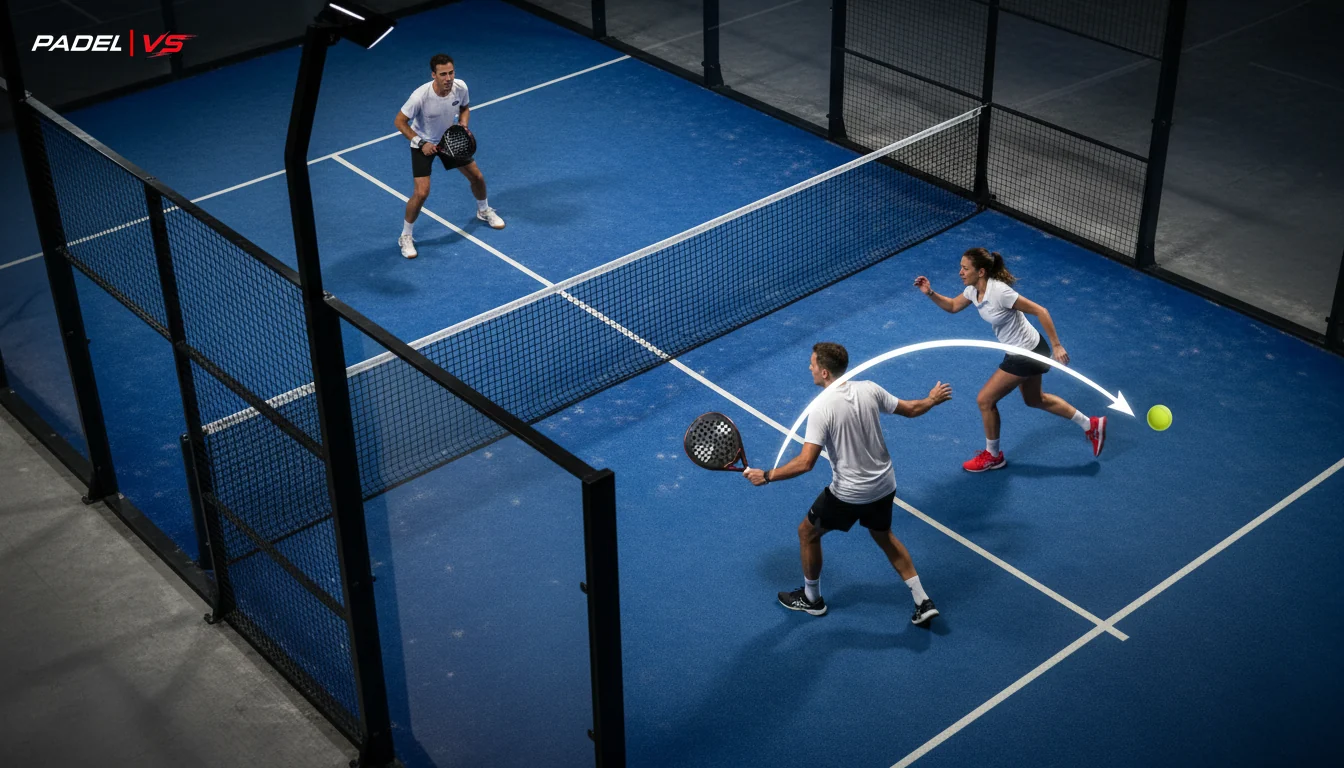
The difference isn't in the trajectory (both shots send the ball upward), it's in the intention, the timing, and what you do afterward. A defensive lob seeks survival. A pressure lob seeks to make the pair at the net — who thinks they're dominating the point — turn their back, run back, and hit a difficult ball while you move forward to claim your own net.
The pressure lob isn't played to escape your opponents' net. It's played to take their net away from them.
Anatomy of a pressure lob: what makes it different
Height and depth, not just height
A classic mistake is thinking a "higher" lob is automatically better. What actually separates a winning lob from one that turns into an easy smash for your opponent is depth: the ball should land within 1 to 1.5 meters of the back glass, which stands 3 meters tall on regulation 20x10 meter courts. If the lob falls short — 3 or 4 meters from the net — your opponent barely has to take a step back and smashes comfortably. If it lands tight against the glass, your opponent has to hit with their back to the court, judging the bounce, body weight completely off balance. That combination of extreme depth and sufficient height (at least 4-5 meters over the net, which stands 88 cm at the center) is what turns a lob into a weapon.
Timing: before they settle into the net
The ideal moment for a pressure lob isn't when your opponent is already planted firmly at the net, weight distributed, ready to volley. It's in that split second right after they've moved up from the back court and are still adjusting their footwork. In that window, their natural reaction is to anticipate a low or mid-height ball, not to turn 180 degrees and sprint back toward the glass. Reading that instant — right after they advance to the net following their own shot — is what separates a Segunda-level player from someone still at Tercera.
When to throw the pressure lob: 5 key situations
Not every moment works. These are the situations where a pressure lob has the highest probability of winning the point outright:
| Court situation | Why it works |
|---|---|
| Net player facing forward, just arrived at position | No time to reset footwork for an overhead shot |
| Opposing pair playing very tight to the net (less than 2 meters back) | A deep, well-placed lob forces them to cover a long distance in very little time |
| You receive a comfortable mid-high ball in your own court | You can generate the lob with forward weight transfer, not from a defensive crouch |
| The net player is visibly weaker on overhead shots (bandeja/víbora) | You exploit their weak point instead of attacking their strength (the volley) |
| Right after your own successful wall shot created hesitation | It breaks rhythm and changes the expectation of what's coming next |
What to do after the lob: the transition to the net
Here's the detail most intermediate players ignore: the pressure lob doesn't end when the ball leaves your paddle. It ends when you occupy the net you just freed up. The instant you hit the lob, you and your partner need to advance together toward the 4-5 meter line, anticipating that your opponent — forced to hit with their back turned or off balance — will likely send back a short, shallow ball, easy to put away.
This means the pressure lob is actually a team play. If one player advances and the other stays back "just in case," you lose the positional advantage the lob just created. A practical rule: if the lob lands within a meter of the opponent's back glass, both of you should be moving up to the net at nearly the same pace the ball travels through the air.
Common mistakes with the offensive lob
- Lob falls short due to miscalculated power: players try to hit it hard and lose control of the trajectory. The pressure lob needs more arc than velocity.
- Not following the shot to the net: staying static at the back after a deep lob gives away the advantage you just built.
- Using it as a one-time surprise: if you never lob, your opponent won't expect it the first time, but after two or three successful attempts it stops being a surprise and becomes a read pattern — you need to vary the rhythm.
- Always lobbing to the same side: Segunda and Primera level players quickly read a pattern if you always target the net player's backhand. Alternating between the right and left side of the court keeps them guessing.
- Ignoring wind and outdoor panoramic court conditions: on outdoor courts, a gust can turn a perfect lob into a ball that sails out. Adjust your height if you feel a headwind.
How the pressure lob changes by category
The tactical value of the lob isn't the same across all ELO categories. At PADEL VS we classify players into six levels (Quinta, Cuarta, Tercera, Segunda, Primera, and Open), and the way this shot gets used changes dramatically as you move up:
| Category | ELO Range | Typical lob usage |
|---|---|---|
| Quinta | <850 | Almost always defensive; inconsistent overhead smashes from opponents make it less necessary as a weapon |
| Cuarta | 850-1000 | Starts being used to neutralize, still with little offensive intent |
| Tercera | 1000-1180 | This is where the true pressure lob is born: enough depth control to punish opponents directly |
| Segunda | 1180-1350 | Regular weapon; combined with reading opponent positioning and rhythm changes |
| Primera | 1350-1550 | Millimeter-precise shot, also used to open gaps and set up follow-up smashes |
| Open | ≥1550 | Fully integrated into the game; executed from seemingly defensive positions to completely flip the point |
If you're in Tercera or Cuarta and feel like your lob "isn't working," the problem is probably not the shot itself, but the timing and lack of transition to the net afterward. This is the phase where deliberate practice pays off fastest.
A simple drill to train the pressure lob
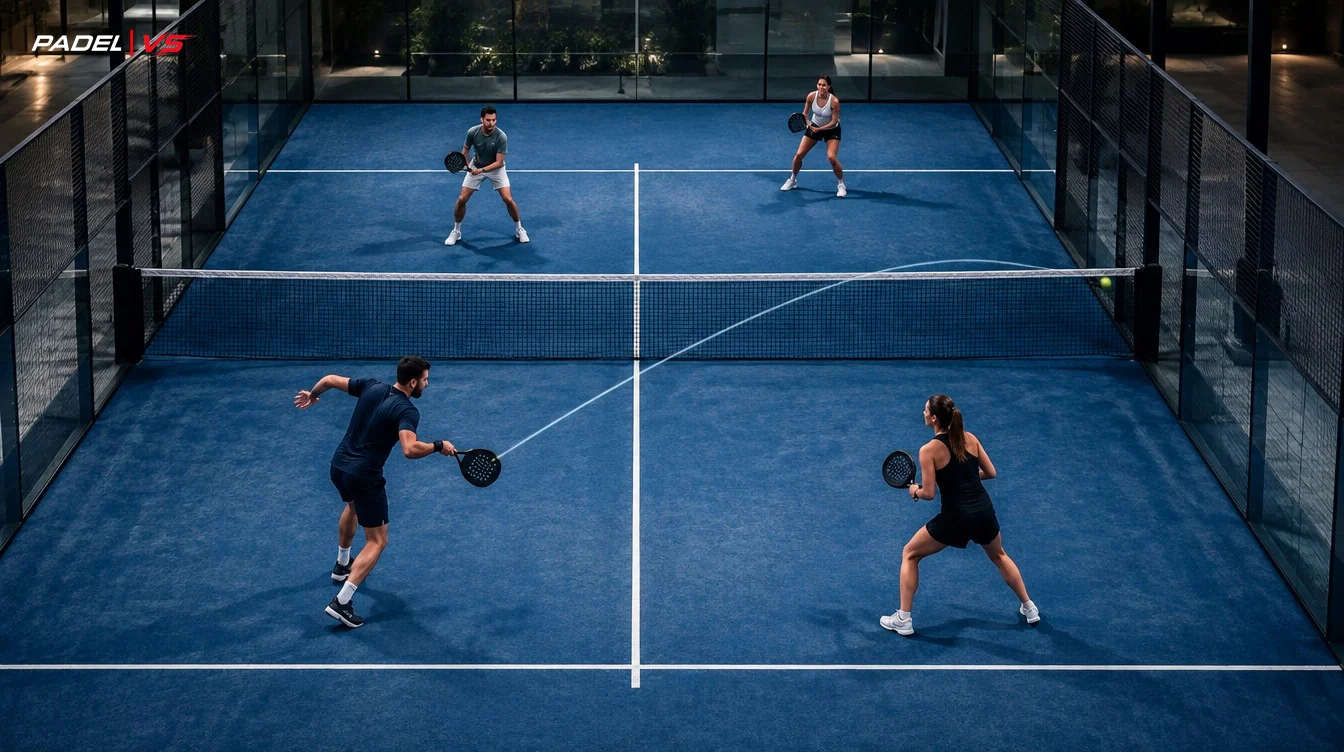
You don't need a full court or four players. With a training partner, do this: one stands at the net, the other at the back. The back player sends lobs trying to land them between the service line and the back glass, alternating sides. The net player, as soon as they see the lob pass overhead, turns and runs to retrieve it against the glass, simulating the real match scenario. Repeat 15 lobs per side, then switch positions. After a few weeks of this drill, you'll notice your depth becomes consistent and you start to "feel" the ideal moment in a real match without consciously thinking about it.
At PADEL VS, where we organize matches ranked by real ELO category, this kind of technical detail is exactly what separates someone moving from Tercera to Segunda from someone who stays stuck. Playing against opponents at your same level, over and over, gives you the repetitions needed for the pressure lob to stop being an occasional shot and become an automatic part of your game.
Conclusion
The pressure lob isn't glamorous. It doesn't have the spectacle of a winning bandeja or the visual impact of a smash from three meters. But in real padel — the kind played point by point at clubs across Mexico, not the kind you see in social media highlights — it's one of the shots with the best effort-to-reward ratio. Mastering it doesn't require more strength or a better paddle (350-375 grams remains the typical range for control-oriented shots like this one); it requires reading position, the patience to wait for the right moment, and the discipline to advance to the net after executing it. Next time your opponent rushes up to the net, don't think of the lob as an escape. Think of it as the shot that's about to hand you that net.