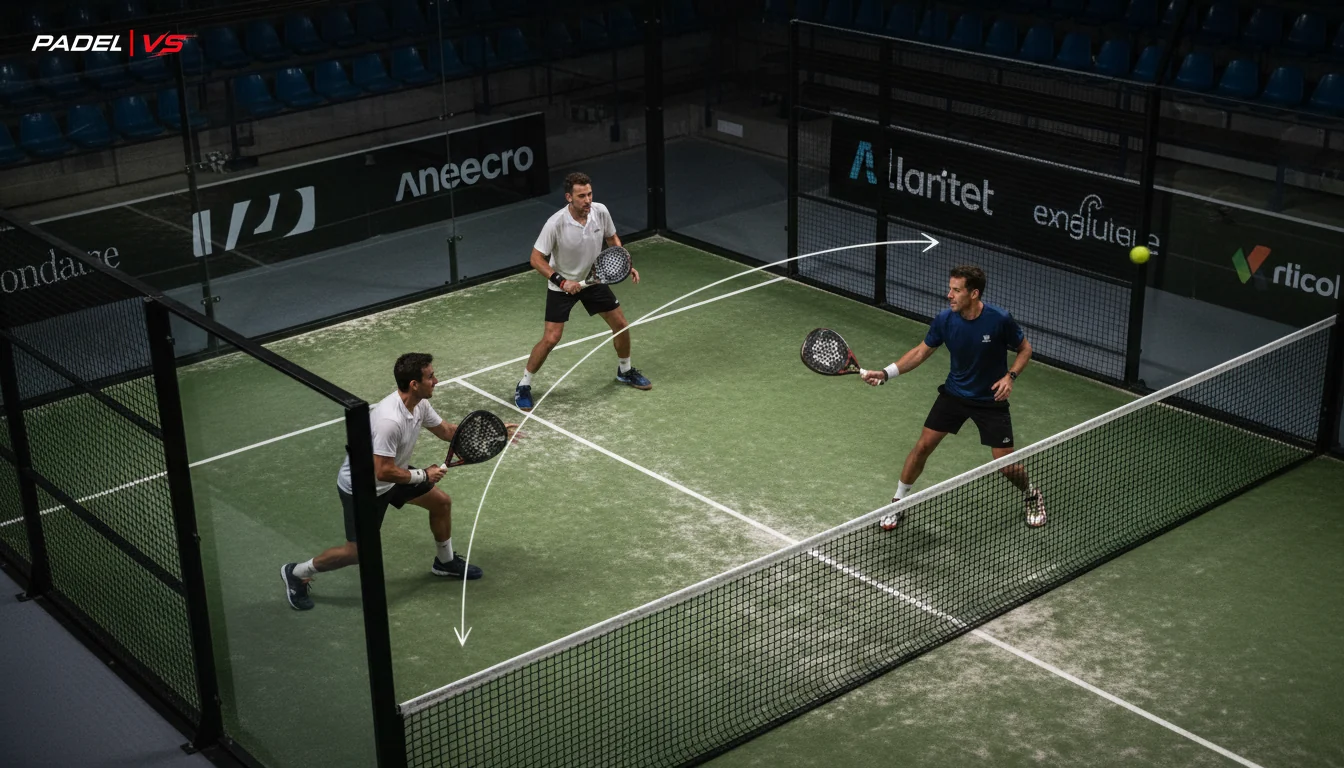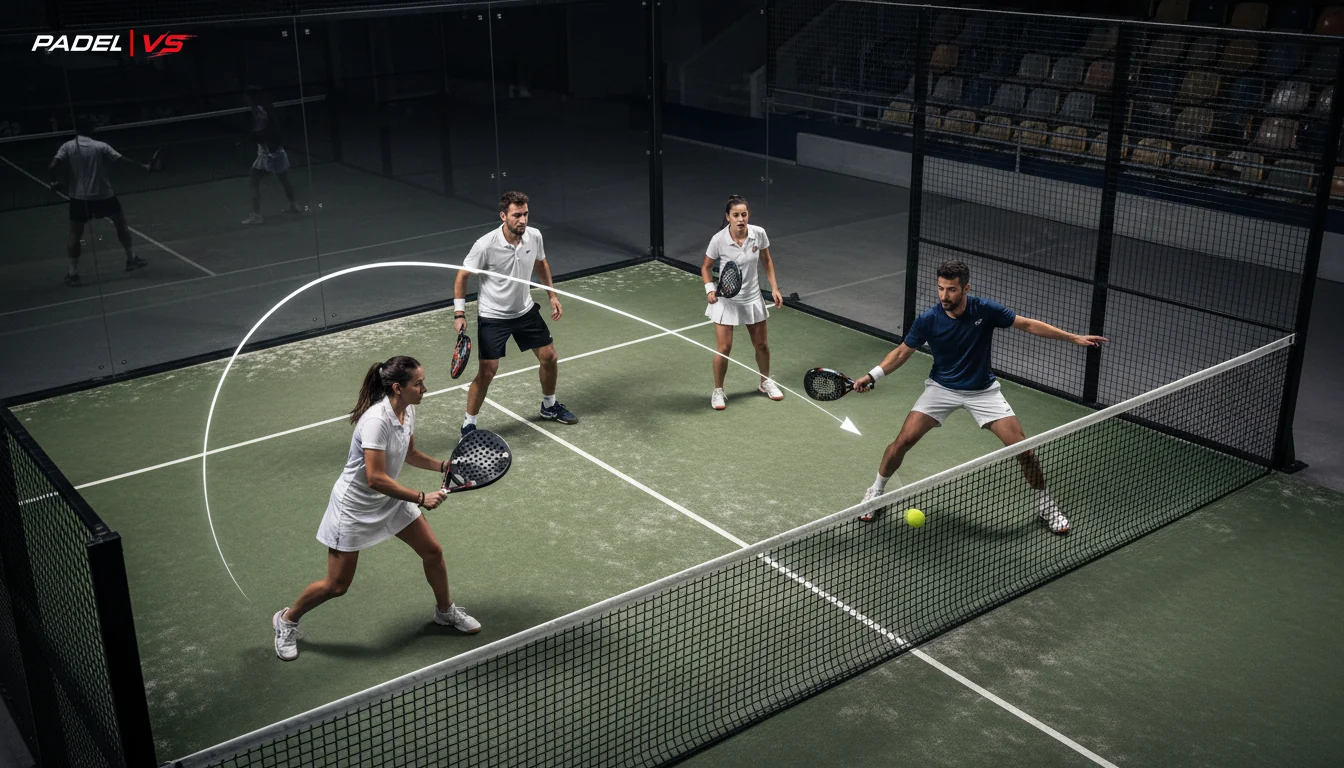

The back of the padel court has a bad reputation: a lot of players treat it as the place where you just survive, scramble the ball back, and hope for an opponent's mistake. But the back court is actually where most winning points get built, because that's where you have the glass, extra time, and angles the net can never give you. The goal isn't to stop lobbing — it's to stop treating the lob as your only tool.
The problem with living off the lob
The lob is a legitimate, even devastating, weapon when used with intention. The problem shows up when it becomes a reflex: every awkward ball gets solved the same way, with a flat, unthoughtful lob. That gives the opponents three things for free: time to reset their position, control of the point's rhythm, and a setup to smash down a víbora or aggressive bandeja that you'll now have to defend from the back court all over again.
In the Quinta (<850 ELO) and Cuarta (850-1000 ELO) categories, this is almost automatic — players who haven't built precision shots default to the lob out of safety, not strategy. The real jump into Tercera (1000-1180 ELO) happens exactly when a player learns when to lob and when to build the point off the wall instead. By Segunda (1180-1350 ELO), the lob becomes a decision, not a crutch.
The lob isn't a hiding place — it's a question you're asking your opponent: what are you going to do with this? If you ask the same question every time, your opponent already knows the answer before the ball arrives.
The glass is your ally, not your enemy
On a regulation court, the back glass wall stands between 3 and 4 meters tall (glass plus mesh on top), and the side walls run 2 to 3 meters. That structure exists to give you a second chance on nearly every ball — but only if you actually understand the rebound.
Wall exits: the three fundamentals
- Let the ball drop. The most common mistake is hitting the ball the instant it comes off the glass, while it's still rising. Wait until it drops to hip height or lower before you commit to a direction — that's where real control lives.
- Position yourself behind and to the side of the trajectory, never pressed up against the glass. You need room for your swing and time to read the rebound angle before deciding on the shot.
- Hit with intention — cross-court or chiquita, not just a safe return. A well-executed wall exit can be just as offensive as a lob, because it surprises opponents with low height and heavy slice.
The chiquita: the weapon almost nobody trains
The chiquita — a short, low, heavily sliced shot, usually hit right after a wall bounce — is probably the most underused shot in amateur padel. It forces the opposing pair to bend low at the net, breaks their volley rhythm, and when executed well, lands so close to the net that returning it with any pace becomes nearly impossible.
The gap between a Cuarta player and a Primera (1350-1550 ELO) player almost always shows up right here: the higher-level player mixes lobs, chiquitas, and down-the-line shots from the back court in a way that keeps opponents from ever anticipating the pattern.
Reading the net: the decision before the shot
Before hitting any ball from the back of the court, you need to look — literally, with your eyes, not just instinct — at what the opposing pair is doing at the net. That read tells you which shot actually makes sense:
| Situation at the net | Height of your ball | Recommended shot | Why it works |
|---|---|---|---|
| Both opponents crowding the net | Any, with enough time | Deep lob to the forehand side | Forces them to turn and run backward — the worst movement for a net player |
| One player poaches into the middle | Medium or low | Down-the-line shot through the gap | The lane they just vacated is wide open with no coverage |
| Both players stuck in no-man's-land | Low, right after a wall bounce | Cross-court chiquita | Gives them no time to decide whether to advance or retreat |
| Net player with a weak backhand volley | Medium | Flat shot to the backhand | Exploits the direct technical weakness — no need for spin |
| Both players retreated after a previous lob | High, with a strong bounce | Transition bandeja or víbora | Lets you move forward to the net yourself while they're still falling back |
Bandeja and víbora as a bridge, not an ending
A lot of players treat the bandeja as a finishing shot, when in reality it's primarily a transition tool. Its main job isn't to win the point right then — it's to win court position: it lets you move from the back court toward the net without exposing yourself to an easy passing shot, because it keeps a deep, controlled ball on the opponents while you advance.
The víbora serves a similar function but with more pace and lateral spin, ideal when you want the ball to skid away from the opponent after the bounce rather than sit up. Neither shot replaces the classic defensive lob — they complement it, giving you a third option whenever a ball comes to you from the back court with some height on it.
When NOT to use a transition bandeja
- When the ball arrives very low (below waist height) — attempting a bandeja there almost always ends in a net error.
- When your partner isn't ready to move up with you — you'll end up advancing alone and exposed down the middle corridor.
- When the opposing net player has a genuinely strong attacking volley — in that case, a well-placed lob is still safer than risking the transition.
Positioning and footwork: the foundation nobody sees
None of these shots work if you arrive late or badly balanced. Three habits make the real difference:
- Split step before every opponent's shot. That small adjustment hop lets you react in any direction instead of standing flat-footed waiting to see where the ball goes.
- Never turn your back completely to the wall unless you're sprinting straight in to retrieve a bounce. Keep your body angled so you can see both the glass and the net at the same time.
- Recover to the center after every shot — not back to the exact spot where you hit it. The center of your side of the court gives you real coverage for whatever comes next: a passing shot, a lob, or a quick ball to the body.
Winning from the back court isn't about defending better than your opponent — it's about attacking with more patience than they have.
A simple drill to train variation
Within the PADEL VS community, we consistently see that the jump between categories — Cuarta to Tercera, Tercera to Segunda — happens when a player stops relying on a single shot from the back of the court. Here's an effective drill to break that habit:
- With a partner or coach feeding balls from mid-court, respond to each ball with a different shot in a fixed rotation: lob, chiquita, down-the-line, transition bandeja, lob again.
- Run 4 sets of 10 balls, forcing the pattern even if it feels awkward or the shot isn't perfect at first.
- After two or three weeks, drop the fixed rotation and start choosing the shot based on the opposing pair's actual position, using the decision table above as a mental reference.
This kind of deliberate practice is exactly what separates a player who "survives" at the back of the court from one who builds points from there. It's also one of the factors that most impacts your ELO over time on PADEL VS — not just winning matches, but winning them with a more complete, less predictable game.
The final balance
Nobody's telling you to stop lobbing — a deep, well-placed lob with the right spin is still one of the most effective shots in padel across every category, including Open (≥1550 ELO). The difference between a mediocre back-court player and a dangerous one is variety: reading the opposing net position, using the glass with intention, dropping a chiquita when nobody expects it, and moving forward with a bandeja or víbora when the point allows it.
Next time you're stuck at the back of the court, before you automatically send the ball up high, ask yourself one quick question: what is the opposing pair actually doing at the net right now? The answer will almost always tell you which shot makes the most sense — and it's rarely going to be "just another lob."