Most points in padel aren't lost because of bad technique. They're lost because someone invaded a space that wasn't theirs, or left one empty that was. That space management is what court veterans call "playing the alley": knowing exactly which strip of the 10-meter-wide court is yours to defend, and recognizing the moment that rule needs to be broken.
What is "the alley" and why does it decide points?
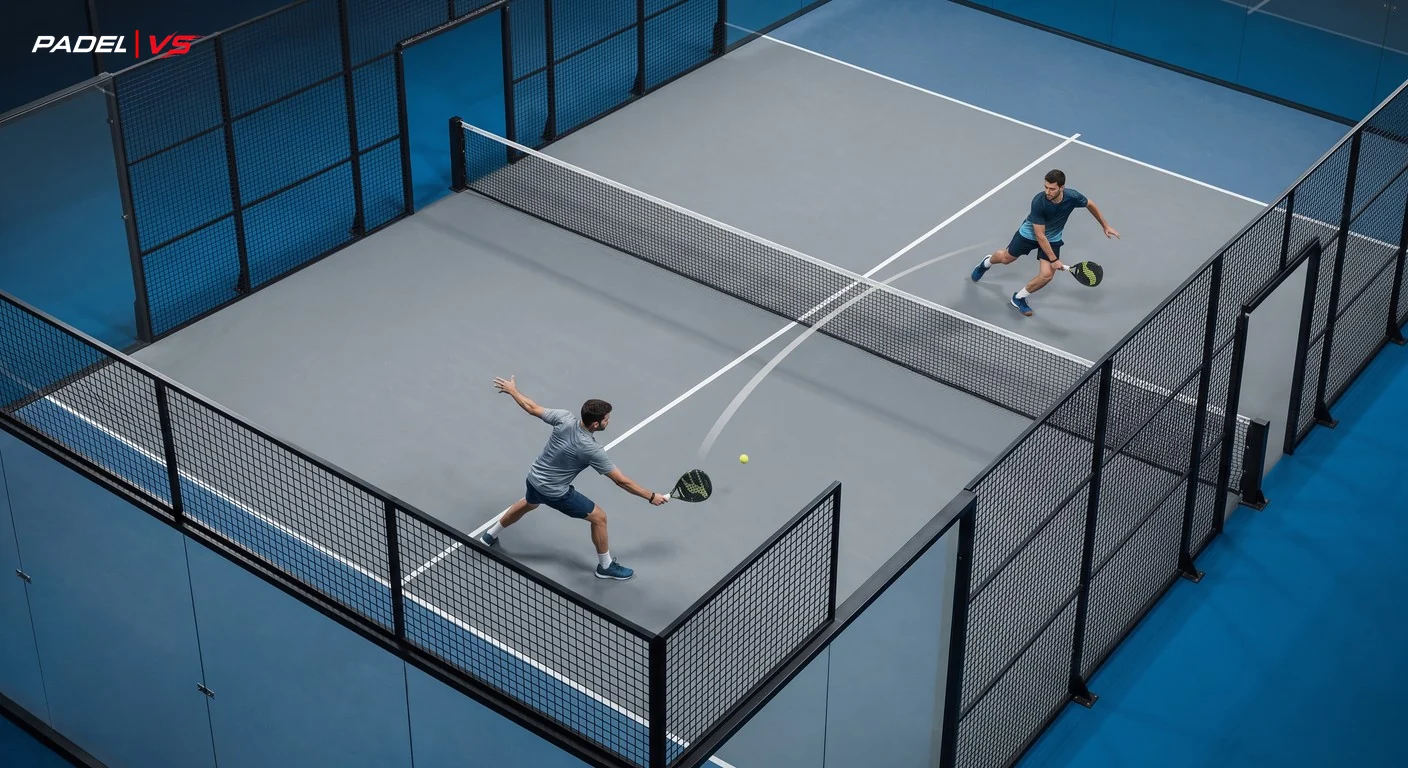
A padel court measures 20 meters long by 10 meters wide, split by the net into two 10x10 halves. Each half is then divided between the two players into two lanes of roughly 5 meters each, running from the net to the back glass wall. That lane is your "alley": the zone that, in theory, nobody else should have to cover for you.
The problem is that padel is never played in straight lines. Lobs, cross-court bandejas, angled smashes, and glass rebounds constantly push players out of their alley. That's where the most repeated decision of every single point comes from: do I cross into my partner's side, or do I hold my ground?
The divided court: your side, the middle, and your partner's side
Before talking about when to cross, you need to understand that there aren't really two alleys — there are three functional zones:
- Your alley: the roughly 5 meters where you're standing, from your service line to the back wall.
- Your partner's alley: the mirror image, on the other side.
- The middle ("the center lane"): the 1 to 1.5-meter strip where both alleys meet, and where the majority of contested balls, smashes, and decisive bandejas happen.
The tactical key isn't defending your alley like a swim lane. It's understanding that the middle belongs to both players, and whoever covers it should be decided by who's better positioned in that specific moment — not by whose "turn" it technically was.
The rule of crossing: when you SHOULD invade your partner's side
Crossing means moving toward your partner's side to cover space they left open. It's not an improvised move — it responds to concrete signals you can train until they become automatic.
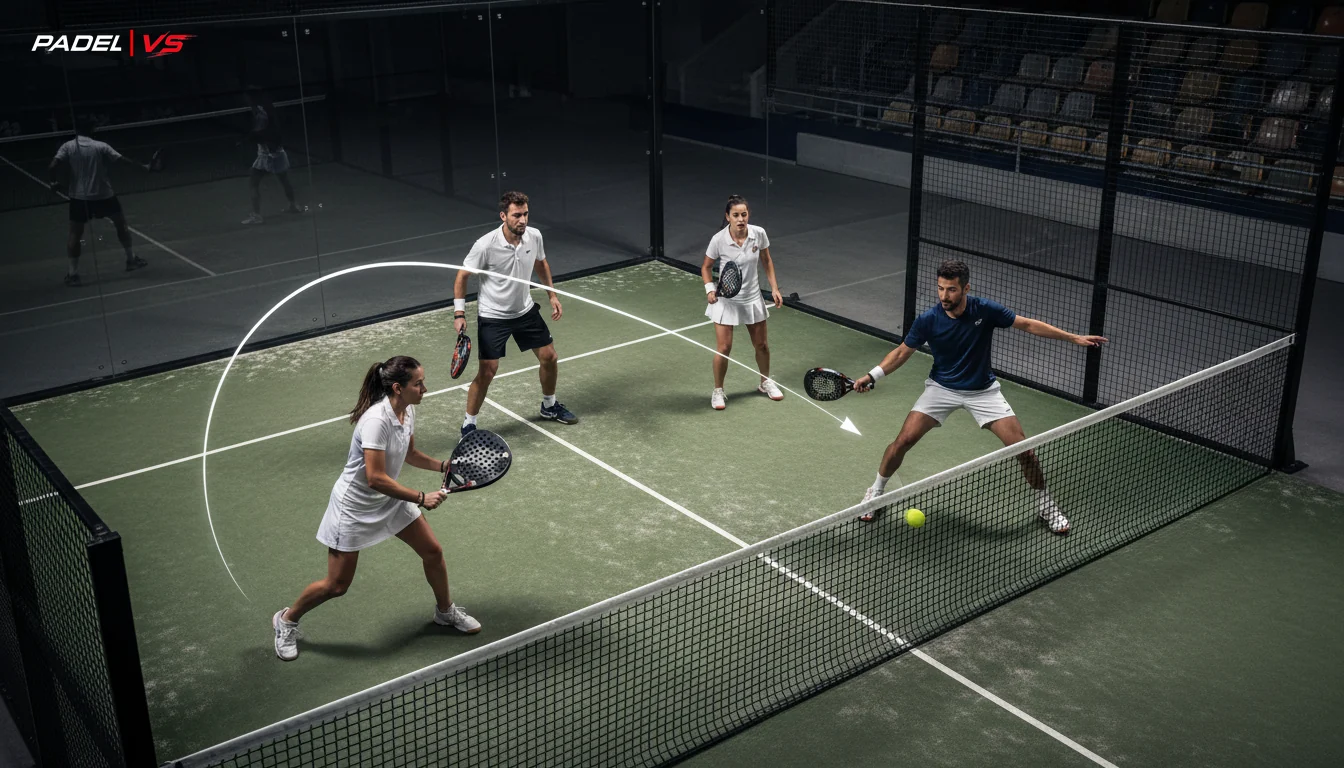
- Your partner was stretched wide by a lob. If the opponent hits a deep lob to your partner's corner and they have to retreat against the glass, the space they leave open (especially at the net) needs covering. That's when you shift toward the center, even though it's technically not "your side."
- A hard diagonal smash or bandeja is executed. When your partner is at the net and the opponent hits a víbora cross-court into their corner, it's normal for them to be momentarily out of position. You close the alley they abandoned while they recover.
- The ball travels through the center and your partner has an awkward angle. Balls landing right in the center lane should be handled by whoever has the better angle and fewer steps to take — not by whoever "owns" the point by unwritten rule.
- Your partner ends up turned toward the back wall after an opponent's smash. If the opponent smashed and your partner had to spin around to chase the ball off the wall, you temporarily own both sides of the net until they recover.
"The alley isn't property, it's a responsibility that gets transferred point by point. The pair that understands this stops playing two singles matches and starts playing real padel."
Signals that tell you it's time to cross
- Your partner shouts or gestures clearly "I can't get there" or "yours."
- You see their body turned sideways or facing away from the net.
- The ball is heading toward the center lane and you're closer to the bounce point.
- Your partner just hit a defensive lob and hasn't recovered net position yet.
When to hold your side: the most common mistake in amateur padel
The mistake we see constantly in Quinta and Cuarta categories isn't crossing too little — it's crossing too much. Many players, out of competitive instinct or distrust in their partner, invade the opposite alley unnecessarily, leaving their own side completely empty.
- Don't cross when your partner simply returned a comfortable ball and is still well-positioned at the net. The point is still shared, each player in their own lane.
- Don't cross preemptively before the opponent has even hit the ball. Crossing too early — the classic "pre-cross" — leaves your alley wide open for a direct attack down that line, something Segunda and Primera pairs exploit mercilessly.
- Don't cross just because you want to "finish" the point yourself while your partner is well positioned. This causes the classic racket collision, or worse, both players letting the ball pass because each assumed the other had it covered.
The problem of "the middle ball"
No decision generates more on-court arguments than the ball that lands right in the center, between the two players. The rule most used in competitive padel is simple: a center ball at net height or above belongs to whichever player can hit it with a forehand (with tactical exceptions to avoid exposing a weaker backhand). If it's a low ball or a lob, whoever has the better angle toward the back wall decides — not whoever is closer in a straight line.
Formations and the alley: parallel attack vs. cross attack
How the opponents attack completely changes when crossing makes sense. This table summarizes the most common scenarios we work through in PADEL VS tactical clinics:
| Situation | Cross or hold? | Why |
|---|---|---|
| Deep lob to your partner's corner | Cross toward center | Your partner retreats and leaves the net open; the center becomes vulnerable to the drop shot |
| Opponent attacks down the line on your side (paralela) | Hold | It's your direct alley; crossing here gives away the point on the opposite side |
| Hard cross-court bandeja toward your partner | Cross temporarily | You cover while your partner recovers from the shot |
| Slow, high ball through the center | Whoever has the better angle decides (verbal call) | There's no fixed lane in the center; whoever's better positioned wins it |
| Direct smash to your partner's back corner | Cross to cover the full net | Your partner turns away from the net; you hold both sides momentarily |
How this changes depending on your ELO level
Reading the alley gets faster and subtler as skill level rises. In Quinta (under 850 ELO), crosses tend to be reactive and late — the player crosses after the ball has already passed. In Cuarta (850-1000), anticipation starts to appear, though timing between partners is still inconsistent. From Tercera (1000-1180) onward, crossing becomes a conscious tactical decision, and by Segunda (1180-1350) and Primera (1350-1550) it becomes almost automatic, driven by non-verbal cues. In Open (1550+), crosses happen so fast that opponents often don't even notice a coverage handoff occurred.
If you're on PADEL VS and unsure which category you actually belong in, this is also a good self-diagnostic: if you constantly collide with your partner or leave obvious gaps in the middle, your court-reading is probably a step below your shot level. Working on alley coverage tends to raise your ELO faster than perfecting your bandeja does.
Communication on court: the word that prevents the collision
Most badly-executed crosses aren't a technical problem — they're a communication problem. One word said at the right time prevents 90% of racket collisions:
- "Mine" — you confirm you're taking the ball, your partner stays put and covers the open alley.
- "Switch" — you signal that you're crossing and your partner needs to temporarily cover your side.
- "Stay" — you tell your partner not to cross, that you've got it comfortably.
- "Center" — you flag that the ball is heading to the middle lane and both players need to adjust, not just one.
"A pair that talks on court reduces unforced errors more than a pair that only trains shots in isolation."
Drills to train alley coverage
- Lob and cross (15 minutes): a coach or your partner feeds alternating deep lobs to each back corner; the player not hitting must cross to cover the partner's net before the ball bounces twice.
- The middle ball (10 minutes): both players stand in the center of their half; balls are fed exactly down the center lane to practice who decides, with mandatory verbal calls on every point.
- Four corners with switch (20 minutes): full points where both players are forbidden from being in the same alley at the same time; if that happens, the point is replayed. This forces internalizing space division.
- Smash and recovery: one player smashes hard toward the partner's back corner while the other must close the entire net for 2-3 seconds before returning to their own side.
What this means for your progress on PADEL VS
On PADEL VS we classify players by ELO categories — from Quinta to Open — precisely because doubles tactics, including alley reading, is one of the factors that most separates one level from the next. It's no coincidence that pairs who move up from Tercera to Segunda almost always do it by fixing their communication and court-coverage problems first, before improving their strongest shot.
If you want to measure your real progress, the best way is playing scored matches against pairs at your level — that's where crossing patterns actually get tested, not in a friendly rally. You can explore tournaments and open leagues at padelvs.com, or message our WhatsApp bot directly to find opponents at your category in your city.
Mastering the alley isn't about memorizing a rigid rule — it's about developing a constant read of where your partner is, where the opponent is, and which space is genuinely vulnerable in every fraction of a second. Start by communicating more on court, train the crossing drills with intention, and you'll notice the points that used to slip away through the middle start closing in your favor.