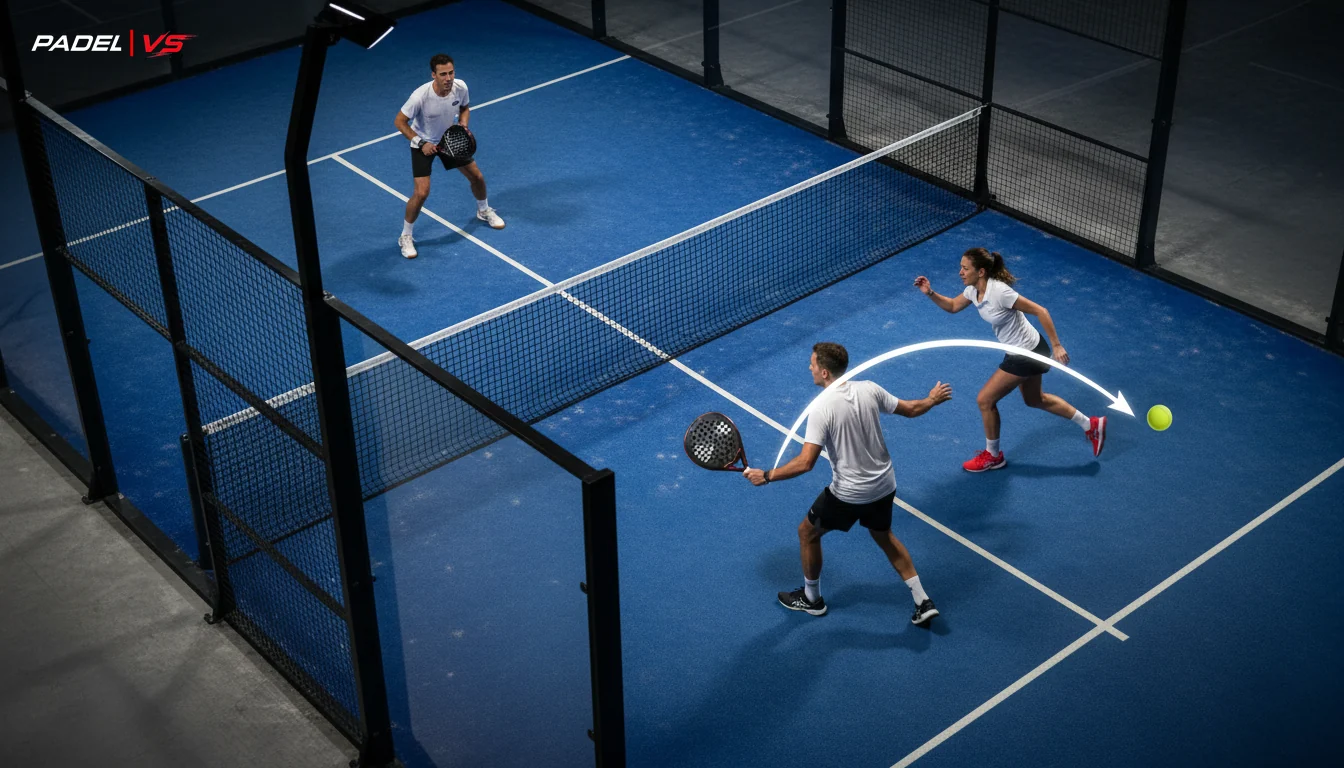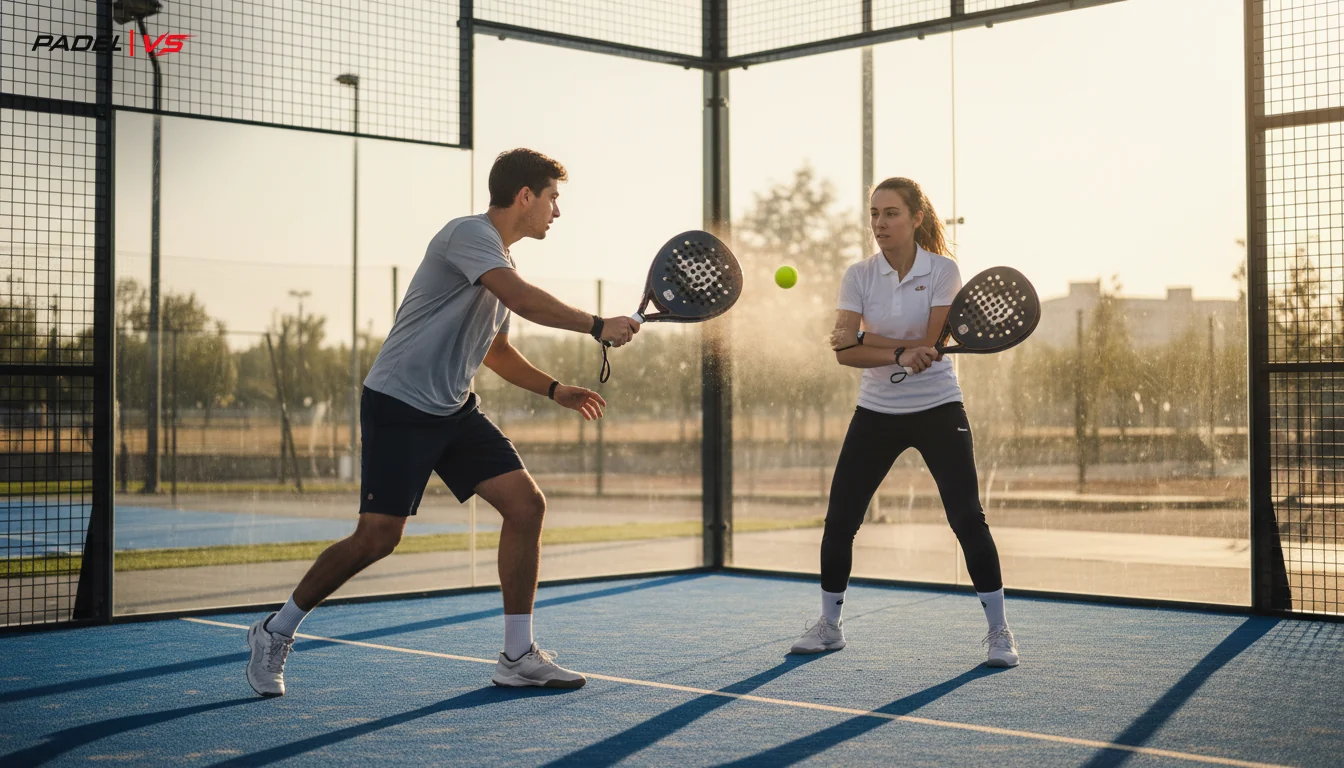

The back wall is where most intermediate padel points are decided — not because the shot itself is technically brutal, but because players consistently arrive late, stand in the wrong spot, and have no plan for what comes after the rebound. This guide breaks down the full system: reading the glass, positioning your body, executing the right shot, and getting back to where you need to be on court.
Why the back wall causes so many problems (and why it doesn't have to)
On a standard padel court measuring 20 × 10 meters, the distance from the service line to the back glass is just 6.95 meters. That narrow strip of space is where defensive padel is actually played, and it's unforgiving. When a ball gets behind your default position in the three-quarter court zone, you have very little time and even less room to make a decision before the glass comes into play.
Here's the key insight most recreational players miss: the back glass is not your enemy. Unlike the side walls — which produce oblique angles and truly unpredictable rebounds — the rear glass returns the ball with a fairly consistent angle. The real problem isn't the glass. It's what happens to a player's body and brain when the ball passes behind them. There's a postural panic response: players over-rotate, lose their reference to the net, and end up facing their own back wall instead of the problem in front of them.
"Turn your back on the net and you give away the point before you even swing. Defend the wall facing forward, not running away from it."
The three types of back wall rebounds you need to know
Before we talk technique, you need a mental library of what you're actually dealing with. The same back glass produces very different rebounds depending on the speed, spin, and angle at which the ball first hits the court floor.
1. The flat, direct rebound
The ball bounces near the baseline and hits the glass at medium height — roughly between 80 cm and 1.2 meters. The rebound travels almost parallel to the ground, with moderate pace and predictable trajectory. This is the most beginner-friendly of the three. What to do: Position yourself about 60–80 cm away from the glass before impact, let the ball rebound and rise, and make contact when it's between hip and shoulder height. You have time. Use it.
2. The high rebound (lob or heavy topspin)
The ball arrives with height and contacts the glass above 1.5 meters. The rebound drops nearly straight down, very close to the wall. This is the one that traps intermediate players most often — the ball can almost seem to stick to the glass. What to do: Back up until you're very close to the glass (without actually touching it), let the ball drop lower than you're comfortable with — knee height works — and make contact with your body turned sideways rather than square to the wall.
3. The skidding, low rebound (slice or backspin)
The ball arrives low, bounces close to the wall, and comes off fast and flat with minimal height. This is the most deceptive because it punishes hesitation. What to do: Resist the urge to back all the way up. Stay 1 to 1.2 meters from the glass so you have room to swing, bend your knees deeply, and contact the ball before it loses all its momentum.
| Rebound Type | Glass Contact Height | Ideal Player Distance from Glass | Recommended Contact Zone |
|---|---|---|---|
| Flat / Direct | 80 cm – 1.2 m | 60 – 80 cm from glass | Hip to shoulder |
| High / Lob | > 1.5 m | 10 – 20 cm from glass | Knee to hip |
| Skidding / Slice | < 60 cm | 1 – 1.2 m from glass | Knee or below |
The most common mistake: confusing "creating time" with "backing up"
When intermediate players see the ball heading toward the back glass, the instinct is to run backward. That part is correct. The mistake is continuing to retreat after the ball has already hit the glass. At that point, the direction you need is the opposite: stop, read, and move toward where the ball is going to land.
Think of it like a goalkeeper. They don't dive before they read the shot. You shouldn't commit to a final position before you've seen the rebound angle off the glass. The correct sequence looks like this:
- Sprint toward the back wall: Get there before the ball if possible, or arrive simultaneously.
- Dynamic stop: As the ball makes contact with the glass, brake with your feet shoulder-width apart and knees bent.
- Read the rebound: You have a fraction of a second to identify the height and direction of the outgoing ball.
- Move laterally or forward: Go to the ball. Never wait for the ball to come to you.
- Hit with intention: This is not a survival shot. It's the first step in your tactical recovery.
Shot selection at the back wall: lob, bandeja, or counterattack
Once you've read the rebound and positioned your feet, you have three realistic exit options. Which one you choose depends on how much pressure you're under.
Option A: The defensive lob (safest and most underused)
When the ball is low, you're under time pressure, or your opponents are at the net in a solid position, the deep lob is your best option. But throw it with intention, not desperation: aim to land the ball 3–4 meters from their back wall, with enough height to clear the net by at least 2 meters. A well-executed lob buys you 2–3 full seconds to recover your court position. It's not giving up — it's buying intelligence.
Option B: The bandeja from the back
When the ball bounces well off the glass and rises to shoulder or head height, you can execute a controlled overhead slice — what padel players call a bandeja — from the back of the court. The goal here is not to win the point outright. Drive the ball with controlled pace toward one of your opponents' back corners to force movement. This back-court bandeja needs more slice and less pace than the attacking version you'd play at the net.
Option C: The counterattack (only for slow, floating balls)
If your opponent sent a short lob that bounced softly off the back glass, you may have a legitimate counterattack opportunity. With the ball at shoulder height or above and minimal pace, a víbora or a driven cross-court ball with pace and direction is on. This is a shot for players in the Tercera range and above (1,000–1,180 ELO in PADEL VS) because it demands coordination, timing, and genuine technical confidence. When in doubt, go back to the lob.
Recovering court position: the step nobody practices
Here's the real separator between players who plateau at Cuarta (850–1,000 ELO) and those who climb to Tercera and beyond: what you do after your shot from the back wall.
The classic mistake is standing still and watching your ball while your opponent is already loading their response. The moment your racket makes contact with the ball, your recovery sprint needs to start. Your target is the mid-court zone — roughly 1.5 to 2 meters behind the service line — and you shouldn't wait to see where your shot landed before you begin moving.
Here's the positional logic for each shot type:
- After a lob: Recover to the service line or slightly behind it. The lob bought you time — use it to reach a solid defensive base before the next ball comes.
- After a bandeja from the back: Move to mid-court and communicate with your partner about who covers which side. Don't leave the center of the court unguarded.
- After a counterattack: If the shot was clean and your opponents are scrambling, move forward with your partner toward the net. If you have any doubt about the quality of the shot, stop at mid-court and wait for the response before committing to the net.
"Back wall defense doesn't end when you hit the ball. It ends when you've reclaimed your position on court."
Three drills that actually fix back wall problems
Technique without repetition doesn't stick. These three drills are specifically designed to address the most common failure points in intermediate back wall play:
Drill 1: Hand-feed wall positioning (solo, 10–15 minutes)
Stand 2 meters from the back glass and hand-feed the ball against it at different heights — low, medium, and high. Before picking up your racket, practice moving your feet to the correct position for each rebound type. The goal is to train your feet and your reading, not your swing. Do sets of 20 repetitions for each rebound category. This drill is boring. It also works.
Drill 2: Net-to-back lob exchanges (pairs)
One player stands at the net and feeds controlled overhead balls toward the back court — not full smashes, but balls designed to force the back-court defender into the glass. The defender practices arriving, reading the rebound, and executing clean defensive lobs. Keep score: how many consecutive lobs clear the net with at least 2 meters of height without being intercepted? Target: sets of 10.
Drill 3: Asymmetric points (game situation)
Play full points where the defending team starts with both players touching the back wall with their rackets, and the attacking team starts at the net. The defense can only win the point by successfully recovering the net. This drill is demanding but it's the most realistic simulation of what back wall pressure feels like in a real match. No drill will prepare you better for the mental side of it.
Common errors by ELO range
| ELO Range (PADEL VS) | Most Frequent Back Wall Error | Priority Fix |
|---|---|---|
| Quinta (<850) | Getting caught off guard — the glass surprises them | Anticipation: read the lob before it bounces, not after |
| Cuarta (850–1,000) | Arriving but ending up facing the back wall | Body mechanics: always sideways to the wall, never fully turned away from net |
| Tercera (1,000–1,180) | Good shot but no recovery movement | Trigger the sprint the instant the racket hits the ball |
| Segunda (1,180–1,350) | Trying to counterattack under heavy pressure | Shot selection discipline: match the shot to the pressure level |
Partner communication during back wall defense
Padel is a doubles sport and the back wall is no exception to that principle. When one player goes to the glass, their partner has a critical job: cover the center of the court and communicate verbally what they see.
The verbal signals that work on court are simple and consistent. "Mine" means the player at the back can take the ball before it reaches the glass. "Yours" means the ball is clearly going to the back wall and the partner needs to let it go. "Going" is what the back-wall player calls out as they're sprinting back, so their partner knows to shift position accordingly. This court language sounds basic written down, but it's one of the biggest differentiators between teams that stay at Cuarta and teams that compete effectively at Tercera and Segunda in PADEL VS.
A quick note on racket choice for back wall play
Your equipment matters more than most players admit when it comes to playing in tight spaces. Rackets with a low to neutral balance point — weight distributed toward the handle rather than the top of the frame — are significantly more maneuverable when you're cramped against the back glass and need to change the angle of your shot quickly. Round-shaped frames also tend to give you a more forgiving sweet spot in those awkward positions where you can't achieve a full, controlled swing.
If you're in the Cuarta to Tercera range, avoid heavy rackets over 370 grams with very high balance points — those are designed for attacking at the net, not defending from the glass. A racket in the 340–360 gram range with round or teardrop shape and neutral balance is your sweet spot for back court defense. Entry-to-mid range options like this are widely available in Mexico for $80–165 USD ($1,500–3,000 MXN aprox), and upgrading your frame knowledge is often a faster win than taking another coaching lesson.
How to track your progress at the back wall
Progress in this part of the game is measurable — and measuring it matters. At PADEL VS, we track ELO movement through competitive matches, which gives you a real, data-based picture of whether your back wall defense is actually improving in live play, not just in drills. If you keep losing points from the back court, your ELO will tell you before your ego does.
We're building a growing competitive community starting in Cancún and expanding to other cities. If you want to start competing with real ELO tracking, open padelvs.com in your browser, or find us in Telegram by messaging @padelvsbot. You can also reach our AI assistant through the WhatsApp bot to ask questions about categories, registration, and how the ranking system works. The back glass will stop being scary the first time you play it correctly under real match pressure — and that's exactly the kind of pressure we're here to provide.