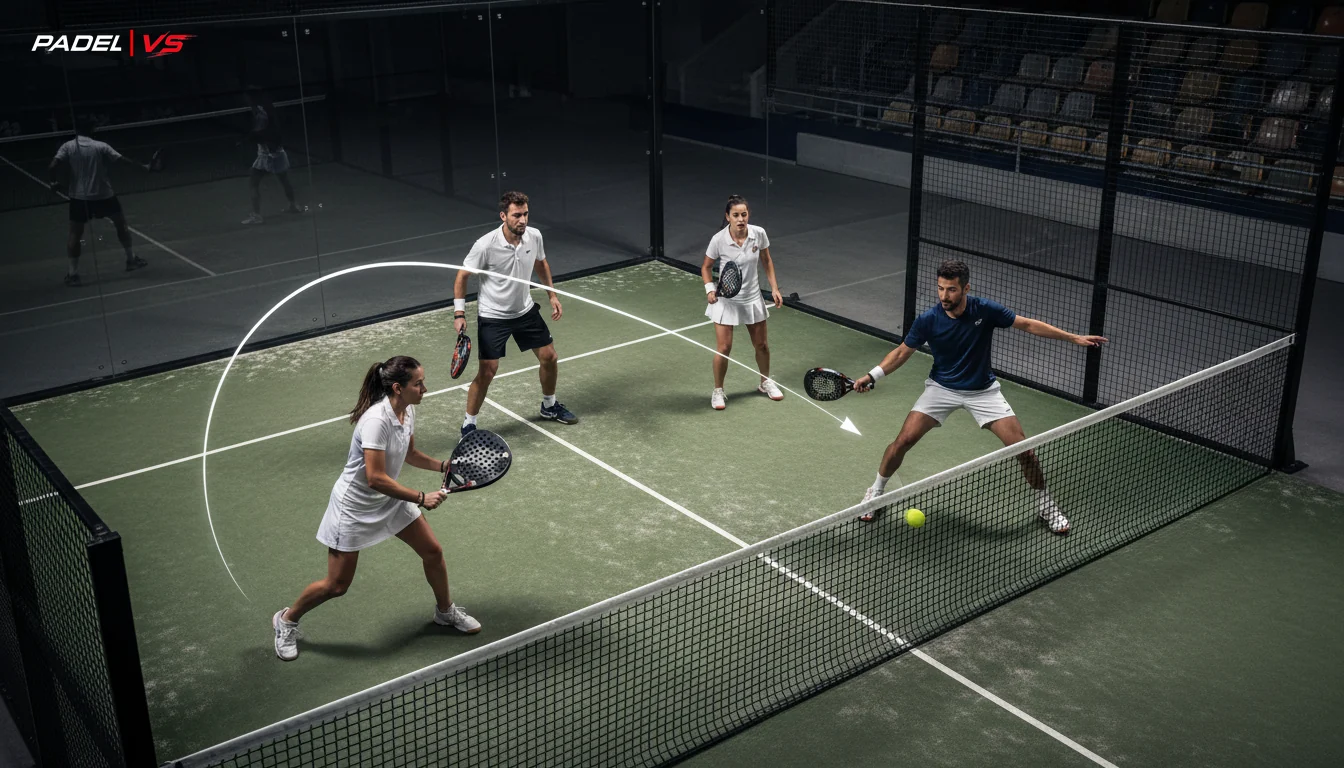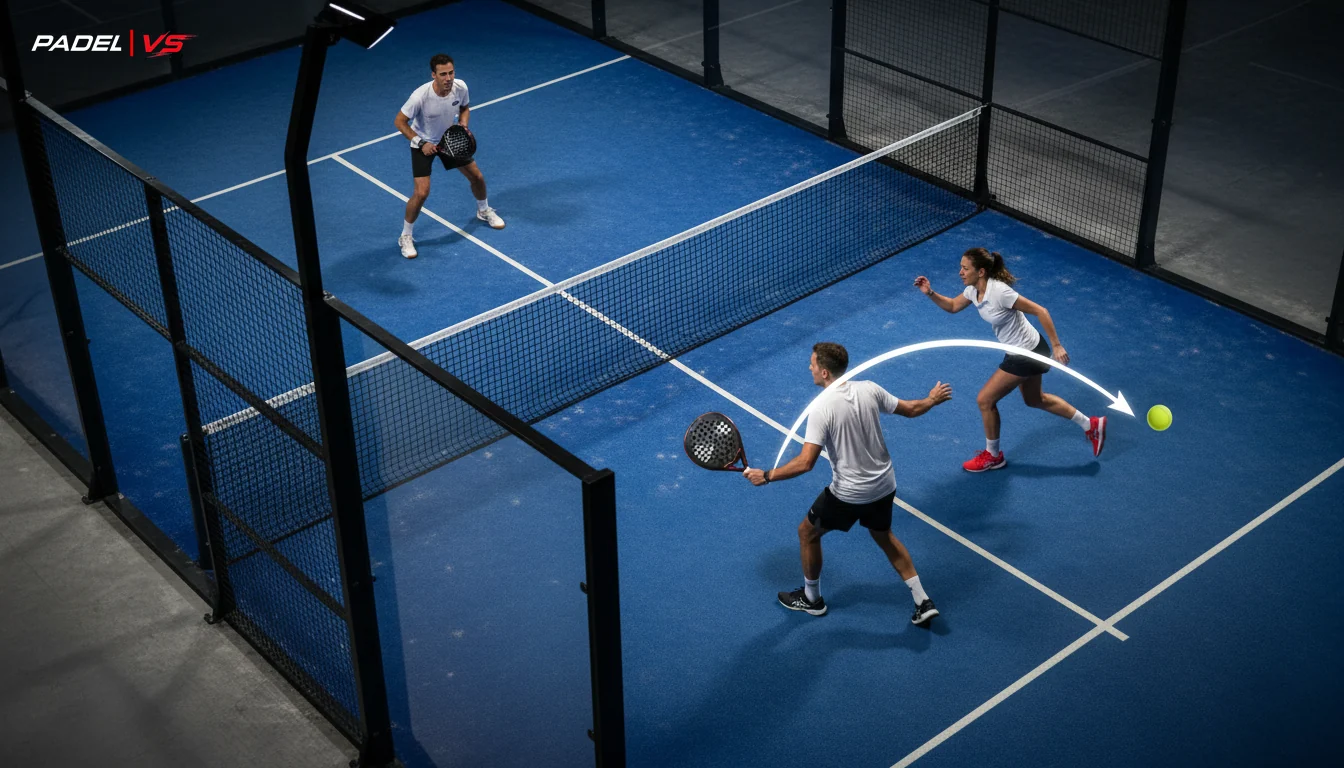
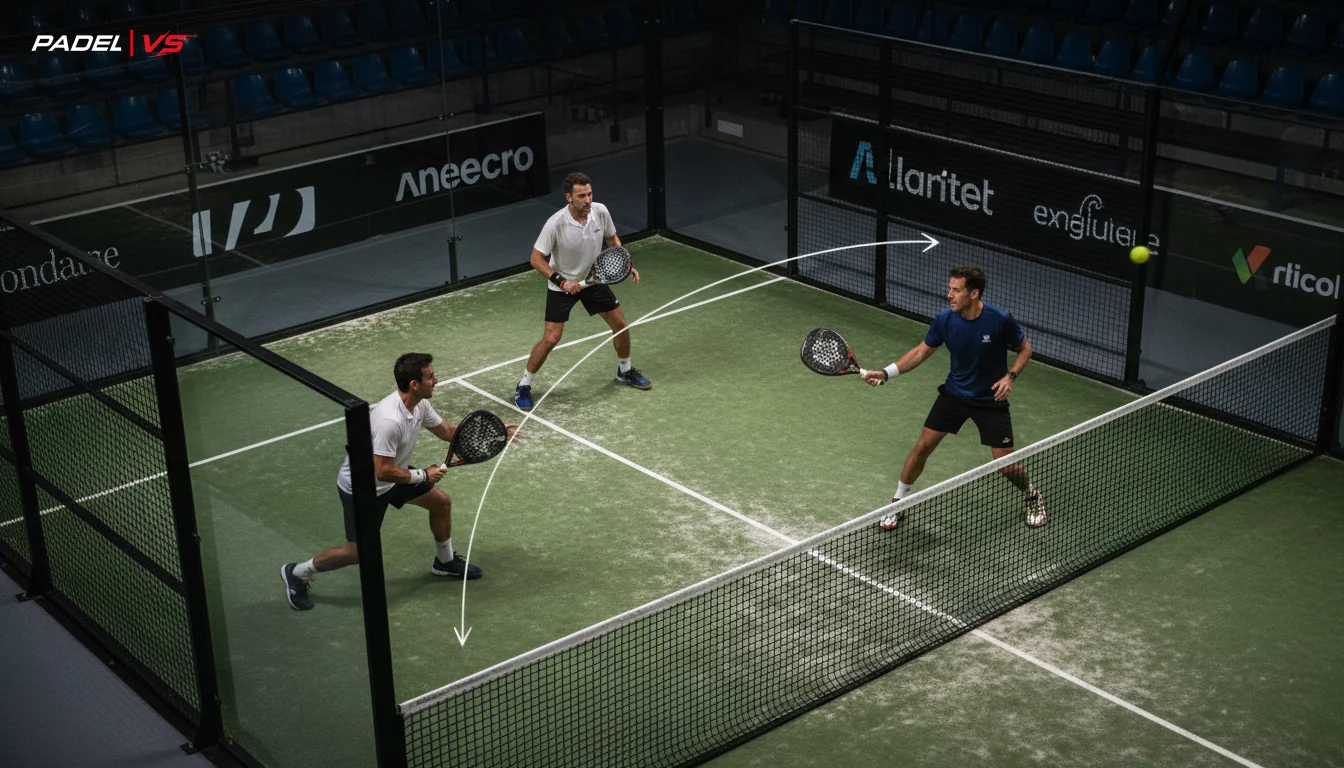
Most Tercera and Segunda category players treat the lob as a last resort — a desperate shot you throw up when you've already lost position at the net. But the cross-court lob is a completely different animal: it's a point-construction shot, a tool for dismantling pairs that defend well and for reclaiming the net with an advantage. Almost nobody trains it intentionally, which is exactly why it's the shot that can separate you from the pack.
Why the cross-court lob is padel's most underrated shot
On a standard padel court — 20 meters long by 10 meters wide — the diagonal distance between opposite corners measures nearly 24 meters, roughly 4 meters more than a straight line down the court. That difference looks small on paper, but it's brutal in terms of reaction time. A well-executed cross-court lob gives your opponent an extra 0.3 to 0.5 seconds to reach the bounce, but paradoxically it also gives them more time to think — and in padel, overthinking almost always means hesitating between forehand and backhand, between volleying or letting it bounce, between communicating with your partner or staying silent.
That hesitation is exactly what you're hunting for. The cross-court lob doesn't attack the player — it attacks the communication between the opposing pair.
The cross-court lob isn't a defensive shot that merely survives — it's an offensive shot that invites the error.
The geometry that makes it lethal
When you play a straight lob, the opponent at the back of the court is already standing almost directly under the bounce. They don't need to move laterally; they just take a step back and respond. The cross-court lob forces them to run diagonally, covering nearly the full width of their own backcourt while also calculating the rebound off the side glass. If you manage to land the lob so it clips the back glass and then the side glass — what we call a "double glass" bounce in padel — the trajectory becomes nearly impossible to read, even for Primera-level players.
There's a second, less obvious effect: when you send the lob to the cross corner, the opposing net player — often your real target — has to turn their head to track the ball. That split-second turn is exactly the window your partner needs to advance toward the net unnoticed.
Mechanics: how to execute it correctly
Grip and preparation
The cross-court lob works best with a continental or semi-continental grip — never a closed drive grip. You need to open the racket face somewhere between 15 and 20 degrees off vertical to generate enough height without sacrificing directional control. Your preparation must look identical to a flat shot; if you raise the racket in an obvious way or change your body posture, your opponent reads the lob before it even leaves your strings and starts retreating early, erasing your time advantage.
Contact point
Make contact slightly in front of your body and above shoulder height — never at waist height, which produces short lobs that turn into easy bandeja setups for your opponent. The swing path should go from low to high, with a relaxed wrist, staying on the ball longer than you would on a flat shot. This is what gives you control over depth. The target: land the lob between 1 and 1.5 meters from the opponent's back glass — deep enough that they can't smash it comfortably, but not so long that you hand them a free error.
When to use it: the 4 key scenarios
Not every cross-court lob serves the same moment in a rally. The difference between an intermediate player who uses it well and one who uses it poorly comes down to reading the tactical moment correctly.
| Scenario | What's happening | Why the cross-court lob works |
|---|---|---|
| Opponents dominating from the net | Both opposing players are up, pressuring with volleys | Breaks the pressure by forcing one of them back, collapsing their attacking formation |
| Your team lost the net | You're both pinned at the back and need time to reset | Buys the meters and seconds your team needs to recover the volley line |
| Opponent has a weak backhand in the back | You've identified a weaker side on one of the opponents | Directing the lob straight to that corner exploits the weakness without looking intentional |
| After a short opposing bandeja | The opponent's bandeja didn't land deep | The cross-court lob punishes the short ball by sending it far from whoever hit it, creating confusion |
The most common mistakes in Tercera and Segunda category
At PADEL VS we track matches and the progress of thousands of players by ELO category, and there's a pattern that repeats constantly between Tercera (1000-1180) and Segunda (1180-1350): the cross-court lob gets used, but it gets used badly. Here are the mistakes we see most:
- Short lob: lands before the opponent's service line, handing over an easy bandeja or direct smash. This is mistake number one, and it's the most punished at higher categories.
- A straight lob disguised as cross-court: the intention is to go diagonal but the execution comes out almost parallel to the net, letting the opposing net player intercept it with a high volley.
- Overhitting: players who come from tennis, or who simply have a strong arm, tend to "hit" the lob instead of guiding it, losing directional precision.
- Not following the lob with a net advance: hitting the lob and then standing still at the back wastes half the tactical value of the shot. A well-played cross-court lob should be followed by an immediate move toward the net.
- Ignoring wind and sun: on outdoor courts, many intermediates overlook these variables and lose lobs that would otherwise have been winners.
How to train it: specific drills
The cross-court lob doesn't improve by playing more matches — it improves through directed repetition. A simple but effective drill: place a cone or marker in the diagonal back corner, 1.5 meters from the glass, and have a partner feed you balls from the net at different heights and speeds. Your target is landing 7 out of 10 lobs within a 2-meter radius of the cone.
A second, more game-realistic drill for doubles: one pair attacks constantly with volleys and bandejas, while the other pair must defend exclusively with cross-court lobs for 15-20 consecutive balls, never allowed to play a straight lob. This forces correct mechanics under real pressure, which is where technique actually breaks down in match play.
If you're looking for partners at your level to practice this kind of focused training, you can find players within your ELO range directly through the Telegram Mini App (@padelvsbot) or by messaging our WhatsApp bot — especially useful if you want to organize tactical training sessions instead of just casual social matches.
The cross-court lob by ELO category
How you should work on this shot changes depending on your competitive level. Teaching it in Quinta is not the same as refining it in Primera.
| Category | ELO Range | Recommended focus |
|---|---|---|
| Quinta | <850 | Priority is simply clearing the opponent; cross-court direction is still secondary |
| Cuarta | 850-1000 | Start consciously working on cross-court direction, even if depth is still inconsistent |
| Tercera | 1000-1180 | Must become a reliable shot under pressure; this is where trained players clearly separate from untrained ones |
| Segunda | 1180-1350 | Becomes a point-construction tool, not just a defensive reflex |
| Primera | 1350-1550 | Combined with pace changes and real-time reading of opponent positioning |
| Open | ≥1550 | A millimeter-precision shot used to dictate the entire rhythm of the point |
Here's an interesting pattern: many players who climb from Tercera to Segunda do so precisely because they stopped using the lob as a panic button and started using it as a plan. On PADEL VS, category jumps usually coincide with the appearance of this kind of mature tactical decision-making, not just improvements in flat-shot power.
Conclusion: the shot that builds points, not just the one that saves them
The cross-court lob demands patience to train and humility to use — it's not a crowd-pleasing shot, it doesn't earn applause the way a smash does, but it wins matches quietly. Next time you feel trapped at the net with no way out, try the long diagonal before reaching for the easy straight lob. You'll notice it completely changes the rhythm of the exchange.
If you want to measure your real progress with these kinds of tactical decisions, play ranked matches and track your ELO evolution at padelvs.com — your category doesn't just reflect your shot power, it reflects how many correct decisions you make under pressure.