The lob has a reputation problem. Most players treat it as the panic button, the shot you throw up when you're out of options and just trying to survive the point. But watching match after match on the courts we track for PADEL VS, one pattern keeps repeating: a well-executed lob isn't an escape route. It's an attacking shot that can win the point outright or force a bad bandeja or vibora against the back glass.
The shot everyone underestimates
The confusion starts with intent. A defensive lob comes out when you're in trouble: pinned against the back wall, off balance, buying time to recover position. Its only job is survival. An offensive lob comes from a neutral or even favorable position, hit when you've read that the opposing pair is crowding the net or badly positioned with their weight leaning forward. Its job is to win the point or force an uncomfortable smash or bandeja that ends in an error.
The ball can travel through the exact same airspace, but the decision behind each lob is completely different. And that decision — not the raw technique — is what separates a Tercera category player (1000-1180 ELO) who treats the lob as a last resort from a Primera player (1350-1550 ELO) who fires it three or four times a set as a weapon to break the opposing pair's rhythm.
A defensive lob asks "can I stay in this point?" An offensive lob asks "can I end this point right now?" Two very different questions using the same basic technical gesture.
Defensive vs. offensive: not the same shot
Even though they share the same base mechanics — open paddle face, high trajectory, intent to get the ball over the net players — there are clear execution differences every player should learn to spot before deciding which lob to hit:
| Aspect | Defensive lob | Offensive lob |
|---|---|---|
| Body position | Off balance, reacting late | Balanced, with time to set up |
| Height goal | As high as possible, no fine control | Calculated height, landing near the baseline |
| Landing zone | Anywhere that buys time | Corners, over the backhand side, or straight into the back glass |
| When it's used | Under pressure, on a compromised ball | On a comfortable ball, with opponents poorly positioned at net |
| Desired outcome | Recover court position | Direct winner or forced opponent error |
The key is in that last row: the defensive lob buys time, the offensive lob ends the point. Once you internalize that distinction, you'll start seeing offensive lob opportunities you used to miss entirely, because your brain only associated the shot with being in trouble.
The technique: hitting a lob that actually hurts
Grip and contact point
The offensive lob should be hit with a continental grip — the same one you use for volleys and bandeja. That lets you disguise your intention until the last possible moment: your opponent shouldn't be able to tell if you're about to hit a flat volley, a bandeja, or a lob until the paddle is already moving upward.
Contact point should be slightly in front of your body, with the paddle face opening between 15 and 25 degrees off vertical, depending on how close you are to the net. The closer you hit the offensive lob to the net, the less face-opening you need, since the ball has less distance to travel before it drops.
The right trajectory
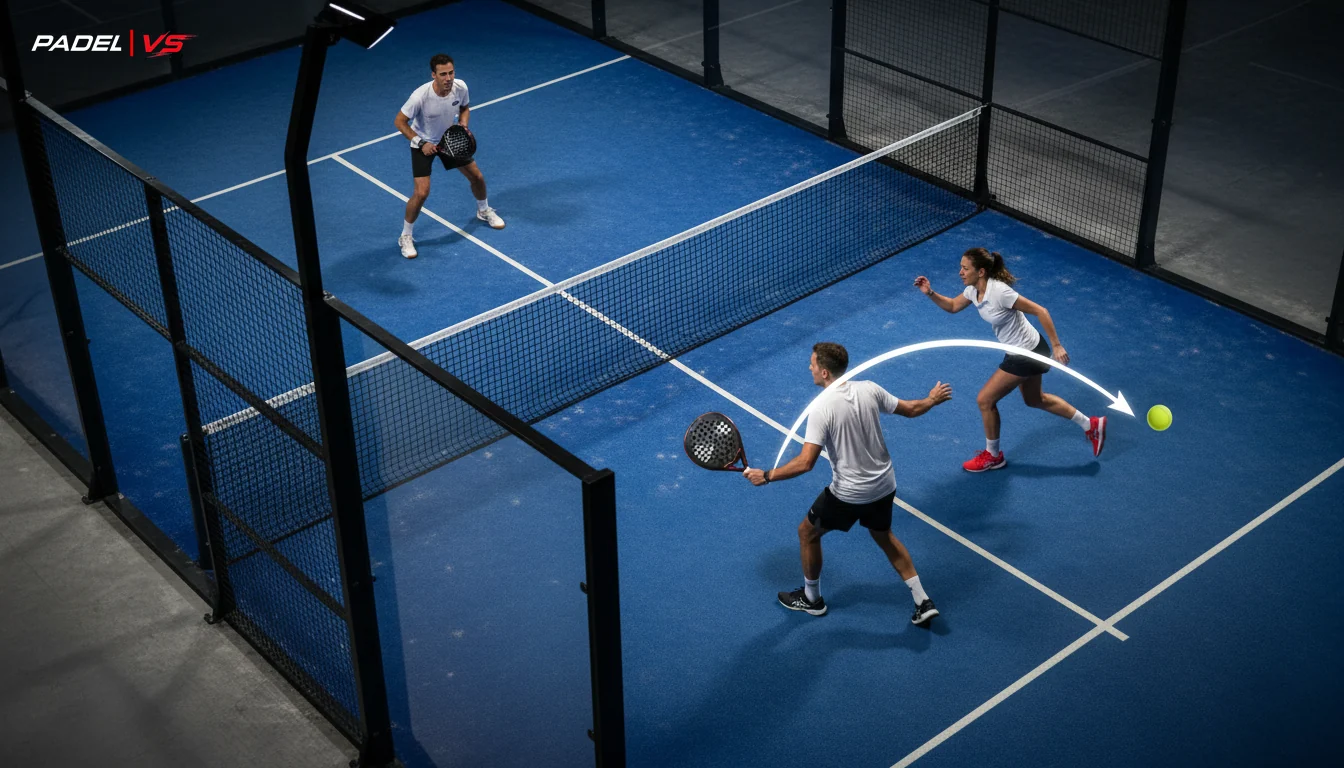
An effective offensive lob doesn't chase maximum height the way a defensive one does. It looks for the minimum height needed to clear the opponent's extended paddle reach — generally 1 to 1.5 meters above their raised-paddle reach — while landing with depth, ideally within the last meter and a half before the baseline (remember padel courts run 20 meters long by 10 meters wide, with back glass walls standing 3 to 4 meters tall depending on the court model).
This flatter, faster trajectory compared to a typical defensive lob cuts down your opponent's reaction time and raises the odds that the ball clips the back glass with an awkward bounce, forcing a defensive shot from a compromised position.
When to throw the offensive lob: reading the court
The offensive lob isn't decided with the paddle — it's decided with your eyes a second earlier. Here are the situations where it statistically pays off most:
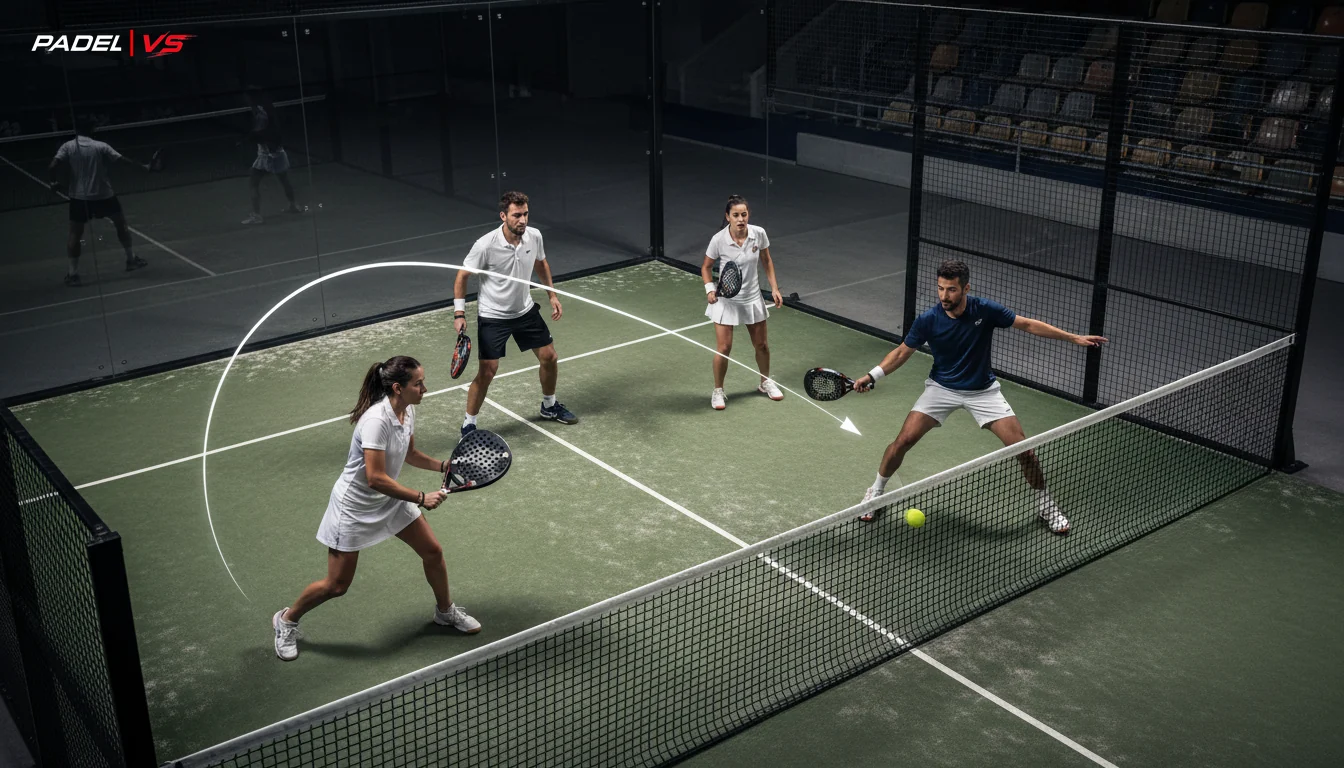
- An opponent crowding the net with no lateral support: when one player on the opposing pair is more than a meter ahead of their partner, a crosscourt lob to the open side is almost always a winner.
- Right after your opponent hits a low volley: if they're forced to volley from below waist height, their natural next move is to creep even closer to the net. That's the exact window to lob, before they can retreat.
- When both opponents are watching the ball instead of the court: in amateur padel, Cuarta and Tercera category players (850-1180 ELO) tend to fixate on the ball and lose track of their own position relative to net and wall. That lapse is fertile ground for the offensive lob.
- Over the backhand side: most players have a noticeably less reliable backhand bandeja than their forehand one. Directing a lob to that zone multiplies the chance of error.
- Right after your opponent misses a smash: if they went for a hard overhead and you managed to return it, it's common for them to stand admiring their own shot instead of recovering position. An immediate lob punishes that.
The mistakes that turn your weapon into a gift
A poorly executed offensive lob is probably the single shot that gives away the most free points in mid-level padel. Here are the mistakes we see repeated most often:
- A short lob out of over-caution. Fear of hitting long makes many players lob too short, handing over an easy smash. It's better to risk a bit of extra depth — which might go out but might also produce an awkward glass bounce — than to leave it short.
- Telegraphing the shot with your body. If your setup posture visibly changes for a lob compared to a volley, your opponent reads the intention and has time to backpedal into smash position.
- Ignoring wind and sun. On outdoor courts, a poorly calculated lob into the sun or with wind at the opponent's back can turn into an easy overhead winner for them. Adjust height and depth for conditions.
- Repeating the same lob over and over. Segunda and Primera category players (1180-1550 ELO) adapt fast. If you always lob to the same side, within two or three points they're already camped out waiting to smash it.
How to practice it: a simple drill
Practicing the offensive lob requires repetition under pressure, not just relaxed rallying. One drill that works well: put a partner at the net simulating different positions (centered, weighted right, weighted left) and practice twenty consecutive lobs alternating depth and direction, counting how many land within the last meter and a half before the back wall. A realistic target for a Tercera category player is over 60% success; for Primera and Open, you should be pushing above 80%.
If you want to speed up that learning curve, a few sessions with a certified coach who films your swing and corrects your contact point can compress months of self-taught practice into a few weeks. In Cancún and other cities, a private one-hour lesson runs about $28-50 USD ($500-900 MXN aprox), and several clubs offer four-lesson packages at a discount.
The lob across ELO categories
How often and how the lob gets used changes a lot depending on skill level. At PADEL VS, we measure competitive level with an ELO system split into six categories (Quinta, Cuarta, Tercera, Segunda, Primera, and Open), and lob usage is one of the tactical indicators that varies most between them.
| Category | ELO Range | Typical lob usage |
|---|---|---|
| Quinta | <850 | Almost purely defensive, inconsistent technique |
| Cuarta | 850-1000 | Starts being used with intent, but with limited court reading |
| Tercera | 1000-1180 | Mix of defensive and offensive, decision-making still reactive |
| Segunda | 1180-1350 | Frequent offensive use, active reading of opponent positioning |
| Primera | 1350-1550 | Planned tactical weapon, built into game patterns |
| Open | ≥1550 | Pinpoint-precision tool, fully integrated into point rhythm |
This progression isn't a coincidence: mastering the offensive lob tends to be one of the technical jumps that raises a player's ELO fastest, because it converts points that used to be lost into points won without needing any raw power.
You don't need to hit the ball harder to win more points. Sometimes you just need to hit it higher — and smarter.
Taking it to the court
Next time you play, before you throw up a lob, ask yourself: am I escaping, or am I attacking? If that answer changes your execution — your grip, your trajectory, your target landing zone — you're already thinking like a player who uses the lob as a weapon instead of a refuge.
If you play in Cancún and want to actually track how much your game improves as you build the offensive lob into your repertoire, PADEL VS is building a system where every recorded match helps calculate your ELO and place you in the category you truly belong to. We're still early stage, growing first in Cancún before expanding to other cities, but you can get started right now at padelvs.com, through the Telegram Mini App at @padelvsbot, or simply by messaging our WhatsApp bot to log your results and watch your progress match by match.