
If you've ever watched a high-level padel match and seen that whipping overhead shot that skids off the glass at an impossible angle, you've seen the vibora in action. It's padel's most recognizable shot — part overhead, part slice, part pure muñeca (wrist) sorcery — and learning it is one of the clearest markers that separates developing players from competitive ones.
What exactly is the vibora?
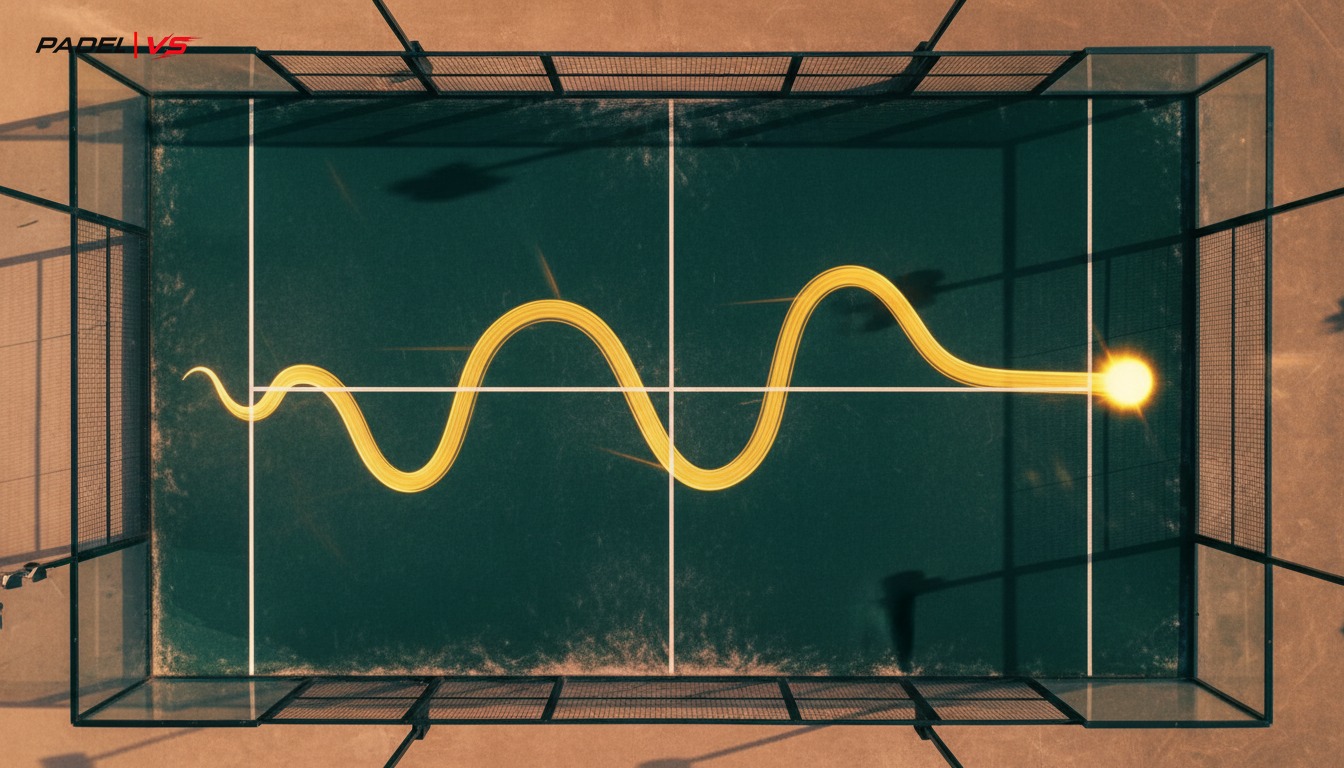
The vibora (literally "viper" in Spanish) is an attacking overhead shot executed with a combination of lateral topspin and slice, created by a sharp pronation snap of the wrist at the point of contact. Unlike a classic smash, which prioritizes raw power and flat trajectory, the vibora generates a low, fast bounce with a sideways kick that makes the ball skid away from the opponent at an awkward angle.
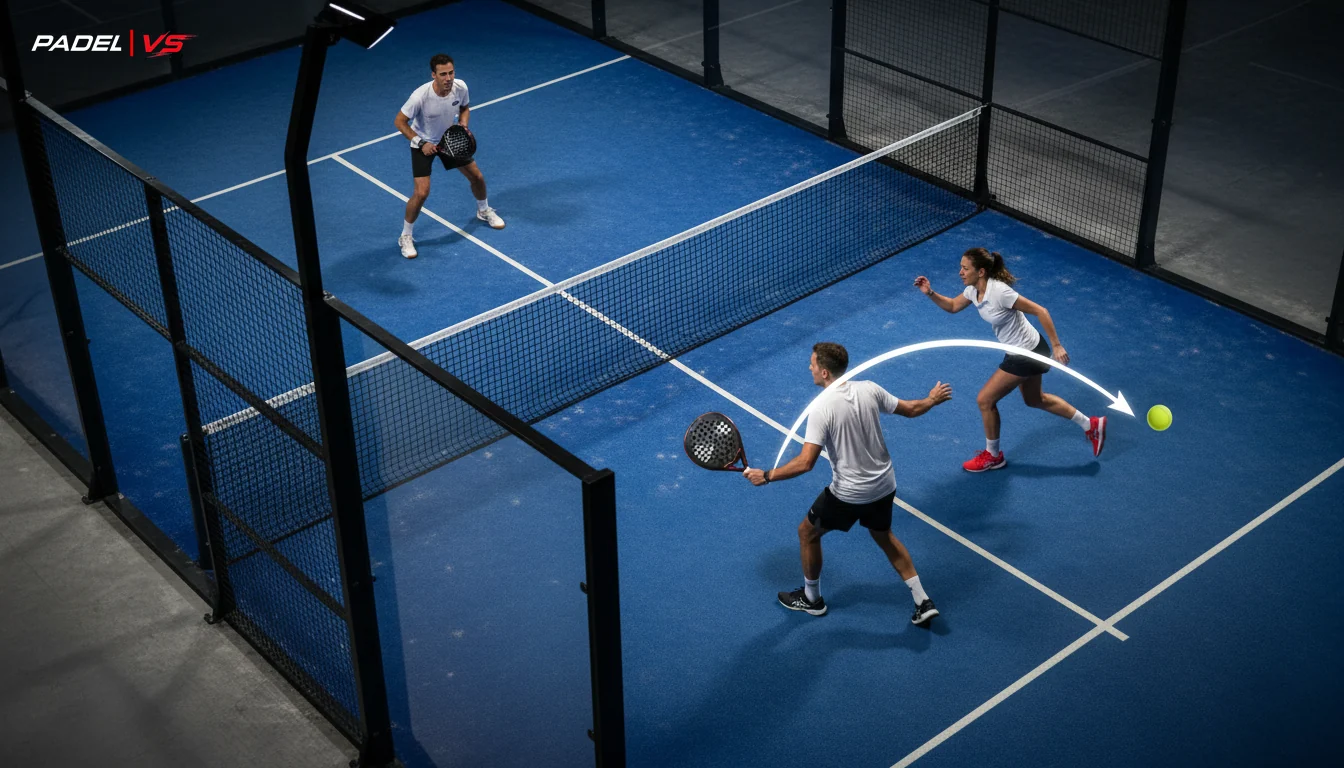
What makes the vibora unique in padel — and completely different from anything in tennis or pickleball — is that it's designed to exploit the glass walls. The ball can be directed to bounce off the back glass or side glass after the skid, creating a second bounce that's nearly impossible to read in time. On a regulation padel court (20 meters long × 10 meters wide, with each pair playing across a 6-meter zone behind the net), the vibora is most effective when executed from around 1 to 2 meters behind the service line, in the attacking mid-court position.
Why the vibora matters competitively
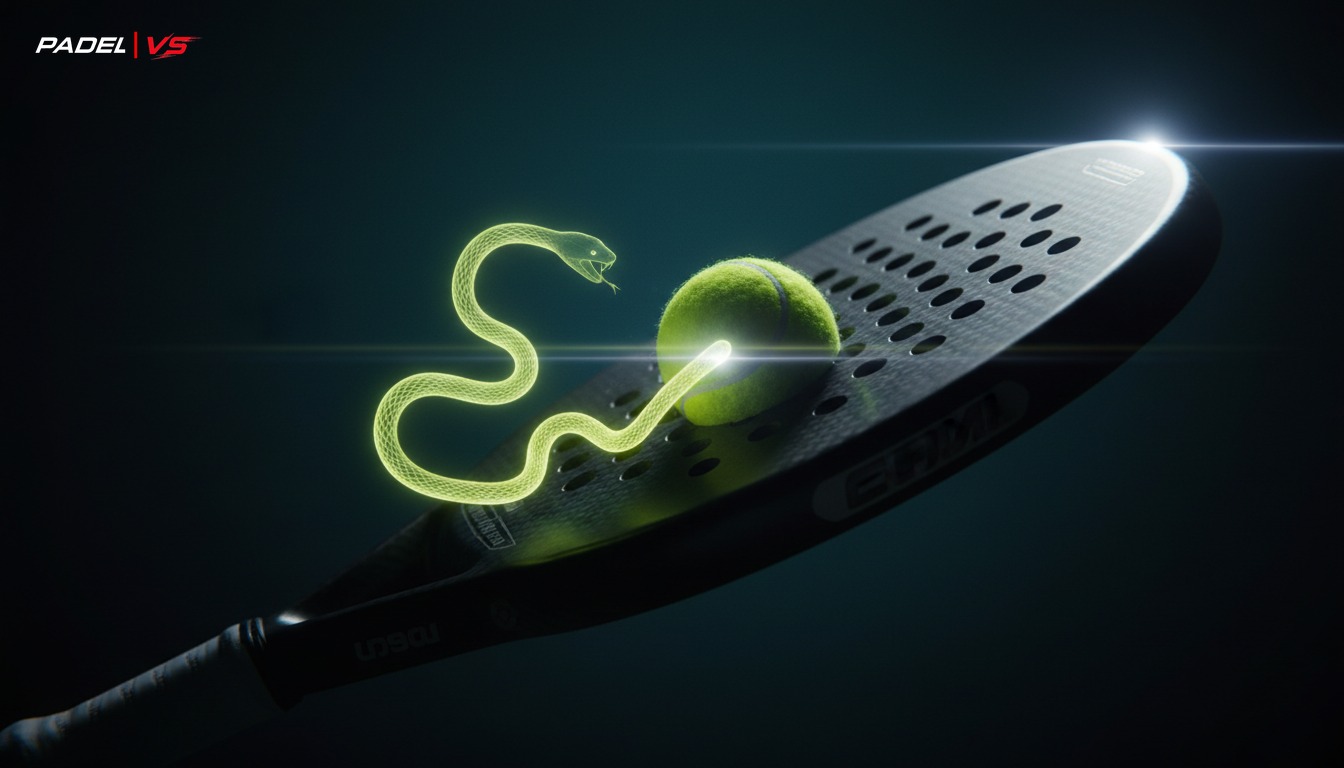
In modern competitive padel, the smash alone is no longer enough. Opponents who can lob consistently will put the ball into positions where a flat overhead smash either goes long or sits up as a clean setup for the counter. The vibora solves this problem because it produces heavy downward and lateral spin even when the contact point isn't perfect.
"The smash wins you points on perfect lobs. The vibora wins you points on everything else." — A truth every attacking padel player eventually learns the hard way.
At the Tercera level (1000-1180 ELO) and above in PADEL VS, you'll start seeing viboras used as a primary finishing weapon, not just as a fallback. Players in Segunda (1180-1350 ELO) and Primera (1350-1550 ELO) use it with deliberate tactical variety — changing direction, pace, and spin volume depending on where the opponents are standing. At Open level (≥1550 ELO), the vibora is essentially a precision instrument.
The full technical breakdown
Step 1: Grip
The vibora requires a continental grip — the same grip used for smashes, volleys, and serves. On a standard padel racket handle (octagonal cross-section, most modern rackets weigh between 340-380 grams), place the base knuckle of your index finger on bevel two of the octagon, counting from the top. This grip gives your wrist the freedom to execute the pronation snap that defines the shot.
Players who migrate from tennis often default to a more closed Eastern grip. With that grip, you can still hit overheads, but you lose the wrist mobility needed for the vibora's characteristic spin. If your viboras keep flying long and flat, your grip is the first thing to check.
Step 2: Reading the lob and positioning
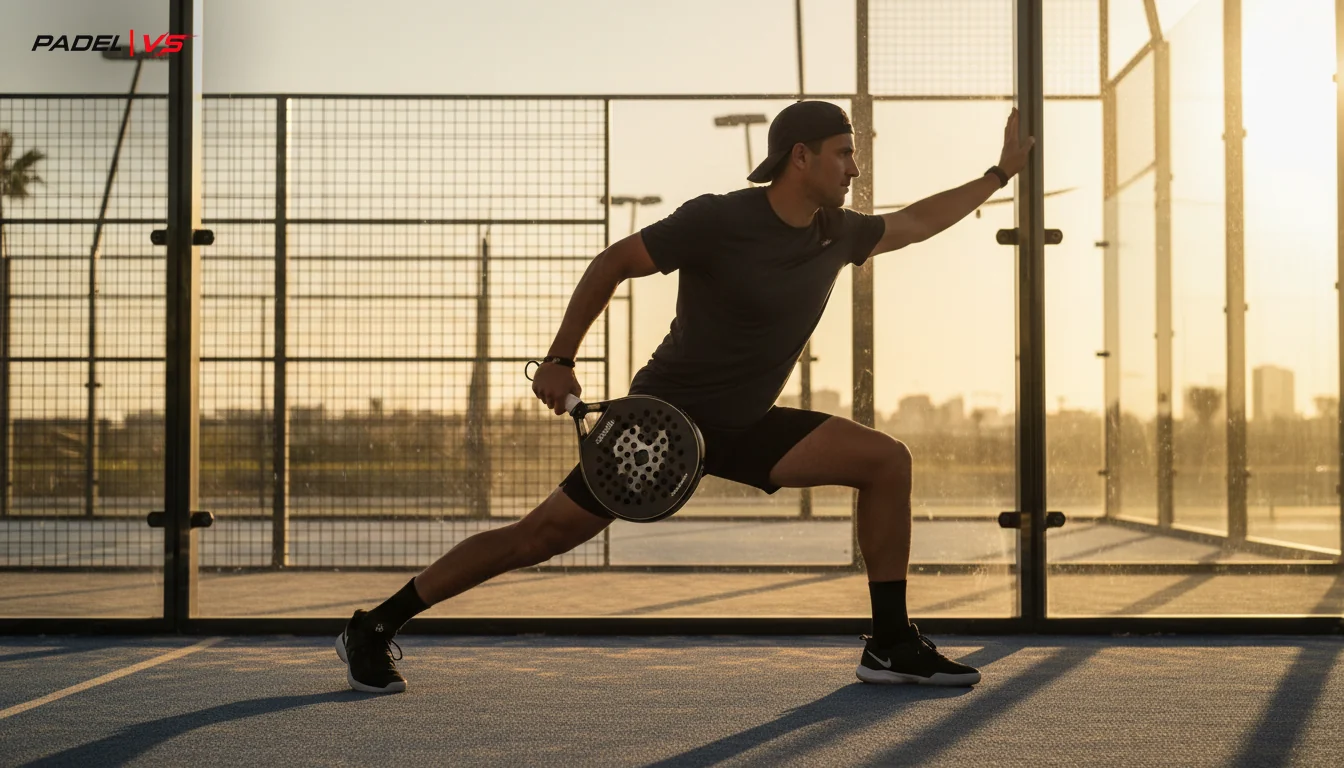
Everything starts with reading your opponent's lob the moment their racket makes contact with the ball. You have roughly 1.5 to 2 seconds to move into position. The ideal setup stance is:
- Right foot slightly forward (for right-handed players), left foot back as the pivot base
- Shoulders rotated so your left shoulder points toward the net
- Body weight loaded onto your back leg as the backswing begins
- Racket raised immediately — elbow at or above shoulder height from the start
A common mistake is waiting to raise the racket until you're already positioned. The racket should come up the moment you identify a lob — not after you've moved to the right spot.
Step 3: The backswing
Here's where the vibora diverges clearly from the smash. In a flat smash, the racket goes up and slightly back over the head in a relatively vertical plane. In the vibora, the backswing is more lateral and compact: the racket head drops behind the right shoulder with the edge facing up, in a position that resembles the start of a back-scratch motion but rotated to the side. This shorter, more horizontal backswing is what loads the wrist for the pronation snap.
Step 4: The contact point
The contact point is the most critical variable in the vibora. It must be:
- Height: At or above eye level, ideally at forehead height or higher
- Lateral position: Slightly in front of and to the right side of the body (for right-handers)
- Arm position: Extended but not fully locked out — maintain a slight bend at the elbow
If the ball drops below eye level before contact, the geometry of the shot changes completely and forces the face of the racket to open upward, sending the ball on a high trajectory rather than a skidding one. A reliable rule of thumb: if you need to significantly bend your knees to get the racket up to the ball, the ball has already dropped too far for a clean vibora.
Step 5: The wrist snap — where the vibora lives
This is the defining moment. At the instant of contact, your wrist fires through a rapid pronation movement — imagine turning a doorknob sharply inward and downward with force. This snaps the face of the racket from slightly open to closed, moving from upper-right to lower-left (for right-handers). The result is a ball that leaves the racket with forward-and-lateral spin, generating a fast, low, angled bounce.
The follow-through finishes with the racket crossing in front of the body toward the left hip, with the frame roughly parallel to the ground. If your racket ends up pointing downward with the edge facing the floor, you've executed the motion correctly. If it finishes high and in front of you like a tennis forehand, you've swung through it without the pronation snap.
Vibora variants and when to use them
| Variant | Direction | Best used when... | Difficulty |
|---|---|---|---|
| Parallel vibora | Same side as the swing | Opponent is out of position laterally | Medium |
| Cross-court vibora | Diagonal across the net | Opening the court or targeting weak side | Medium-high |
| Body vibora | Directly at the opponent | Net player is in a predictable position | High |
| Delayed vibora | Variable | Off a lower contact point after retreating | High |
The cross-court vibora is statistically the highest-percentage choice in most competitive situations because the net is lowest in the center and the angle creates a longer diagonal distance for the ball to travel — giving you more margin for error. The parallel vibora, however, is more effective when the receiving opponent is already drifting toward the center.
The most common mistakes (and how to fix them)
Mistake 1: Late preparation
The racket doesn't come up until after the player has moved into position, shortening the available backswing time and forcing rushed contact. Fix: Train yourself to raise the racket as your first movement when you identify a lob — before your feet even start moving to the right spot.
Mistake 2: Stiff forearm
A tense forearm kills the wrist snap completely. The result is a flat, high-flying overhead with none of the vibora's characteristic spin. Fix: Practice the full swing motion in the air (shadow swinging) with a focus on keeping the wrist loose until the snap moment. The acceleration should come from a relaxed arm, not a rigid one.
Mistake 3: Facing the net square-on
Executing the vibora without rotating the shoulders means the arm has no kinetic chain to draw from. The shot becomes purely arm-powered and loses its snap. Fix: Work on the shoulder rotation as an isolated drill. From a static position, practice turning until the left shoulder faces the net, then swing from there.
Mistake 4: Over-extending the arm before contact
Reaching for difficult lobs by fully extending the arm before the wrist snap means there's no range of motion left for the pronation to work. Fix: Prioritize footwork. A slightly worse racket position with good footwork will always beat a reaching shot with bad footwork.
Mistake 5: No leg drive
The vibora isn't a pure arm shot. A small transfer of weight from the back foot to the front foot — or a slight jump at contact — adds both power and stability. Without it, the shot relies entirely on arm speed and becomes inconsistent under pressure.
A 4-week training plan to build a match-ready vibora
- Week 1 — Shadow swings: 10 minutes daily in front of a mirror. No ball. Focus on grip, backswing position, and the feel of the wrist pronation. The goal is muscle memory for the motion, not power.
- Week 2 — Static feeding: A partner feeds you balls by hand from 3 meters away, placing them at the correct height. Focus only on contact point and direction — forget about pace. Hit 50 repetitions per session, alternating parallel and cross-court.
- Week 3 — Dynamic feeding: Partner feeds from the net position using a racket, simulating realistic lob trajectories. You read the flight path, move to position, and execute. Introduce timing variations — some fast lobs, some floating ones.
- Week 4 — Live situations: Play points starting from the attacking position at net. Every lob must be answered with either a vibora or a smash depending on the contact height. No allowed retreating to baseline — force yourself to attack with the vibora.
What level should you be using the vibora?
In PADEL VS, we track player development through a structured ELO-based category system. Here's a realistic expectation framework for the vibora at each level:
| Category | ELO Range | Vibora expectation |
|---|---|---|
| Quinta | <850 | Not a priority yet — build smash and volley fundamentals first |
| Cuarta | 850-1000 | Begin learning the motion; apply it on comfortable, slow lobs |
| Tercera | 1000-1180 | Functional vibora with consistent direction control |
| Segunda | 1180-1350 | Vibora with variants and tactical shot selection |
| Primera | 1350-1550 | Primary finishing weapon — consistent under pressure |
| Open | ≥1550 | Refined vibora with pace variation, spin control, and deception |
Equipment considerations for the vibora
Not all padel rackets are equally vibora-friendly. A few things to keep in mind when choosing a racket with this shot in mind:
- Weight: Rackets in the 340-360g range allow faster wrist speed. Heavier rackets (370g+) can produce more power but reduce the pronation speed needed for clean vibora spin.
- Balance: Head-light or balanced rackets are easier to control on the vibora than head-heavy ones. Head-heavy frames bias toward power smashes.
- Sweet spot size: Round-shaped rackets (larger sweet spot) are more forgiving on viboras hit slightly off-center, which is common when learning.
- Ball condition: Always practice technical shots with properly pressurized balls. A flat ball responds completely differently to spin — it won't give you the feedback you need to learn the shot correctly.
Racket prices vary widely in Mexico. Entry-level options suitable for learning the vibora start around $55-90 USD (1,000-1,600 MXN aprox), while mid-range rackets where you'll likely spend most of your competitive journey run $110-220 USD ($2,000-4,000 MXN aprox). High-performance rackets from brands like Bullpadel, Nox, or Adidas Padel reach $280-500 USD ($5,000-9,000 MXN aprox).
"Every shot in padel that you don't practice becomes a liability in a match. Every shot you master becomes a weapon. The vibora is worth every hour of practice it takes."
Tracking your progress with PADEL VS
One of the underrated benefits of playing in a structured competitive environment is that your ELO tracks the real-world impact of technical improvements. When your vibora starts winning points consistently, that shows up in your match results — and in your ELO progression in PADEL VS.
We're building our competitive community starting in Cancún, expanding to other cities across Mexico. You can access PADEL VS directly from your browser at app.padelvs.com / padelvs.com, through our Telegram Mini App (@padelvsbot), or via our WhatsApp AI agent to register for matches, track your category progress, and find opponents at your level. No app download needed.
When you're ready to register for matches and tournaments, we accept card, bank transfer, cash and crypto (USDT/BTC/ETH), with QR registration at the club. We're building the infrastructure so the payment method never gets in the way of the competition.
The vibora is an investment, not a shortcut
The vibora is not a shot you learn overnight. It requires deliberate work on grip, shoulder rotation, timing of the contact point, and wrist speed — all choreographed into one fluid movement that has to happen in under a second. But the payoff is genuine: a well-executed vibora adds a weapon to your game that forces opponents to read not just pace but spin, angle, and intent simultaneously.
Start with the fundamentals. Shadow swing until the motion feels natural. Feed with a partner until the direction is consistent. Then bring it into match situations where the pressure forces you to trust the shot. By the time you're consistently landing viboras in the Tercera category and climbing toward Segunda, it won't feel like a technique you learned — it'll feel like part of how you play padel.
And that's exactly the point.