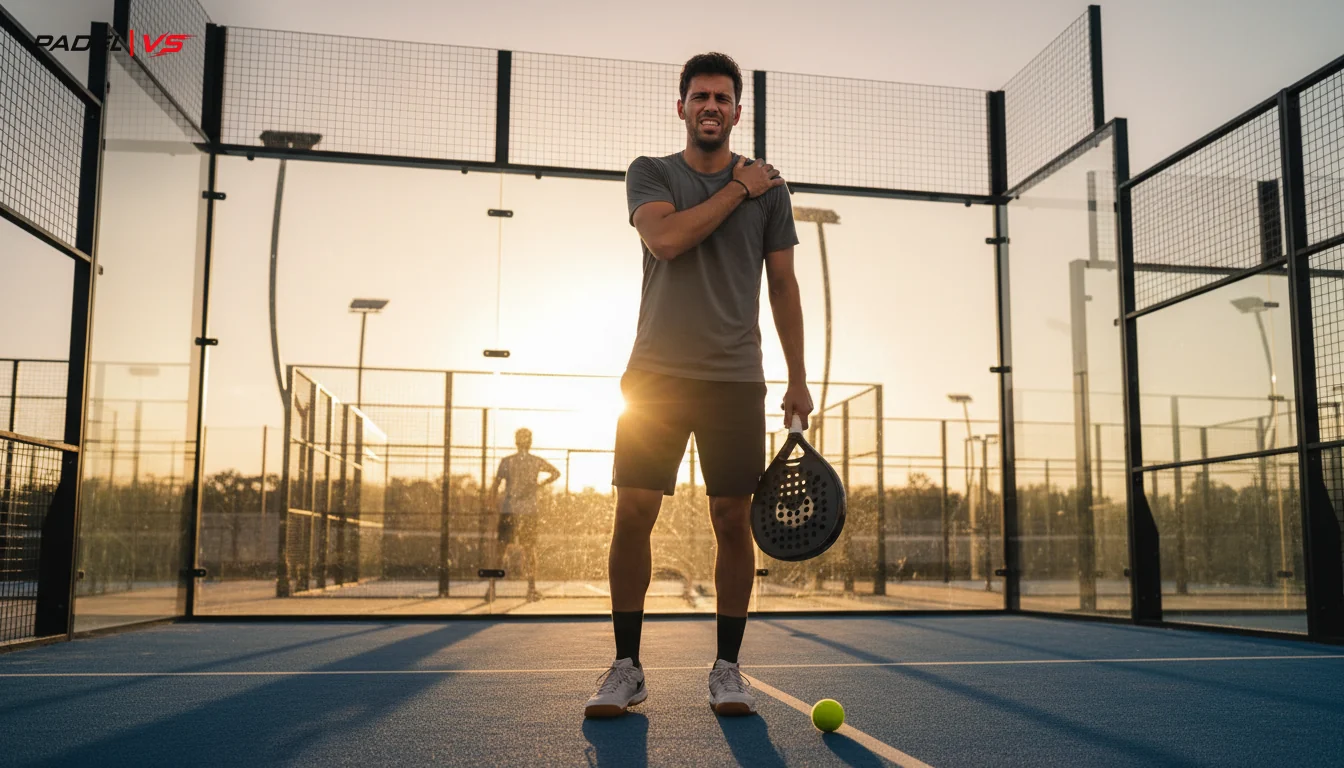
Shoulder pain is, alongside tennis elbow, the most common injury among amateur and competitive padel players. The combination of overhead strokes, relatively heavy rackets, and a court that forces you to chase impossible balls off the glass makes the rotator cuff the most vulnerable part of your body in this sport. This guide explains what it is, how to catch it early, and how to get back on court without relapsing.
What Is the Rotator Cuff, and Why Does Padel Stress It So Much?
The rotator cuff is a group of four muscles and their tendons (supraspinatus, infraspinatus, teres minor, and subscapularis) that wrap around the shoulder joint and give it stability. Unlike the hip or the knee, the shoulder is a highly mobile but inherently unstable joint by design — it depends almost entirely on these small muscles to stay in place during explosive movements.
In padel, every bandeja, víbora, smash, and high wall exit demands raising the arm above 90 degrees with forced external rotation, exactly the range of motion where the supraspinatus tendon passes closest to the acromion (the bone above the shoulder). When that tendon gets irritated from repeated friction, it's called subacromial impingement syndrome, the step before tendinopathy or, in advanced cases, a partial rotator cuff tear.
What makes padel unique compared to other racket sports is that the contact point is often further back and higher than ideal, especially when a player tries to smash balls that already passed the optimal hitting window. That split-second delay forces the shoulder to compensate with more forced internal rotation, accumulating stress with every point.
The Shots That Punish Your Shoulder Most
- The smash: the highest angular velocity movement for the shoulder. Players who smash repetitively during warm-up or on every high ball — without real tactical need — accumulate the most injuries.
- The víbora: combines extreme external rotation with a wrist snap that adds extra torque to the cuff, especially the supraspinatus.
- A poorly executed bandeja: when hit with a fully extended arm and no knee bend, all the impact absorbs into the shoulder instead of distributing through the full kinetic chain (legs-core-arm).
- High wall exits: reaching for a ball that bounced high off the glass, with the body out of alignment, creates unnatural shoulder angles.
- The power serve: repeated dozens of times per match, it's a source of cumulative microtrauma many players underestimate.
Warning Signs: When Pain Isn't Normal
There's an important difference between normal muscle fatigue after an intense match and the onset of a real injury. Learning to tell them apart is one of the most valuable skills you can develop as a recreational or competitive player.
| Normal Muscle Fatigue | Warning Sign (Injury in Progress) |
|---|---|
| Mild, diffuse soreness across the whole arm | Sharp, localized pain in the front or side of the shoulder |
| Gone within 24-48 hours of rest | Persists more than 3-4 days or returns every time you play |
| Doesn't limit range of motion | Can't raise your arm overhead without pain |
| No nighttime pain | Wakes you up when sleeping on that side |
| Improves with warm-up | Gets worse as the match goes on |
| No weakness on contact | Arm feels "weak" on smashes or serves |
If you identify two or more signs from the right-hand column, it's time to reduce training load and consider an evaluation with a sports physiotherapist or orthopedist before the discomfort turns into a structural injury.
Shoulder pain that appears "suddenly" almost never is sudden. It's the final phase of weeks or months of microtrauma the body was quietly compensating for.
Padel-Specific Risk Factors
Not every player carries the same risk. These are the factors that come up most often in sports physiotherapy consultations related to padel:
- Racket weight and balance: head-heavy rackets, typically between 365 and 375 grams, generate more torque in the shoulder on every impact. A player with a history of shoulder discomfort should consider a low- or medium-balance racket, in the 350-365 gram range.
- Playing above your real level: when you compete against opponents from a higher category than yours, you tend to force shots your technique doesn't yet handle safely, especially smashes. At PADEL VS we use an ELO-based category system (Quinta <850, Cuarta 850-1000, Tercera 1000-1180, Segunda 1180-1350, Primera 1350-1550, and Open ≥1550) specifically so you compete at a level where your technique and physical conditioning can sustain the demands of the match without forcing movements your body isn't ready for yet.
- Skipping shoulder-specific warm-up: stretching your legs but not activating the rotator cuff before playing is one of the most common mistakes, even among Segunda and Primera category players.
- Playing too many matches without recovery: weekend tournaments with 3-4 consecutive matches and no recovery work is a direct recipe for tendinopathy.
- Age and tendon density: after age 35-40, the supraspinatus tendon loses elasticity and vascularization, requiring more warm-up time and more careful load progression.
- Flawed serve technique: a serve with a low elbow and forward wrist compensates with the shoulder for what the core should be resolving.
Prevention: The Healthy Shoulder Protocol
Specific Warm-Up (5-8 Minutes Before Stepping on Court)
- Arm circles, small to large, 20 reps per side.
- Resistance band: external and internal rotation with elbow tucked to the body, 15 reps per side.
- "Y-T-W" raises with a band or light dumbbells (2-4 lb / 1-2 kg) to activate the lower trapezius and rhomboids.
- Progressive shadow strokes: start with lobs and soft bandejas, gradually increase intensity up to full smashes.
Rotator Cuff Strengthening (2-3 Times per Week, Off Court)
| Exercise | Target | Sets x Reps |
|---|---|---|
| External rotation with resistance band | Infraspinatus and teres minor | 3 x 12-15 |
| Face pulls with cable or band | Posterior deltoid and rhomboids | 3 x 15 |
| Side plank with arm raise | Scapular stability | 3 x 8 per side |
| Band row at chest height | General scapular strengthening | 3 x 12 |
| Light dumbbell overhead press | Deltoid and overhead range control | 2 x 10 |
Technique and Load Management
Not every high ball needs to be hit with maximum power. Learning to let a difficult smash go, instead of forcing an impossible shot, is a tactical decision that's also a health decision. Limiting the number of consecutive matches without a day of active recovery (mobility work, not total rest) significantly reduces the risk of cumulative tendinopathy.
When It Already Hurts: What to Do and When to See a Specialist
If you're already feeling persistent discomfort, the most widely accepted initial protocol in sports medicine is:
- Relative rest: stop playing padel, but don't stop moving the shoulder entirely. Full immobilization prolongs recovery.
- Ice: 15-20 minutes after any activity that causes discomfort, during the first few days.
- Anti-inflammatories: only under medical guidance and for short periods, never as a permanent fix to keep playing.
- Professional evaluation: if pain persists more than a week or limits everyday activities (combing your hair, putting on a t-shirt), see a sports physiotherapist or a shoulder-specialized orthopedist. An ultrasound or MRI may be needed to rule out a partial tendon tear.
In Cancún and other cities where the padel community is growing, there are increasingly more physiotherapists with specific experience in racket sports. It's worth asking at your club or in player groups for direct recommendations before booking a generic appointment.
Return to Play: A Gradual Comeback Protocol
The most common mistake when coming back from a shoulder injury is jumping straight into full matches at the same intensity as before. This multiplies the risk of relapse, which is usually worse than the original injury.
| Phase | Approximate Duration | Allowed Activity |
|---|---|---|
| Phase 1 – Pain-Free Mobility | 1-2 weeks | Active mobility, resistance-band exercises without load, no racket |
| Phase 2 – Reintroducing Soft Shots | 1-2 weeks | Light rallying, only forehands and lobs, no smashes or víboras |
| Phase 3 – Medium Intensity Shots | 2 weeks | Bandeja and víbora at moderate intensity, no power serves |
| Phase 4 – Controlled Match Play | 1 week | Full match, but avoiding forced difficult smashes |
| Phase 5 – Full Return | After 4 symptom-free weeks | Normal competition, with ongoing warm-up and strengthening |
If pain reappears at any phase, the recommendation is to go back a full phase, not just "play more carefully." The tendon needs clear, consistent signals that it can tolerate the load before you progress.
Coming back too soon isn't bravery — it's the surest way to turn a three-week injury into a three-month one.
Playing Smarter with PADEL VS
An important part of prevention is competing at the right level. On PADEL VS, your category adjusts based on your actual ELO after each recorded match, helping you find opponents at a level where you don't need to force impossible smashes just to stay competitive. We're also gradually building a directory of clubs and sports health professionals in Cancún and other cities where the community is growing, so finding a good physiotherapist or a club with a well-maintained playing surface becomes easier over time. You can check your progress and category directly at padelvs.com, through the Telegram Mini App via @padelvsbot, or by messaging our WhatsApp bot.
Conclusion
The rotator cuff doesn't forgive overconfidence. The combination of overhead strokes, heavy rackets, and the constant temptation to smash every high ball makes the shoulder the most punished joint in padel. The good news is that most of these injuries are preventable with specific warm-up routines, regular strengthening, and — above all — the humility to listen to warning signs before they turn into an injury that keeps you off the court for months.