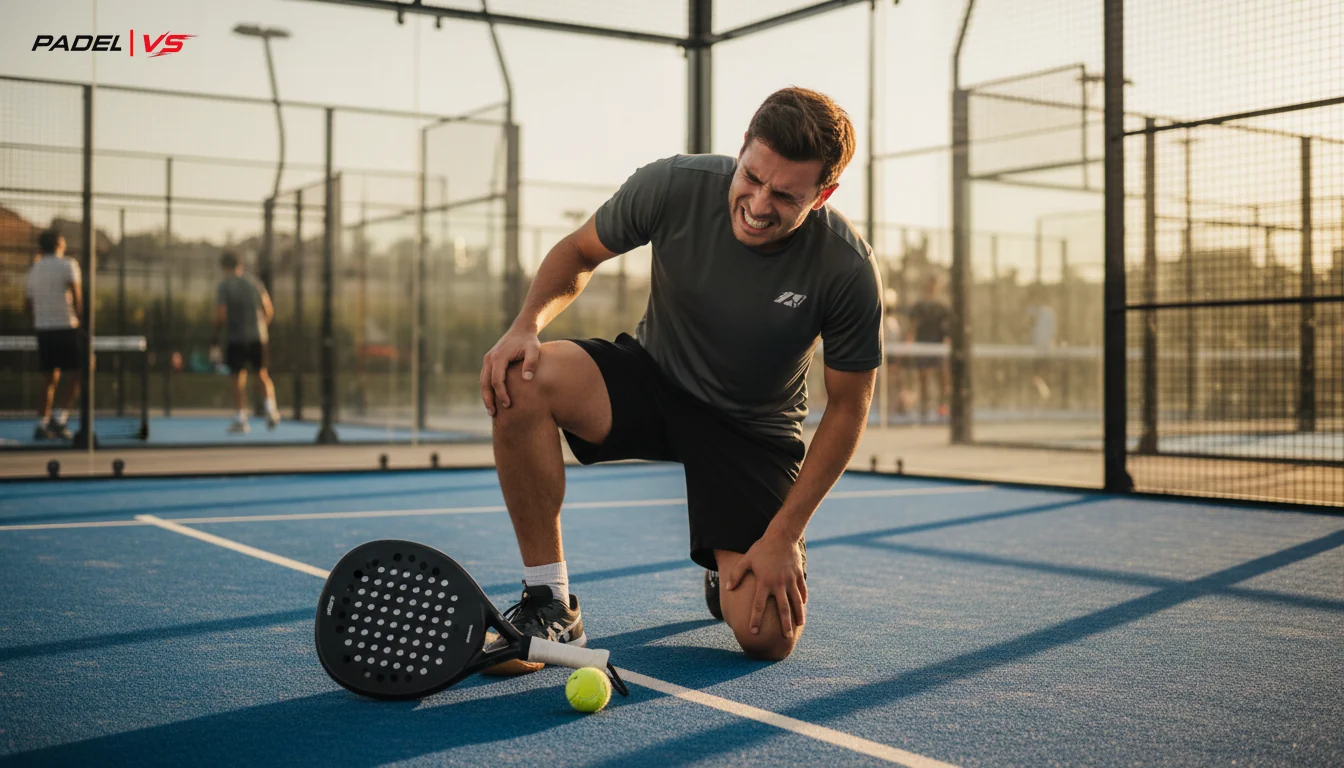
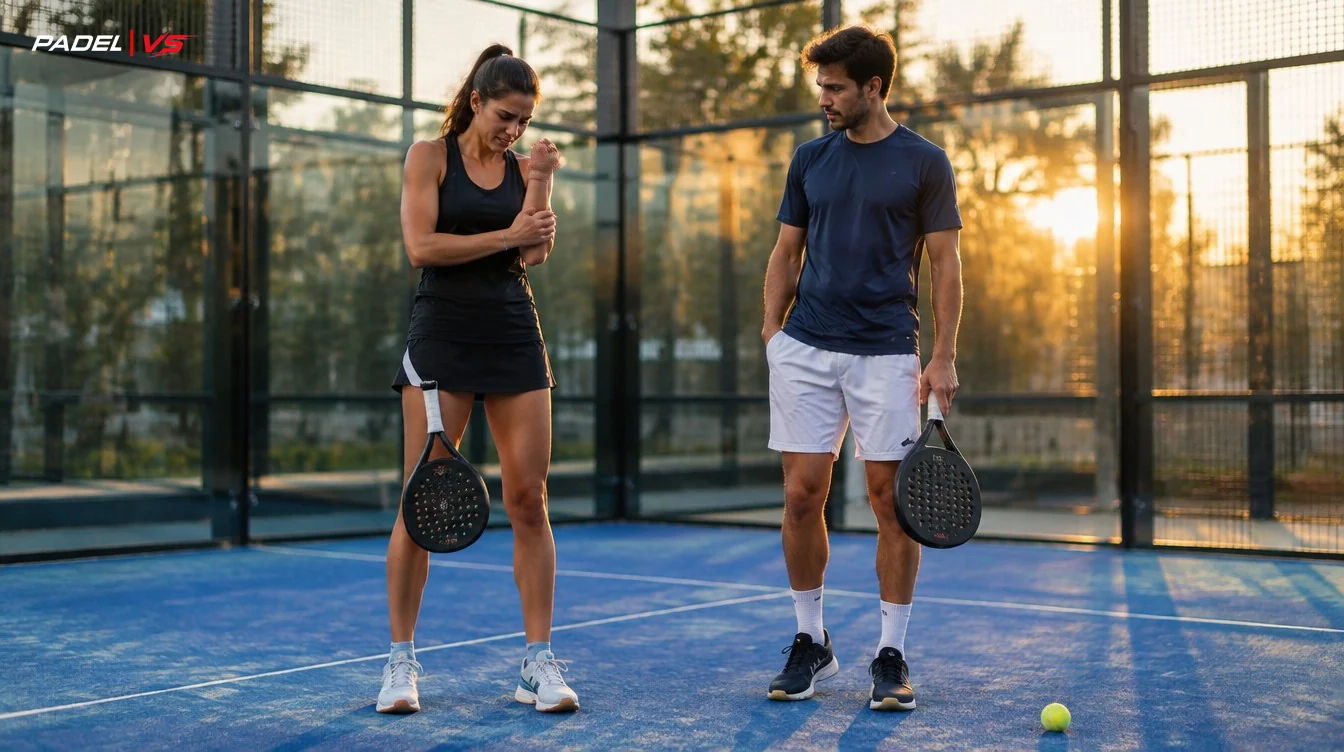
If you play padel more than twice a week, it's only a matter of time before you feel a strange twinge in your wrist after a mishit bandeja or an unexpected rebound off the glass. That's not a coincidence: the wrist is one of the most demanded joints in this sport, and also one of the most neglected in players' physical preparation. This guide explains why it happens, how to catch it early, and what concrete exercises you can do to keep competing without becoming another overuse injury statistic.
Why the Wrist Takes So Much Punishment in Padel
Unlike tennis, where the swing tends to be more linear with a longer arm path, padel forces the wrist to work in tight spaces, with explosive strikes and, above all, unpredictable rebounds off the glass and back walls. Every time you return a ball that shoots off the back wall at a strange angle, your wrist makes an almost instant micro-adjustment to correct the paddle's angle. Multiply that by 200-300 shots in a competitive match and you'll understand why this joint accumulates so much stress.
The shots that stress the wrist the most are:
- The bandeja: requires wrist stability at the moment of impact to control trajectory without excessive arm power.
- The víbora: combines forearm rotation with a more open wrist snap, generating tension on the ulnar side (the pinky side).
- The smash: the final "whip" motion overloads the extensor tendons if technique isn't clean.
- Wall returns with little reaction time: force the wrist to correct the paddle angle in fractions of a second, without support from the rest of the body.
The structure most commonly affected is the triangular fibrocartilage complex (TFCC), a kind of shock absorber between the ulna and carpal bones. It's extremely common among padel players and is often mistaken for a simple "sprain" when it's actually a progressive wear injury.
The Most Common Causes of Wrist Pain in Padel
1. Faulty Grip and Stroke Technique
A frequent mistake, especially in Quinta and Cuarta categories (under 1000 ELO in PADEL VS's system), is using the wrist as the main engine of the shot instead of the shoulder and torso. This creates excessive repetitive flexion-extension that the tendon isn't designed to absorb long term.
2. A Paddle That's Too Heavy or Poorly Balanced
High-end paddles typically weigh between 360-375 grams, with weight distributed toward the head for extra power on the smash. A recreational player using a competition paddle without the necessary forearm strength is literally loading extra weight onto the wrist with every shot. As a general rule: if you don't compete in Primera or Open (ELO above 1350), you'll likely benefit from a 355-365g paddle with a low-to-medium balance point.
3. Core Hardness and Vibration Transfer
While most paddles use EVA or solid Foam cores, the density of that core directly affects how much vibration the wrist absorbs. A very hard Foam core transmits more vibration on impact, which over time irritates tendons and the TFCC area.
4. Overtraining Without Recovery Periods
Playing back-to-back tournaments, training, and also joining social matches in the same week with no rest is the perfect recipe for tendinitis. The wrist needs 24-48 hours of active recovery after intense hitting sessions.
5. Lack of Baseline Strength and Mobility
Many amateur players never specifically train the forearm and wrist. They show up on court with weak support musculature that can't absorb the repetitive load of the game.
| Cause | Typical Sign | Affected Area |
|---|---|---|
| Faulty technique | Pain after bandeja or víbora | Extensor tendons |
| Paddle too heavy | Fatigue midway through the match | Forearm and wrist |
| Excessive vibration | Tingling sensation after impact | TFCC |
| Overuse without rest | Pain that worsens over days, doesn't improve | Cumulative tendinitis |
| Lack of baseline strength | Instability on backhand strikes | Wrist ligaments |
Warning Signs: When the Pain Is No Longer Normal
Mild discomfort after an intense match can be normal. What is not normal is the following:
- Pain that persists more than 48-72 hours after playing.
- Visible swelling or localized warmth in the wrist.
- A "click" or snapping sensation when rotating the wrist.
- Loss of grip strength (the paddle slips, or you struggle to close your fist).
- Nighttime pain that wakes you up.
- Tingling or numbness extending into the fingers.
"Pain that comes and goes during the same match is a warning, not a coincidence. The body doesn't complain without a reason."
If you identify two or more of these signs, the right move is to stop immediately, not to "push through" the weekend tournament. Playing through an active injury often turns a two-week recovery into a two-month one.
Exercises to Strengthen and Protect the Wrist
Prevention doesn't require fancy equipment. With a resistance band, a stress ball, and a light dumbbell (1-3 kg), you can build a 10-15 minute routine, three times a week.
1. Wrist Curls with a Light Dumbbell
Rest your forearm on a table with your hand hanging off the edge, holding a 1-2 kg dumbbell. Raise and lower the wrist in a controlled motion. 3 sets of 15 reps per side.
2. Radial and Ulnar Deviation
Holding the dumbbell vertically (like a hammer), move the wrist side to side without moving the forearm. This exercise directly trains the movement pattern demanded by the víbora. 3 sets of 12 reps.
3. Pronation-Supination with a Resistance Band
Anchor the band at a fixed height, hold it with your elbow tucked against your body, and rotate the forearm inward and outward. This mimics the preparation motion of the bandeja. 3 sets of 12 per side.
4. Progressive Grip Squeeze
Use a stress ball or grip trainer. Squeeze for 5 seconds, release for 5 seconds. 3 sets of 10-12 reps. This directly strengthens your ability to hold the paddle without compensating with tendon tension.
5. Joint Mobility (Wrist Circles)
Before every training session, do 20 wrist circles in each direction, with and without the paddle in hand. This simple warm-up significantly reduces the risk of acute injury.
6. Flexor and Extensor Stretches
With your arm extended, flex the wrist down and up, assisting with your other hand, holding each position 20-30 seconds. Do this after playing, not before.
| Exercise | Sets x Reps | Frequency |
|---|---|---|
| Wrist curls with dumbbell | 3x15 | 3x/week |
| Radial/ulnar deviation | 3x12 | 3x/week |
| Pronation-supination with band | 3x12 | 2-3x/week |
| Progressive grip squeeze | 3x10-12 | Daily |
| Wrist circles | 20 per direction | Before every session |
What to Do If Your Wrist Already Hurts
If you already have active discomfort, the most effective initial protocol is still the POLICE method (an evolution of the classic RICE): Protection, Optimal Loading, Ice, Compression, and Elevation. In practice:
- Stop the activity causing the pain (yes, even if it's your club's tournament final).
- Apply ice for 15-20 minutes, 3 times a day, during the first 48-72 hours.
- Use a compression wrist brace or light splint during everyday activities.
- Avoid complete rest: gentle, pain-free movement actually helps tissue recovery.
A consultation with a sports physiotherapist in Mexico typically costs between $28-50 USD ($500-900 MXN aprox) per session, and in most cases of mild tendinitis, 4-6 sessions combined with the exercises above get players back on court without relapse.
"It's not about quitting padel. It's about playing in a way that lets you keep playing ten years from now."
Choosing the Right Paddle to Protect Your Wrist
Beyond brand or design, there are three factors to check before buying your next paddle:
- Weight: 350-365g if you play Quinta, Cuarta, or Tercera (under 1180 ELO); up to 375g only if you already compete in Primera or Open with a solid physical base.
- Balance: low or medium for players prioritizing control and protecting the wrist; head-heavy only for players with refined technique and trained forearm strength.
- Core: soft Foam or EVA if you have a history of wrist discomfort; avoid hard rubber cores built purely for power.
How Your Level and Community Play a Role in Prevention
At PADEL VS we built the category system (Quinta, Cuarta, Tercera, Segunda, Primera, and Open) precisely so you play opponents at your real level. This isn't just about competitiveness: playing evenly matched games reduces the physical stress spikes that happen when a Quinta player tries to "force" Segunda or Primera-level shots to keep up with a stronger opponent — one of the silent causes of overuse injuries. Matching your competitive level to your real ELO is, indirectly, also protecting your wrist.
If you're in recovery, use the time to build a training community: finding partners at a similar level through PADEL VS lets you schedule controlled-intensity sessions instead of unpredictable social matches where you end up playing maximum-effort points before your body is ready.
When to See a Specialist
Seek medical attention if the pain doesn't improve after a week of relative rest and gentle exercises, if there's persistent swelling, or if you feel real joint instability (like the wrist is "giving way" to one side). A hand and wrist specialist may order an MRI to rule out a TFCC tear or De Quervain's tenosynovitis, both common among padel players with 3-4+ years of regular play.
Wrist pain doesn't have to mean the end of your season. With correct technique, the right equipment, and a 10-minute prevention routine three times a week, most recreational and competitive players can keep stacking matches, tournaments, and ELO points without their body sending them the bill.