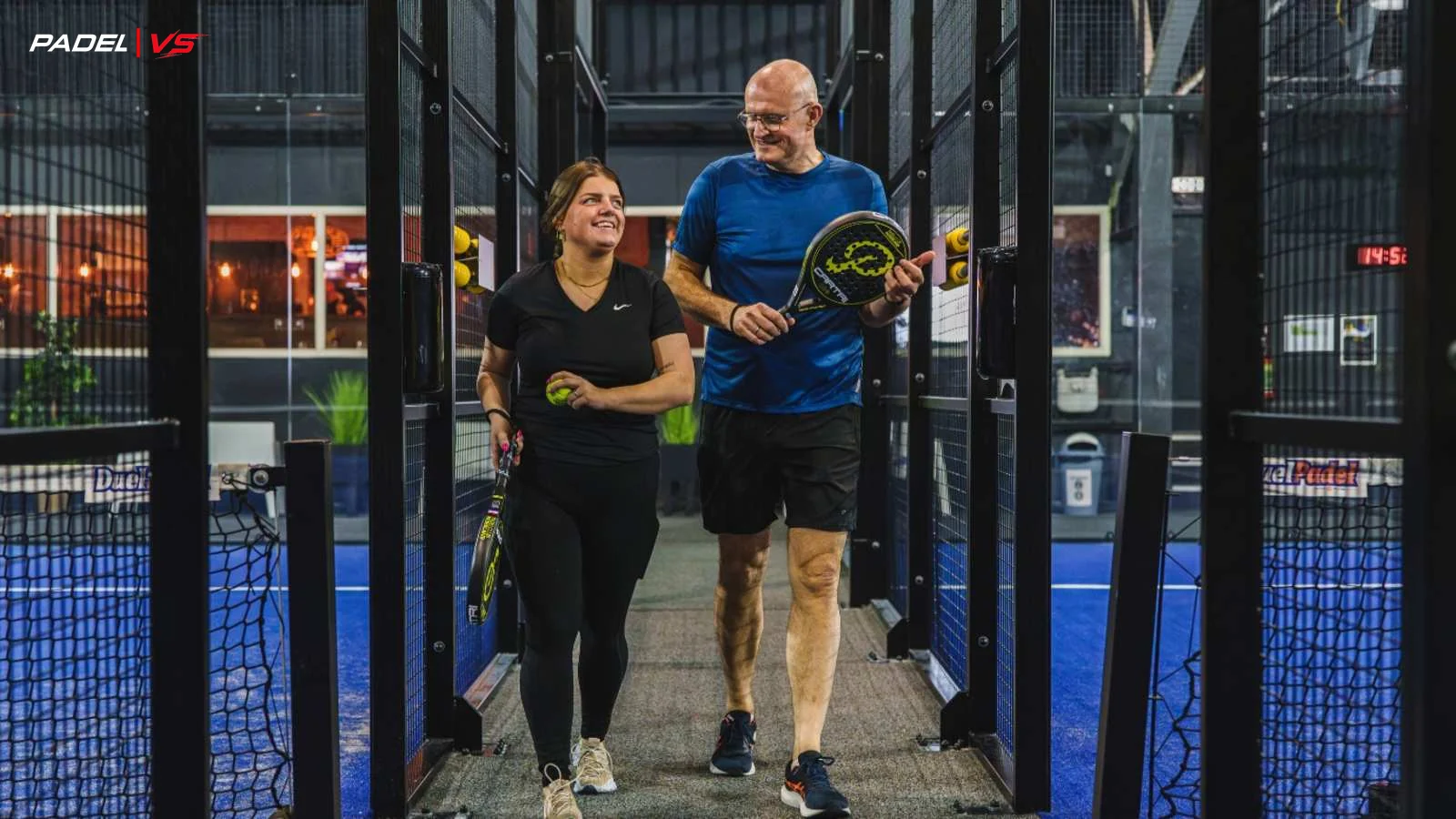
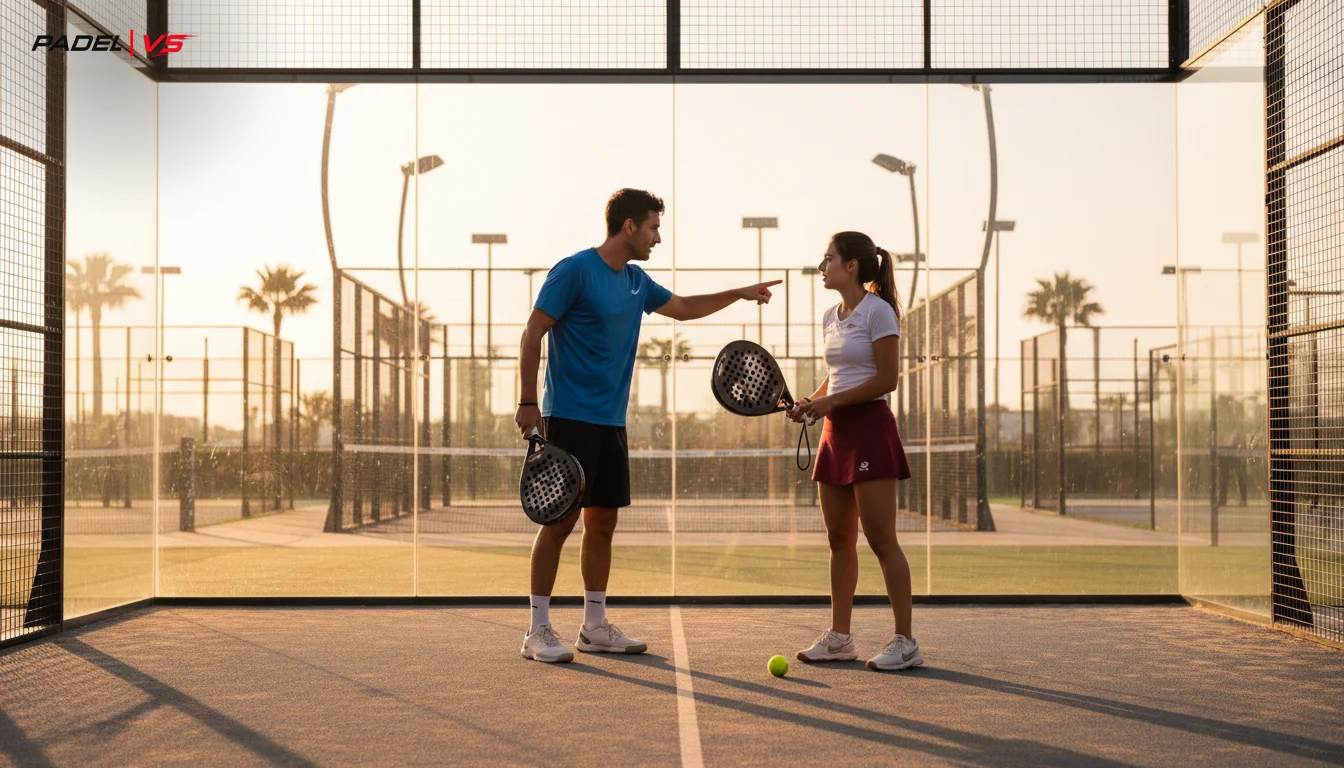
Most amateur padel players don't struggle with lack of talent, they struggle with lack of time. Work, family, city traffic, and court rentals that run $22-44 USD ($400-800 MXN aprox) per hour make playing more than twice a week unrealistic for most people. The good news is you can improve consistently with just two court sessions a week, as long as the rest of your week is designed with intention.
The real problem: limited time, high expectations
It's common to see players in the Cuarta or Tercera category (850-1180 ELO in the PADEL VS system) who play twice a week for months and feel stuck. The issue isn't frequency, it's the lack of structure. Playing two casual matches a week without any technical goal is fun, but it isn't training — it's just playing. And playing without purpose just repeats your current mistakes instead of correcting them.
A real training routine doesn't depend on how many hours you spend on court, it depends on what you do during those hours and what you do outside of them. Players who climb from Tercera to Segunda (1180-1350 ELO) despite limited availability almost always share a pattern: they train the physical and technical side off-court so their two weekly sessions do triple duty.
Diagnose before you schedule: what's actually missing?
Before building any calendar, answer three questions honestly: is your limiting factor physical (you fade in the third set), technical (your bandeja and víbora are still inconsistent), or tactical (you don't know when to move to the net)? Most amateur players struggle with a mix of all three, but there's usually one that weighs more heavily than the others.
Physical vs. technical vs. tactical
In padel, unlike tennis, long points with back walls 3 to 4 meters high and side glass generate more shot repetitions per point. That means anaerobic endurance (short, intense repeated efforts) matters more than pure cardiovascular endurance. If you're gassed after 40 minutes, your priority should be physical work. If you're missing your bandeja under pressure but arrive fresh in the third set, your priority is technical.
The ideal weekly structure with only 2 court sessions
Here's the core idea: if you only have two available court slots, the rest of your week can't be passive. You need to distribute four elements across your off-court days: strength, mobility, short cardio, and real rest. Here's a reference structure for a 7-day week:
| Day | Activity | Duration |
|---|---|---|
| Monday | Shoulder, hip and wrist mobility + core activation | 20-30 min |
| Tuesday | Court Session 1: technique and game patterns | 90 min |
| Wednesday | Functional strength (legs, core, shoulder) at gym or home | 45-60 min |
| Thursday | Short interval cardio (bike, rowing, or running) | 25-30 min |
| Friday | Court Session 2: competitive match with a clear goal | 90-120 min |
| Saturday | Light mobility + wrist work with resistance band | 15-20 min |
| Sunday | Full rest | - |
Adjust the days to fit your real schedule; what matters isn't hitting this exactly, it's respecting the logic: never stack two heavy strength days right before a court session, and always take a full rest day before the week's most important match.
What to do on your off-court days
Strength and power
Padel demands explosive power over short distances: the sprint toward the back glass, the lateral push for the víbora, the jump on a smash. Two 45-minute functional strength sessions per week — squats, lateral lunges, Romanian deadlifts, rotational core work — transfer directly to the court. You don't need a high-performance gym; dumbbells, a resistance band, and your own body weight are enough for players from Quinta up to Segunda.
Mobility and injury prevention
The most common amateur padel injury is tennis elbow, caused by repeated impact from the bandeja and víbora with a 350-375 gram racket that isn't well matched to your strength level. Ten minutes of daily wrist and shoulder mobility work drastically reduces that risk. Add hip mobility too: padel demands constant torso rotation, and a stiff hip ends up transferring that rotation load to your lower back.
Wall work and shadow padel
If you have access to a frontenis-style wall, or even a smooth wall at home, 15 minutes of ball striking against it trains hand-eye coordination without using your booked court time. "Shadow padel" — repeating the technical motion of the bandeja, víbora, and lob without a ball, in front of a mirror — sounds simple, but it fixes posture errors that go unnoticed on court because you're focused on the ball instead of your body.
"You don't improve at padel because of the hours you play, you improve because of the hours you train with a specific purpose in mind."
Getting the most out of your 2 court sessions
Session 1: technique and patterns
Reserve your first weekly session for working, not competing. Practice specific patterns: bandeja-víbora-back wall retrieval, defensive lob exit, kick serve targeting the opponent's backhand. Play restricted points (for example, you can only win the point if you finish it at the net) to force new tactical decisions. This session works best with a similarly skilled partner or a coach, rather than with friends who just want to rally.
Session 2: competitive match with purpose
Your second session should be an actual match, ideally against opponents with an ELO similar to or slightly above yours. This is where you apply what you worked on in Session 1 under real pressure. Before starting, set a concrete goal for that match: "I'm moving to the net every time I get the chance" is far more useful than "I'm going to play well."
Use your ELO to measure real progress
One of the biggest mistakes when training with limited time is measuring progress by feeling ("I felt like I played better") instead of by objective data. On PADEL VS, every logged match adjusts your ELO according to the official category system, giving you an accurate picture of your evolution month over month, independent of subjective perception.
| Category | ELO Range | Description |
|---|---|---|
| Quinta | <850 | Where it all begins. Learn without pressure. |
| Cuarta | 850-1000 | You already understand the game. |
| Tercera | 1000-1180 | Real competitive padel. |
| Segunda | 1180-1350 | One step from the top. |
| Primera | 1350-1550 | Padel elite. |
| Open | ≥1550 | The maximum category. |
The women's system uses the same ranges with small adjustments (Sexta <800). If your ELO moves consistently upward over three months, your routine is working, even if you're only playing twice a week. If it plateaus, it's time to review which part of the plan — physical, technical, or tactical — needs more attention.
Tools to track your progress
On PADEL VS you can log your matches and check your ELO history from the web at padelvs.com, from the Telegram Mini App via @padelvsbot, or by messaging directly with the WhatsApp bot. You don't need to download any extra app; all your tracking lives inside the channels you already use every day. That's especially useful when your time is limited: you can review your progress during your commute instead of sitting down to analyze stats on a computer.
Common mistakes when training with limited time
- Always playing with the same partners at the same level: it doesn't expose you to different playing styles or force you to adapt your tactics.
- Skipping the warm-up to save time: it actually shortens your useful session time, because the first 15 minutes get spent adjusting your body instead of working on technique.
- Not resting between sessions: playing Tuesday and Wednesday back-to-back and then not touching a racket for ten days creates fatigue spikes that turn into injuries, not progress.
- Only training what you're already good at: it's tempting to repeat the bandeja you've already mastered instead of working on the víbora that still gives you trouble.
"The player who trains twice a week with a plan will, in six months, outperform the one who plays four times a week with none."
A sample 4-week plan
Week 1: diagnosis. Play your two normal sessions but record a clip of each match on your phone to identify your most frequent error pattern (are you losing points at the net? at the back? on serve?). Week 2: introduce the strength and mobility work described above, and dedicate court Session 1 exclusively to fixing the identified error. Week 3: keep the physical work going, add 15 minutes of shadow padel twice a week. Week 4: check your recent ELO on PADEL VS and adjust the plan based on what actually moved the needle.
This four-week cycle is short enough to keep you motivated and long enough to see real change, especially in the Cuarta and Tercera categories, where technical improvement shows up quickly once there's structure behind it.
Consistency beats quantity
You don't need to play five times a week to improve at padel. You need the hours you do have available — both on and off the court — organized around a clear goal. Two well-used court sessions, combined with functional strength, mobility, and honest ELO tracking, build real progress quarter after quarter. Limited time isn't an excuse to stop improving; it's simply the filter that forces you to train smart instead of training a lot.