

Padel has its own language. When you hear experienced players talk about a bajada de pared, a defensive globo, or the feared saque dorado, it can sound like a secret code. This glossary of 30 essential terms is designed so you know exactly what's being discussed—both on and off the court.
Why does vocabulary matter in padel?
Padel is not tennis with walls, nor is it outdoor squash. It's a sport with its own internal logic, specific ruleset, and a jargon that reflects that identity. Knowing the right terms helps you communicate better with your doubles partner, understand your coach's instructions, and make faster decisions under pressure. At competitive levels like Tercera (1000-1180 ELO) or Segunda (1180-1350 ELO), the difference between winning and losing a point often comes down to whether both players on a team understand the same tactical call without needing to speak.
"Padel is learned by the body, but understood by the mind. Knowing the vocabulary is half the journey."
The 30 essential terms
Court and structure terms
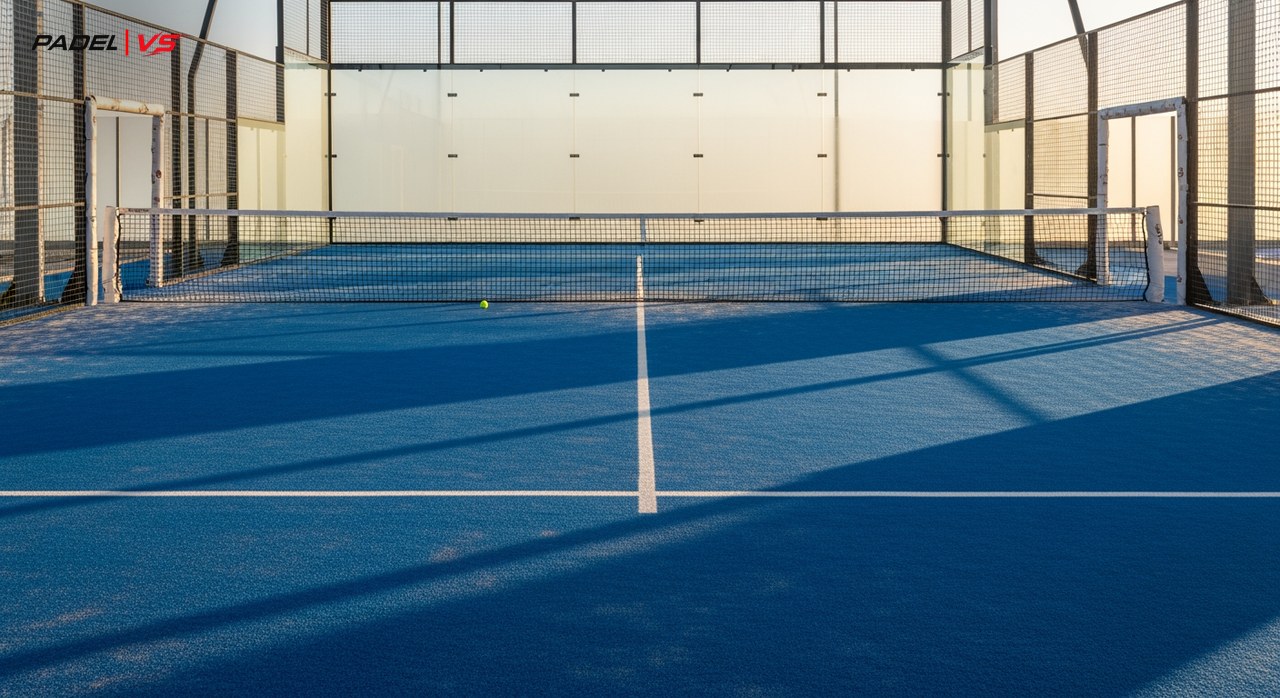
Before talking about shots, you need to know the stage. A padel court measures 10 meters wide by 20 meters long, enclosed by tempered glass walls and metal mesh. These are the structural terms you must master:
- Glass wall (cristal): The rear wall of the court, typically made of tempered glass 8 to 12 mm thick. It's an active playing surface: the ball can bounce off it and remain in play. Advanced players use it strategically to recover seemingly lost points.
- Metal mesh (malla metálica): The upper portion of the side and rear walls, usually starting from about 3 meters height on the sides. The ball can strike it and stay in play, though the bounce is far less predictable than off glass.
- Service line: The line that defines the service zone, located 3 meters from the net. On a serve, the ball must bounce inside the diagonally opposite service box.
- Service box (cajón): Each of the four rectangles of approximately 5 × 4.5 meters that mark the serving areas. The serve must land in the diagonal opposite box—much like tennis, but with wall rebounds adding complexity.
- Side corridor: The roughly 1-meter-wide strips between the lateral lines and the glass side walls. These are active playing zones; the ball can travel through them and remain valid as long as it bounced first within the court boundaries.
Rules and scoring terms
- Golden point (saque dorado): One of the most significant rule changes in recent years. When the score reaches deuce (40-40), instead of playing advantage points, one single decisive point is played. The receiving team chooses which side they want to receive on. At PADEL VS we apply this rule across all tournament formats to keep matches moving and reduce dead time.
- Tie-break: The tiebreaker system used when a set reaches 6-6. Individual points are played until one team reaches 7 with a 2-point margin (or in a deciding match tie-break, up to 10). Sides change every 6 points.
- Super tie-break (Match tie-break): Played instead of a full third set, typically first to 10 points with a 2-point lead required. This is the standard format in most amateur tournaments to limit total match time.
- Service fault: A serve is invalid if the server steps on the service line, if the ball doesn't land in the diagonal service box, if it hits the net without crossing, or if the server tosses the ball and lets it drop without striking it. Two consecutive faults award the point to the receiving team.
- Service let: When the ball clips the net tape during a serve and lands in the correct service box. The serve is replayed with no penalty. If it clips the net and lands outside the box, it counts as a fault.
Offensive shot terms
- Smash: The most powerful shot in padel. Executed overhead when a high ball arrives, with the goal of slamming it into the back glass or directly into the ground to finish the point. There are three main types: the direct smash (into the ground), the smash into the back glass (designed to bounce out of reach), and the three-wall smash (side glass, then back glass, then out).
- Vibora: A lateral attack shot executed at shoulder height with a horizontal, sliced trajectory. The ball travels flat and fast, making it extremely difficult for opponents to read. It's one of the most visually impressive and tactically effective shots in modern padel.
- Bandeja: Similar to the vibora but with a more vertical trajectory. Executed slightly above head height with a sliced swing that directs the ball toward the side glass. Ideal for maintaining net position while keeping pressure on the opponents.
- Rulo: A lateral attack shot with topspin. The ball rises, strikes the back glass with force, and exits fast and elevated—making the return extremely difficult. It's particularly effective against teams defending close to the glass.
- Drop shot (dejada): A soft, short shot—with or without spin—that makes the ball fall just over the net in the opponent's court. It's devastating when the opposing team is in a defensive position near the back glass.
Defensive and control shot terms
- Lob (globo): The quintessential defensive shot. Executed by sending the ball in a high arc to pass over the opposing team (who are typically at net) and land near the back glass. A well-executed lob can completely reverse the tactical position of a point.
- Wall drop (bajada de pared): The action of striking the ball after it has bounced off the back or side glass, before it touches the ground a second time. Mastering this shot is essential for playing from the back of the court: the ball exits the glass at an angle and speed that must be read correctly.
- Contrapared: A shot executed after the ball bounces off your own back wall. The player lets the ball travel past them toward the glass, then retrieves it off the bounce and redirects it. This is a fundamental skill that separates experienced players from beginners—and there's no real English equivalent, which is why the Spanish term sticks.
- Volley (volea): A shot taken before the ball touches the ground, typically executed from a net position. Can be forehand or backhand. In padel, the control volley is just as important as the attack volley—often more so.
- Chiquita: A low, controlled shot that passes just above the net on a very flat trajectory. It's hard to counter because it forces the opponent to hit upward, surrendering the initiative. Again, the Spanish name is universally used even in English-speaking padel communities.
Tactical and positional terms
- Net position: The most favorable tactical position in padel. Both players of a team stand close to the net (approximately 1.5 to 2 meters), ready to volley and attack. Controlling the net is the primary tactical objective at intermediate and advanced levels.
- Barrera (parallel formation): A tactical formation where both players stand parallel to the net, covering the full width of the court. It's the ideal attacking position and signals a team that's comfortable at net.
- Down-the-line (paralelo): A shot sent along the side wall, parallel to the net. Less risky than a cross-court shot because the net is lower in the center, and the trajectory is more direct—but also more predictable for the opponent.
- Cross-court (cruzado): A shot sent diagonally across the court. Technically more demanding (since you're passing over the higher part of the net near the posts), but it opens up the court geometry and can unbalance the opposing team.
- Down the middle: A tactic of sending the ball between the two opposing players to generate hesitation about who should hit it. Particularly effective against teams that lack communication or have an undefined center responsibility.
Equipment terms
- Padel racket (pala): Unlike tennis, a padel racket has no strings—it's solid, perforated with holes, and typically made from fiberglass or carbon fiber with an EVA or foam core. Rackets are classified by shape (round, diamond, teardrop), material, and hardness. Standard weight ranges from 340 to 385 grams. A good intermediate-level racket typically costs $80-165 USD ($1,500-3,000 MXN approx).
- Overgrip: The thin adhesive tape wrapped over the racket handle to improve grip and absorb sweat. It's a consumable item—changed frequently by active players. Usually costs $1.60-4.50 USD ($30-80 MXN approx) per unit.
- Protective tape (manguito): The thick adhesive tape that protects the racket frame from impacts against the glass or ground. Essential for players who regularly practice wall-bounce shots, as the frame takes significant wear over time.
- Padel ball: Visually similar to a tennis ball but with lower internal pressure (between 4.6 and 5.2 kg/cm²) and a softer feel. The lower pressure produces a more controlled, predictable bounce—adapted to the reduced court space of 200 m². Once opened, a ball loses pressure within a few hours of play.
- Wristband and knee pad: Widely used protective and comfort accessories in padel. The wristband helps absorb repetitive impact from striking; the knee pad protects the joint during lateral movements and dives. Essential for players who compete regularly.
Quick reference table: shots by game situation
| Game situation | Recommended shot | Tactical goal |
|---|---|---|
| High ball at net (your team attacking) | Smash or bandeja | Finish the point or push to the back |
| Opponents at net, your team at back | Lob (globo) | Recover position and reverse momentum |
| Short ball close to opponent's net | Drop shot (dejada) | Pull opponent away from the glass |
| Defending from the glass | Bajada de pared / contrapared | Buy time and reposition |
| Lateral ball at mid-height | Vibora or rulo | Attack toward the side glass |
| Volleying from net | Chiquita or control volley | Maintain net dominance |
How does a Quinta player learn this vocabulary?
If you're currently in the Quinta category (<850 ELO), it's completely normal if many of these terms still feel unfamiliar. That's okay: vocabulary gets internalized through play. What we recommend is starting to use it actively during training sessions. When your coach says "bajada de cristal," you already know what it means. When your partner shouts "globo," you understand the instruction in half a second. That significantly accelerates the learning curve.
At PADEL VS, the ELO rating system tracks your progression from your very first official match. As you move up categories—from Quinta to Cuarta, from Cuarta to Tercera—you'll encounter opponents who use these shots with greater intentionality. Knowing the name of what you're seeing helps you anticipate, ask your partner to execute it, and eventually incorporate it into your own game.
"You don't need to execute a perfect vibora to know when to call for one. Vocabulary comes before technique, and that's perfectly fine."
Terms that confuse beginners
Some terms create confusion because they sound similar or because their meaning in padel differs from tennis usage:
- Fault vs. let: A service fault counts toward a double fault and can cost you the point. A service let (ball clips the net and lands in the correct box) is simply replayed with no penalty. Understanding this distinction avoids frustrating arguments mid-match.
- Smash vs. bandeja vs. vibora: All three are aerial attack shots, but with very different trajectories and effects. The smash goes with power into the ground or glass; the bandeja goes with slice toward the side glass; the vibora travels low and horizontal. Using the wrong one in the wrong moment is a common mistake in the Cuarta and Tercera categories.
- Contrapared vs. bajada de pared: The contrapared is when you let the ball pass behind you and play it off your own back wall. The bajada de pared is simply executing a shot after the bounce off the rear wall, regardless of whether the ball came from the front. The distinction matters when communicating with your partner about who takes the ball.
How to keep learning
This glossary is a starting point. The next step is watching commented matches, listening to your coach with these terms in mind, and above all—playing. In PADEL VS you can log your matches and compete in ELO-categorized tournaments so you always play against opponents at your level. Open padelvs.com in your browser, or access our Mini App in Telegram via @padelvsbot, to see upcoming tournament slots available in Cancún and the cities where we're currently building the community.
Padel vocabulary isn't a test you need to pass before stepping on court: it's a tool that becomes natural the more you play. Save this glossary, share it with your doubles partner, and start using it in your next match.