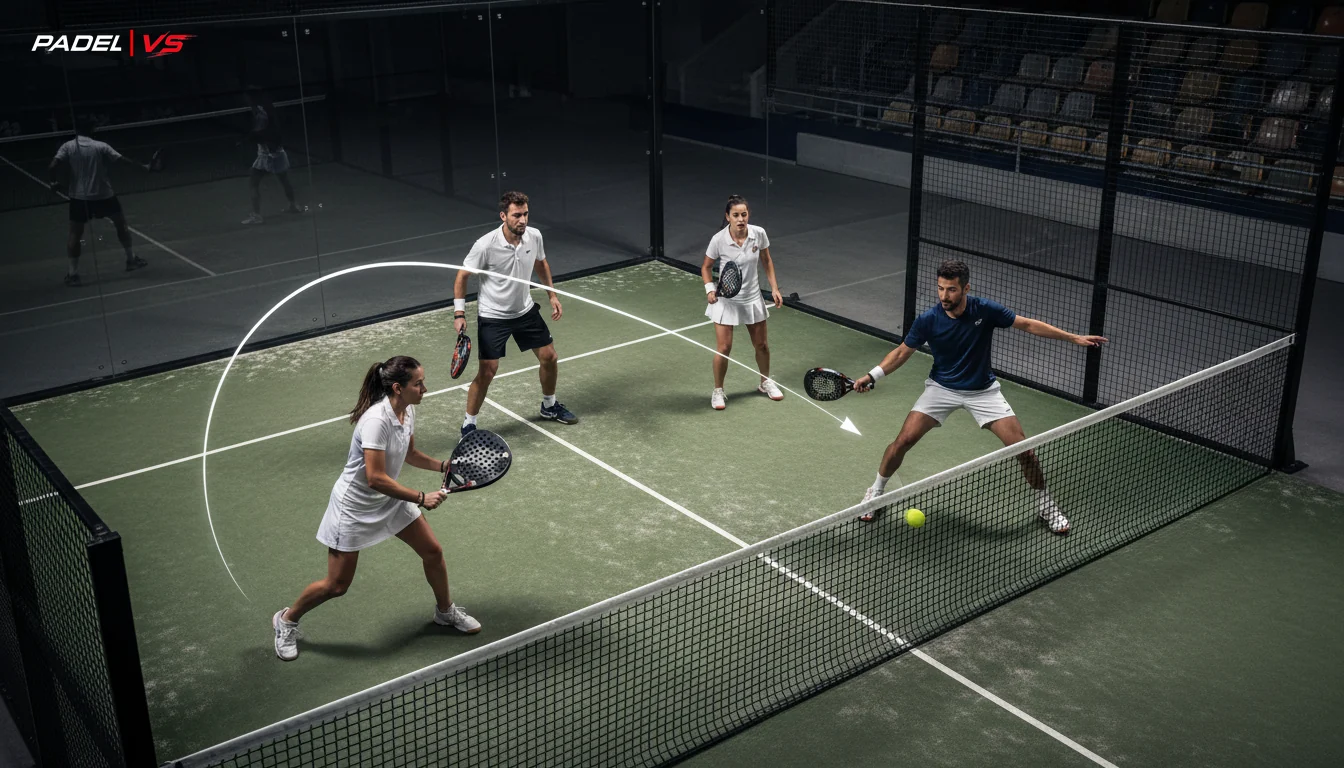

Choosing a padel partner is one of the most important decisions for your development as a player. The right pair can take you to tournament victories that seemed impossible, while an incompatible partner turns every match into an uphill battle, regardless of your individual technical level.
Unlike tennis, where you shine or fail alone, padel is a pure doubles sport. Your partner isn't simply someone occupying the other side of the court: they're your strategic associate, your emotional support in critical moments, and the person with whom you build each point from serve to finish. At PADEL VS we've observed that well-aligned pairs climb faster in the ELO system than technically superior players who are poorly matched.
The Anatomy of a Successful Partnership: Beyond Technique
Many players make the mistake of seeking the "best available player" as a partner, assuming superior technical level guarantees results. Reality is more complex. A functional partnership is built on four fundamental pillars:
1. Technical Compatibility and Position Roles
Modern padel defines two clear roles: deuce side (right) and ad side (left). Each position has specific responsibilities that go beyond dominant hand:
| Position | Key Responsibilities | Ideal Profile |
|---|---|---|
| Deuce Side (Right) | Return of serve, center control, parallel finishing, defensive lobs | Patient player, tactical vision, consistency over power |
| Ad Side (Left) | Serving, finishing volleys, backhand window protection, aggressive overheads | Aggressive player, good reflexes, competitive temperament |
If both players prefer deuce or both only feel comfortable on ad side, the partnership starts with a structural disadvantage. In categories from Tercera (1000-1180 ELO) upward, this specialization becomes critical. A Cuarta player (850-1000 ELO) might survive constantly switching positions, but it limits their development and their partner's.
2. Balance of Playing Styles
The most effective partnerships combine complementary styles, not identical ones. Identifying your own style is the first step:
- Control Player: Prioritizes point construction, minimizes unforced errors, prefers deep balls and lobs over risky smashes. Average 6-8 shots per point won.
- Aggressive Player: Seeks quick finishes, dominates the net, takes calculated risks with winning volleys. Average 3-5 shots per point won.
- Hybrid Player: Adapts game according to situation, can build or finish as the match requires. Greater versatility but less specialization.
The classic formula that works in 70% of competitive partnerships: a control player on deuce side + an aggressive player on ad side. The deuce player sets up, the ad player finishes. When both are aggressive, unforced errors skyrocket. When both are defensive, you constantly surrender initiative.
"Your ideal partner isn't someone who plays like you, but someone who compensates for what you don't do well. A partnership is a complete organism, not the sum of two identical halves."
3. Goal Alignment and Commitment
This is the area where most partnerships collapse, even with good on-court chemistry. Before committing to a long-term partner, align expectations on:
- Playing frequency: Do you play once per week or four times? Do you train in addition to competing?
- Financial investment: Federated tournaments cost $22-44 USD ($400-800 MXN aprox) per pair. Premium club tournaments can reach $80-165 USD ($1,500-3,000 MXN aprox). Are both willing to invest?
- Competitive ambition: Are you seeking social fun or climbing categories? Are you willing to analyze recorded matches, work on specific weaknesses?
- Schedule availability: At PADEL VS we see that 40% of partnerships separate due to schedule incompatibility, not on-court problems.
A Tercera player who trains 3 times weekly and wants to reach Segunda (1180+ ELO) won't work with a partner who can only play Sundays and views padel as casual hobby. Neither is right or wrong, they're simply incompatible.
4. Communication and Personality
Padel is a sport of constant communication: who takes center balls, tactical changes during the point, adjustments between games. Personalities must allow honest dialogue without destructive conflict.
Signs of good communicative compatibility:
- Can discuss errors without it becoming personal
- Give each other constructive feedback between points
- Genuinely celebrate each other's successes
- Assume own responsibility before pointing out partner's errors
- Maintain positive energy even when losing
Red flag signs:
- One constantly blames the other for defeats
- Visible negative body language (throwing racket, frustration gestures toward partner)
- Inability to adapt: "we always play my strategy"
- Lack of support in critical moments (10-10 in tiebreak and there's tension instead of confidence)
The Search Process: Where and How to Find Partners
Finding the right partner requires strategy. It's not about playing with the first person who appears and crossing your fingers.
Method 1: Play with Multiple Candidates ("Dating" Model)
Before committing to a partner for a tournament or season, play at least 5-8 practice matches with different people. Observe:
- Performance consistency: Do they play the same when winning 5-2 as when losing 2-5?
- Tactical adaptability: Can they change plans when initial strategy isn't working?
- Post-match energy: Do they want to analyze what went right/wrong or just go home?
- Punctuality and formality: Systematically arriving late to practice matches signals low commitment.
At PADEL VS, the matchmaking functionality helps players connect with others of similar ELO. You can use casual matches as "trials" before formalizing a pair for competitive tournaments. It's completely valid and recommended to play with 3-4 different people in a month before deciding who to compete with seriously.
Method 2: Evolution from Friendship or Existing Relationship
Many players start playing with friends, family members, or romantic partners. This has advantages (pre-existing trust, easy communication) and disadvantages (difficult to separate on-court tension from personal relationship).
If playing with your romantic partner or best friend:
- Establish "court rules": what happens in the match stays in the match
- Clearly define whether the goal is fun or serious competition
- Have backup plans for when the on-court relationship affects the personal one
- Celebrate that some days you don't play together to maintain freshness
We've seen married couples win Primera tournaments (1350-1550 ELO) and also divorce over conflicts originating on court. It's not automatically a good or bad idea, but requires extra emotional maturity.
Method 3: Platforms and Organized Communities
The digital era has transformed partner search. Current options in Mexico:
- PADEL VS: Intelligent matchmaking system based on ELO, preferred position, available schedules, and declared objectives. You can filter by category (Quinta, Cuarta, Tercera, etc.) and location in Mexico City, Cancún, and soon more cities.
- Club WhatsApp groups: Most clubs have member groups where matches are organized. Participate actively, offer to complete pairs, you'll gain reputation.
- Club and community Instagram: Post in stories that you're seeking a partner, specify your level (honestly), position, and objectives.
- Americano tournaments: Format where you rotate partners each match. Excellent for meeting many players quickly and evaluating who you have chemistry with.
The Litmus Test: First Matches Together
The first 3-5 matches with a new partner are decisive. Don't expect immediate perfection, but do observe trends:
What to Evaluate in First Matches
| Aspect | Positive Sign | Negative Sign |
|---|---|---|
| Communication | Constantly talking, defining who takes center balls, adjusting positions | Total silence or only talking to blame each other |
| Adaptation | Change tactics if not working, try different formations | Insist on same failing strategy entire match |
| Court coverage | Synchronized movements, few defensive gaps | Constantly colliding or leaving enormous spaces |
| Pressure management | Support each other in critical moments, positive energy | Visible tension, avoid looking at each other when making errors |
If after 5 matches together you still feel uncomfortable on court, it's probably not the right partnership. Basic chemistry should appear quickly, although perfect synchronization takes months.
The Adjustment Period: 3-6 Months of Building
Once you decide to commit to a partner, give it real development time. The best professional circuit partnerships take 6-12 months to reach their synchronization peak. As an amateur, expect at least 3 months of regular play before judging the pair's real potential.
Expected progress milestones:
- Month 1: Define fixed positions, establish basic signals ("yours", "mine", "center"), identify each other's strengths/weaknesses.
- Month 2: Begin anticipating partner's movements, develop 2-3 rehearsed plays from serve, improve defense of known weak points.
- Month 3: Fluid defensive synchronization, effective non-verbal communication, ability to read the match and adjust together without timeout.
- Month 6: Complete chemistry, instinctive plays, blind trust in each other's decisions, consistent competitive results.
"Padel partnerships are like fine wines: they need time to mature. The difference between an average pair and a championship one often isn't talent, but patience to build together."
Special Cases: Level Differences and Imbalances
What happens when you want to play with someone of different level? Does a partnership work where one is Tercera (1000-1180 ELO) and the other Cuarta (850-1000)?
When Partner is Higher Level
Advantages:
- Learn faster through exposure to better play
- Pushes you out of your comfort zone
- Access matches against superior opponents
Risks:
- Can create dependency: they "carry" the match, you don't grow
- Frustration if you feel you're hindering more than helping
- Relationship imbalance: not a partnership of equals
How to make it work: The superior player must consciously accept the mentor role. Playing together should have clear educational purpose. Establish specific objectives for the lower-level player ("this month you work return of serve until reducing direct errors to under 15%"). Avoid dynamics where the strong player simply compensates all the time.
When Partner is Lower Level
Advantages:
- Develop leadership and tactical vision
- Learn to build points with limited resources (useful in higher categories)
- Satisfaction of helping another improve
Risks:
- Can stagnate technically due to lack of demand
- Frustration if the other doesn't progress at expected pace
- Loss of competitiveness in your natural category
How to make it work: Clearly define that these matches are "coach mode", not your main competitive project. Maintain a second partner at your level or higher for matches where you demand maximum from yourself. Use matches with lower player as laboratory to test new strategies without result pressure.
The 10% Difference Rule
For balanced competitive partnerships, we recommend maximum 10% ELO difference. For example:
- Player A: 1050 ELO (Tercera) + Player B: 950 ELO (high Cuarta) = 10.5% difference, works.
- Player A: 1200 ELO (Segunda) + Player B: 900 ELO (low Cuarta) = 33% difference, probably doesn't work competitively.
At PADEL VS, the matchmaking system considers these differences and automatically suggests compatible ranges when searching for a partner.
Partnership Maintenance: How to Make It Last
Finding the right partner is just the beginning. Maintaining an effective pair long-term requires active work:
Successful Partnership Rituals
- Post-match review (5-10 minutes): Immediately after each match, discuss 2-3 things you did well and 1-2 you need to improve. Keep it constructive, never accusatory.
- Monthly video analysis: Record 1-2 matches per month and watch together. You'll notice patterns invisible in real-time: recurring defensive gaps, systematic technical errors.
- Quarterly specific training: Every 3 months, invest in 2-3 classes with a professional coach who watches you play and gives specific pair feedback. Approximate cost: $44-66 USD ($800-1,200 MXN aprox) per 90-minute session in Mexico City.
- Low-pressure test tournaments: Play 1-2 minor tournaments yearly just to test new things (different formations, rehearsed plays) without result pressure. It's competitive laboratory.
- Off-court communication: Maintain contact between matches. Share videos of interesting plays, discuss strategies against upcoming opponents. Connection builds off-court too.
When It's Time to Separate
Not all partnerships should be eternal. Signs it's time to seek a new partner:
- You've been together 6+ months and results are stagnant or worsening
- On-court conflicts are affecting personal friendship
- Life changes (relocation, work schedules, children arrival) make availability incompatible
- One of you evolves significantly faster (ELO difference exceeds 15%)
- It's simply no longer fun to play together
Separation can be friendly and professional. The best players at PADEL VS have 2-3 "ex-partners" with whom they maintain excellent relationships and occasionally play casual matches. Padel is a small community: keep doors open.
PADEL VS: Building Partnerships with Technology
At PADEL VS we're building specific tools to solve the matchmaking problem in padel. Our system considers:
- ELO and category: Matchmaking within compatible ranges (Quinta, Cuarta, Tercera, Segunda, Primera, Open)
- Preferred position: Filters players seeking the position complementary to yours
- Geographic and time availability: Only shows players with whom you can actually coordinate matches
- Declared objectives: Separates casual players from serious competitors
- Compatibility history: After playing with someone, you can rate the experience. The system learns and improves future suggestions.
We're in early months in Cancún with planned expansion to other cities in Mexico in 2027. The community is growing, and each new player increases the probability of finding your ideal partner.
Additionally, our tournament system allows ad-hoc pair formation for specific events. If you want to try competing but don't have a regular partner, you can register individually and the system matches you with someone of similar level. It's the perfect way to meet potential long-term partners in real competitive context.
Conclusion: The Right Partner Multiplies Your Potential
Padel is a doubles sport, not an individual one. The right partner not only improves your competitive results, but makes every match more enjoyable, accelerates your learning, and converts padel into something more than a sport: into a memorable shared experience.
Take the time to choose well. Play with several candidates, evaluate compatibility in all four dimensions (technical, style, goals, personality), and give real development time to the partnership you choose. On-court chemistry isn't instantaneous, but when you build it consciously, the results are transformative.
Whether you're in Quinta (<850 ELO) seeking your first regular partner, or in Primera (1350-1550 ELO) optimizing a high-performance pair, the principles are the same: compatibility, communication, commitment, and patience. The rest comes with shared practice and accumulated matches.
At PADEL VS we believe every player deserves to find their ideal partner. We're building the platform to make that process less random and more intelligent. Meanwhile, get on court, try different people, and keep an open mind. Your perfect partner might be one match away.