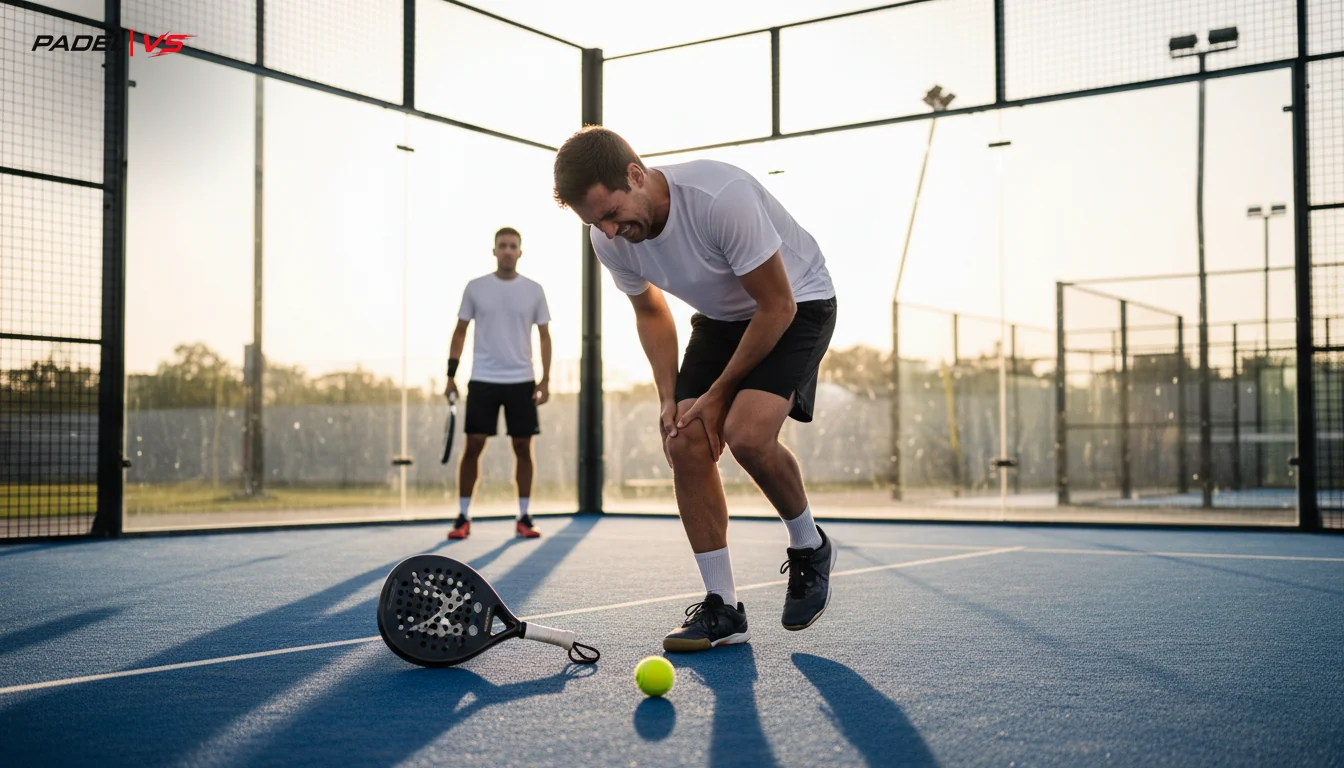
Padel is a sport built on explosive bursts: lateral sprints, low defensive positions close to the glass wall, and rallies that demand constant reactive movement in a confined 10 × 20 meter court. That combination pushes muscles to their limits faster than most players expect, and when muscles hit that limit, cramps and tightness follow. If you've ever walked off the court with a locked calf or a knotted trapezius, this article will explain exactly why it happened and what to do before it happens again.
Muscle Tightness vs. Cramps: Understanding the Difference
Before diving into prevention, it helps to understand what you're actually dealing with. A cramp is a sudden, sharp, involuntary contraction that typically resolves within seconds to a couple of minutes. It's dramatic, painful, and usually linked to acute dehydration or electrolyte depletion. Muscle tightness or contracture, on the other hand, is a sustained, semi-permanent shortening of muscle fibers that can last days or weeks without proper treatment. Both are common in padel, and both have different causes and different management strategies.
In padel specifically, the most commonly affected muscle groups are:
- Gastrocnemius and soleus (calves): Explosive lateral movement and push-off for the lob destroy the posterior chain over a long match.
- Hamstrings: The low defensive stance and the overhead tray shot (bandeja) keep hamstrings under constant eccentric load.
- Trapezius and rhomboids: Holding the racket in attacking position generates cumulative tension across the upper back and neck.
- Rotator cuff: The smash and forced backhand create repetitive stress on the shoulder complex that accumulates across matches.
- Forearm flexors: Gripping the padel handle — which is shorter and thicker than a tennis grip — for 60-90 minutes creates chronic tension in the forearm muscles.
Why Padel Creates More Muscle Problems Than Other Racket Sports
Padel has three structural characteristics that make it uniquely demanding on the muscular system — more so than tennis or squash in specific ways:
1. Short-distance, maximum-effort movement patterns
The glass walls compress the playing area dramatically. Unlike tennis, where you have time to accelerate gradually and decelerate over several steps, padel requires you to go from zero to full speed in one or two steps, then stop just as abruptly. This near-constant eccentric loading — the braking phase of movement — is the primary driver of microtear accumulation and subsequent tightness.
2. Glass-wall rebounds force reactive, uncoordinated muscle firing
When the ball bounces off the back glass at an unpredictable angle, you have milliseconds to reposition. These reactive adjustments activate muscle chains in a disorganized sequence, especially in players at the Quinta or Cuarta level (below 1,000 ELO in PADEL VS) who haven't yet automated efficient movement patterns. Uncoordinated muscle firing is one of the leading causes of localized tightness.
3. Match duration compounds the problem
In PADEL VS competitive formats, matches are played as best-of-three sets. A closely contested match between Tercera-level players (1,000–1,180 ELO) can easily last 90 minutes, often in warm, humid conditions. At that duration, even well-hydrated players start to deplete intramuscular glycogen and electrolyte reserves, setting the stage for cramps in the decisive moments.
"The cramp doesn't politely announce itself before the third set — it waits for the most important point of the match to arrive."
Risk Factors That Multiply Your Chances of Tightness
| Risk Factor | Why It Matters | What You Can Do |
|---|---|---|
| Dehydration | Sodium and potassium loss impairs muscle contraction/relaxation cycle | 500ml pre-match + 200ml every 20 min during play |
| Insufficient warm-up | Cold muscle = less elasticity = higher microfiber tear risk | Minimum 10-12 minutes of progressive warm-up |
| Overtraining | Cumulative fatigue without adequate recovery | At least 48h between intense sessions |
| Wrong footwear | Shoes without lateral support increase muscular stress on every cut | Use padel-specific shoes, not tennis or running shoes |
| Racket too heavy | Rackets over 380g fatigue the forearm and shoulder faster | Match weight to your level (300-360g for lower categories) |
| Magnesium deficiency | Magnesium regulates muscle relaxation post-contraction | Magnesium-rich foods or supplementation (consult a doctor) |
What to Do When Tightness Strikes Mid-Match
The instinct when a muscle locks up during a match is to push through it. That's almost always the wrong call. Here's the correct protocol:
- Stop the point and take a break: In formal PADEL VS tournaments, injury timeouts are permitted. Use them without hesitation — pride costs more than a few lost seconds.
- Passive stretching immediately: For the calf, press your foot against the glass wall and gently push the heel toward the floor for 30 seconds. For the hamstring, sit on the court with one leg extended and slowly fold your torso forward.
- Electrolyte intake: If you have an isotonic drink, this is the moment to take it. If you only have water, adding a small pinch of table salt can partially compensate for sodium loss.
- Local pressure technique: Press the most painful point firmly with your thumb for 20-30 seconds. This activates Golgi tendon organs and signals the muscle to partially release its tension.
- Make an honest call: If pain is above 6/10 or the tightness doesn't release within 3-4 minutes, leave the match. A tight muscle that continues under load is one bad step away from a grade-1 or grade-2 tear.
Post-Match Treatment: The First 72 Hours
How you manage the first 72 hours after tightness appears determines whether you're back on court in three days or three weeks.
First 24 hours: the acute phase
Apply moist heat (not dry heat) for 15-20 minutes every 3-4 hours. Heat increases local blood flow and helps break the spasm-ischemia-pain cycle that keeps the contracture alive. One critical point that many players get wrong: do not use ice on muscle tightness. Ice is appropriate for acute inflammation, bruising, and joint swelling — not for muscular spasm. Cold reduces blood flow to the area and can actually make a contracture worse.
Days 2-3: gentle mobilization
Introduce slow, gentle movement of the affected muscle. For a tight calf, walk barefoot on a flat surface and do slow ankle circles. For the trapezius, perform slow cervical rotations and shoulder rolls. The goal is to deliver oxygenated blood to the damaged area without creating additional microtrauma.
When to see a physiotherapist
If the tightness remains equally intense after 72 hours, seek professional help. The most effective physiotherapy techniques for padel players with persistent contractures are: dry needling (for active trigger points), transverse friction massage, and muscle energy technique manual therapy. These approaches directly address the neuromuscular inhibition pattern that sustains the contracture. Look for a sports physiotherapist familiar with racket sports — the demands of padel are specific enough that generic sports physio advice can miss the mark.
Prevention Protocol: What to Do Before Every Match
Prevention wins the long game. A well-executed warm-up can reduce the risk of muscle tightness by a meaningful margin — and in padel, where you can play three or four times a week, that adds up over a season. Here's the pre-match protocol we recommend at PADEL VS:
Phase 1: General activation (5 minutes)
- Light jog around the court or in the corridor outside
- Alternating two-foot jumps with low high-knees
- Dynamic hip circles and arm swings (moving, not static)
Phase 2: Padel-specific activation (5-7 minutes)
- Lateral shuffle drills side to side — simulate real in-game movement width
- Shadow swings: simulate a drive, backhand, and overhead tray shot (bandeja) with your racket, no ball
- Controlled lob jump × 8 reps — practice the push-off and landing mechanics
- Lateral lunges reaching toward the glass — opens the hip in the lateral plane specific to padel
Phase 3: Progressive rallying (3-5 minutes)
Start by hitting softly from mid-court and gradually increase intensity. The first 10-15 exchanges should never be at full power. This gradual loading warms the connective tissue in the shoulder, elbow, and wrist progressively rather than shocking it from the first point.
"A player who warms up properly isn't wasting time before the match — they're buying insurance against the injuries that would cost them weeks off the court."
Nutrition and Hydration: The Most Overlooked Prevention Tools
The muscle that cramps in the third set usually showed warning signs much earlier in the match — and often in the hours before it even started. Nutrition and hydration are not optional extras; they are part of the injury prevention protocol.
Before the match
- 2-3 hours before: A moderate meal with medium-absorption carbohydrates (rice, pasta, oats) plus moderate protein. Avoid high-fat meals that slow gastric emptying and divert blood to digestion during play.
- 30-45 minutes before: A piece of easy-to-digest fruit (banana is ideal — potassium content plus fast carbohydrates) and 300-500ml of water.
During the match
In matches lasting more than 60 minutes, consume isotonic sports drink during changeovers. Sweat sodium loss in warm playing conditions can reach 1-2 grams per hour — enough to meaningfully disrupt the sodium-potassium pump that controls muscle contraction. Water alone won't replace that loss fast enough.
After the match
- Within the first 30 minutes post-match: fast-absorbing protein (protein shake, boiled eggs, Greek yogurt) to begin repairing microtears and reducing delayed onset muscle soreness.
- Electrolyte water or natural coconut water to replenish minerals lost during play.
- Natural anti-inflammatory support: turmeric with black pepper (piperine enhances bioavailability) has shown modest but consistent reductions in post-exercise muscle soreness in multiple peer-reviewed studies.
Strength Training: The Long-Term Prevention Strategy
Players who train strength outside the court experience significantly fewer muscle cramps and tightness episodes. A stronger muscle has a larger reserve before reaching the fatigue threshold where spasms begin. For padel players, the highest-priority exercises are:
- Bulgarian split squat: Targets hamstrings, glutes, and ankle stabilizers in a single-leg pattern that closely mirrors padel movement mechanics.
- Eccentric calf raises (Alfredson protocol): Three sets of 15 reps on a declined surface, three times per week. This strengthens the calf under eccentric load — the same condition that produces tightness during play — and can substantially reduce the frequency of calf contractures over time.
- External shoulder rotation with resistance band: Strengthens the rotator cuff and directly reduces the cumulative trapezius tension that builds from smashing and high-ball defense.
- Side planks with hip abduction: Stabilizes the hip complex and reduces the load placed on the adductors and abductors during lateral movement.
In the PADEL VS competitive ladder, from Tercera upward (1,000 ELO and above), the difference between players who arrive fresh to a third set and those who tighten up is rarely purely technical — it's physical. Two 30-45 minute strength sessions per week can be the variable that moves you from Tercera to Segunda in your next rating period.
Tracking Load to Prevent Overuse
One of the most underused prevention tools is simply knowing how much you're playing. If you're logging three or four matches per week in PADEL VS plus a training session or two, you're accumulating significant muscular load. You can monitor your match history and frequency directly on padelvs.com, through the Telegram Mini App (@padelvsbot), or by messaging the WhatsApp AI bot. Seeing your weekly match volume in concrete terms is often the wake-up call players need to build in a proper recovery day before the next tournament.
The general rule for players in the Cuarta-to-Segunda range (850–1,350 ELO): no more than four competitive matches per week without at least one full rest day between high-intensity sessions. Recovery isn't weakness — it's the training itself.
Conclusion: Your Muscles Are Telling You Something
Cramps and muscle tightness in padel are not random bad luck. They are predictable responses to identifiable inputs: insufficient warm-up, poor hydration, inadequate strength base, excess load without recovery, or faulty movement patterns. When you understand the mechanism, you can intervene at the source rather than just managing symptoms after the fact.
The players who reach their peak level and stay there are not the ones who never get injured — they're the ones who treat their body's warning signals as data, adjust their approach, and come back smarter. Apply the protocols in this article consistently over a month and notice the difference in how your legs and shoulders feel going into that third set. That freshness isn't luck — it's earned before you even walk onto the court.