
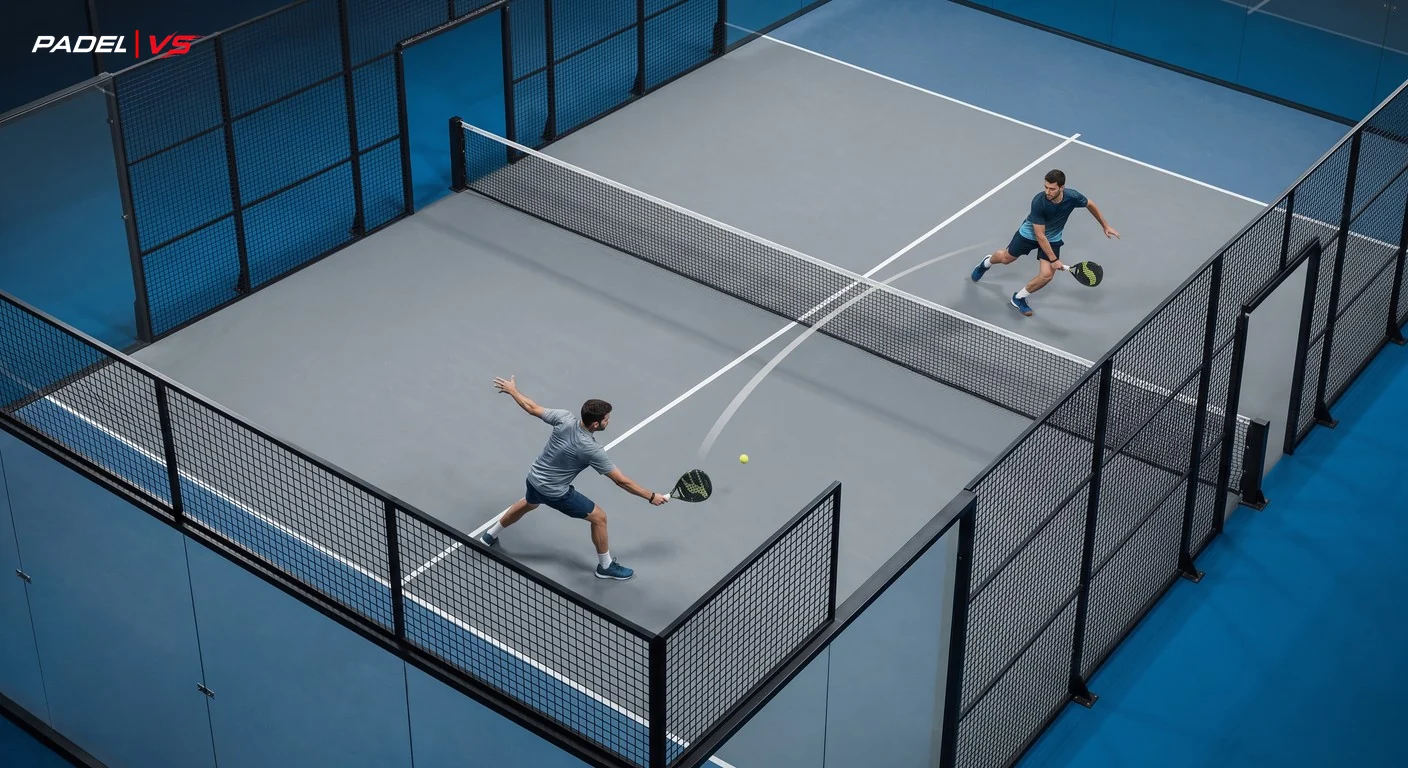
Most intermediate padel players—roughly the Cuarta to Tercera range, which in PADEL VS translates to 850–1,180 ELO—build their entire game around the diagonal as if it were a law of physics. They play cross-court by default, expect cross-court by habit, and never stop to question whether the diagonal they love so much is the exact one their opponents are exploiting. The diagonal switch is the single tactical move that separates players who hit well from players who think well.
Why the diagonal dominates amateur padel
Before you can break something, you need to understand why it exists. A regulation padel court is 10 meters wide by 20 meters long, and the full corner-to-corner diagonal measures approximately 22.4 meters. That gives you roughly 2.5 meters more trajectory than a straight line down the sideline, which means more margin for error, more time to recover your position, and a more difficult read for your opponent who has to cover the far side of the court.
On top of that, when you play cross-court from the right side of your partner, you're naturally attacking the weaker transition zone of the opposing pair: the gap between the left-side player and the lateral glass. All of this makes the diagonal statistically the safest play under pressure, especially in defensive situations or during baseline rallies.
The problem emerges when the diagonal stops being a tactical decision and becomes an automatic reflex. At that point, your opponent already knows exactly where the ball is going before you've even made contact.
"The most dangerous opponent isn't the one who hits hardest—it's the one who makes you defend exactly where they've already decided to attack."
Understanding the "dominant diagonal" and how to crack it
The dominant diagonal is the axis of play that a team establishes as their primary pattern during a point. It typically forms in the first two or three exchanges: one team serves into the diagonal, the other returns cross-court, and the point develops along that axis until someone forces a change or makes an error.
Breaking that diagonal doesn't simply mean hitting down the line occasionally. It means doing so at the right moment, with the right preparation, and with a clear tactical objective in mind. There are four specific situations where breaking the diagonal isn't just acceptable—it's optimal:
- When the receiving opponent is over-positioned toward the cross-court. If you can see the player about to receive your shot has drifted 60–70 cm toward the center anticipating the diagonal, the line is open.
- After a deep lob that pushed your opponents back. A well-placed lob that forces both opponents toward the back of their court leaves the lateral glass side relatively exposed. A diagonal switch there creates a sharp angle that's difficult to cover.
- On the third attack shot as you move to the net. Use the diagonal to construct the point (first and second shots), then on the third contact, break with a line shot to destabilize the opposing formation and approach the net with position advantage.
- When court conditions favor the straight line. In clubs with open roofs or significant lateral airflow, crosscourt balls can sail long. A downwind line shot can be simultaneously safer and more aggressive.
Three technical executions of the diagonal break
1. The disguised line shot (the "shoulder fake")
This is the most effective and the hardest to read. The key is that your stance, hip rotation, and dominant shoulder position perfectly mimic the preparation for a cross-court. The deception happens in the last 20% of the swing: instead of opening the racket face toward the center of the court, you keep it slightly closed and redirect the ball down the line.
Technically, you need a racket with good control on the hitting surface—something you'll typically find in carbon fiber models with a textured face, generally in the 350–375 gram range—because the margin of error when closing the face is minimal. If your racket is too powerful and you lack touch, the disguised line shot ends in the net or into the lateral glass.
2. The glass redirect (the "cristal exit")
This is where padel separates itself completely from tennis. When the ball bounces off the lateral glass and comes to you at shoulder height or above, you have the option to redirect it 90 degrees toward the diagonal opposite from where it came. That is, if the ball arrived via the right-side glass, you send it cross-court toward the opponent's left diagonal.
This move works because the opponent who sent the ball down your glass is almost certainly already moving to cover the straight return. The diagonal redirect catches them mid-movement, which is the hardest moment to react from. The critical technical point here is not to rush: the ball coming off the glass often gives you more time than it appears, and errors happen when players try to hit too early.
3. The bandeja with direction change
The bandeja (overhead slice) is the quintessential control shot in padel. When you're at the net and receive a moderate lob—not perfect, but not unreachable either—most intermediate players automatically bandeja cross-court to maintain pressure on the dominant diagonal. The variation: bandeja down the line toward the player who didn't lob, who is typically less prepared because they assumed the ball was going cross-court.
For this line bandeja to work, three conditions must be met: the ball must be low and fast (if it floats, the opponent has time to reposition); you must be centered or slightly toward the shot side; and your partner must already be communicating and covering the cross-court in case the opponent manages to defend.
Reading the court: knowing when to pull the trigger
No tactical move works without correctly reading your opponent's position. In padel doubles, you need to monitor four variables simultaneously:
| Variable | Signal to break diagonal | Signal to maintain diagonal |
|---|---|---|
| Lateral position of receiving opponent | Shifted more than 1 meter toward center | Centered or toward the sideline |
| Body weight of receiving opponent | Loading forward or toward the cross | Neutral or shifted back |
| Your own balance at impact | Stable, with preparation time | Moving or under pressure |
| Your partner's position | Covering cross, can shift to line | Out of position, needs cross as safety valve |
Reading all four variables simultaneously is what develops the "tactical eye" of a padel player. It doesn't happen overnight, but it can be accelerated significantly with specific situational training drills.
Drills to train the diagonal switch
The problem with most amateur training sessions is that players practice shots, not decisions. Here are three specific drills to develop the diagonal switch as a genuine tactical skill:
Drill 1: The coach signal (or partner signal)
Play a normal point until the coach—or a player standing outside the court—gives a visual signal: raising a hand, moving a cone. At that moment, whichever team has the ball must switch the diagonal on the next shot, regardless of the game situation. At first it looks forced and awkward. With repetition, the switch starts to appear naturally because the brain learns to search for that moment within the point structure.
Drill 2: Restricted diagonal sets
One team can only play cross-court. The other can only play straight. Play short sets to 5 points. The team restricted to line shots learns to read when the cross-court is open—and how to force it to be open. It's mentally exhausting and tactically effective.
Drill 3: The three-two with mandatory switch
In every sequence of five shots within a point, the third shot must go to the opposite side from the previous two. This specifically trains breaking the diagonal at the attack moment (third touch), which is the most common scenario in competitive padel from Tercera level upward.
Common mistakes when trying to break the diagonal
- Breaking without position: The most frequent error. You attempt the diagonal switch while running, off-balance, or under pressure. The result is an uncontrolled shot that becomes an unforced error.
- Telegraphing with your body: Your preparation gives away the line shot before you've even hit. Your opponent is already moving before impact. Work specifically on shoulder deception.
- Not communicating with your partner: Your partner expects cross-court, you hit line, and now there's a massive gap in the center of the court. The diagonal switch is a partner decision, not an individual one.
- Overusing the switch: If you break the diagonal every three shots, your opponent learns your pattern and the surprise element disappears. The switch must be infrequent to remain effective.
- Ignoring ball speed: A diagonal switch with a slow ball is relatively easy to read. With a fast, low ball it's devastating. The speed of the shot amplifies the tactical effect of the switch.
"In padel, surprise is worth more than power. A well-executed diagonal switch wins points that no smash ever could."
How this applies at each PADEL VS competitive level
The tactical importance of the diagonal switch varies significantly depending on where you sit in the competitive ladder. Here's a realistic breakdown:
| Category | ELO Range | Diagonal Switch Priority |
|---|---|---|
| Quinta | <850 | Low — focus on consistency first; wild switches create more errors than winners |
| Cuarta | 850–1,000 | Medium — begin reading positions; introduce the glass redirect as first tool |
| Tercera | 1,000–1,180 | High — diagonal switches should appear regularly; opponents now punish predictability |
| Segunda | 1,180–1,350 | Essential — full tactical vocabulary required; disguised line shots are standard |
| Primera | 1,350–1,550 | Automatic — decisions happen pre-consciously; switch timing is sub-second |
| Open | ≥1,550 | Strategic — the switch is a weapon used to dictate entire rallies, not just individual points |
The biggest jump in padel development—the one that produces the most visible results in the shortest time—happens between Cuarta and Tercera. And that jump almost never comes from hitting harder. It comes from making better decisions at the right moment. The diagonal switch is, arguably, the highest-return tactical investment available in that ELO range.
Tracking your tactical progress on PADEL VS
One of the practical benefits of the PADEL VS ELO system is that your rating reflects not just wins and losses, but the consistency with which you perform against opponents at your level. As you incorporate the diagonal switch more effectively, you'll notice certain rallies that used to stretch out unnecessarily now resolve faster—and that translates into fewer accumulated unforced errors, better match control, and eventually upward movement in your category.
If you're playing in PADEL VS registered tournaments, you can track your matches and ELO movement at padelvs.com, or directly through the Telegram Mini App (@padelvsbot), where your match history and rating changes are available in real time. The WhatsApp AI bot can also send you notifications about upcoming matches and help you analyze result trends. We're in early stages—we launched in Cancún and are building outward—but the goal has always been to give you data that helps you improve, not just play.
When you register for tournaments through the platform, payment is flexible by design: you can pay via Stripe (credit or debit card), Mercado Pago (including OXXO cash payments and bank transfers), or even cryptocurrency through B4Bit (USDT, BTC, ETH)—something essentially no other padel platform in Latin America offers. You can also pay cash at the club and complete your registration via QR code afterward. No friction between you and the next competitive match.
The diagonal as a tool, not a destination
The core idea of everything in this article comes down to this: the diagonal is not the goal of the point—it's the means of getting to the goal. The best players in professional circuits, and the best amateurs competing at Primera and Open level, use the diagonal to build the point and break it to finish the point. That conceptual distinction—so simple to state and so difficult to execute under pressure—is what separates the player who spends years stuck in Cuarta from the one who moves up to Tercera in their first full season.
Start with the signal drill. Add it to your regular training sessions over the next four weeks. Don't chase the perfect switch from day one—chase the timely switch. Over time, your brain will start seeing those moments where the line is open as if they were lit up on the court. And when that happens, you'll have made the most important tactical leap of your intermediate padel career.