
A quality padel racket can set you back anywhere from $83 to $444 USD ($1,500–8,000 MXN aprox), and without proper care, that investment can deteriorate in less than six months. Padel — a sport played on a 10 x 20 meter court enclosed by glass walls and metal mesh — exposes your equipment to stresses that are completely different from tennis, pickleball, or any other racket sport.
Why padel racket maintenance is different
Unlike a tennis racket where you can simply restring when performance drops, a padel racket is a sealed structural unit. Its core — typically EVA rubber or polyethylene foam — and its outer shell of fiberglass or carbon fiber work together as a single piece. Once the internal structure is compromised, there is no repair. A crack in the core changes the racket's entire response profile: you lose control, power, and that crisp feedback that lets you place the ball exactly where you want it.
In Mexico specifically, climate is a silent racket-killer. Summer temperatures in cities like Cancún, Monterrey, or Mexico City's surrounding areas can push interior car temperatures well above 60°C (140°F) — enough to start separating the adhesive layers inside your racket's frame. Coastal humidity along the Caribbean and Pacific coasts accelerates grip degradation and can seep into micro-cracks on the surface. Understanding these factors gives you an immediate edge over players who treat racket care as an afterthought.
"Your racket is a precision instrument. A surgeon doesn't leave their tools in a hot car. Neither should you."
Post-session cleaning: the three-minute habit that changes everything
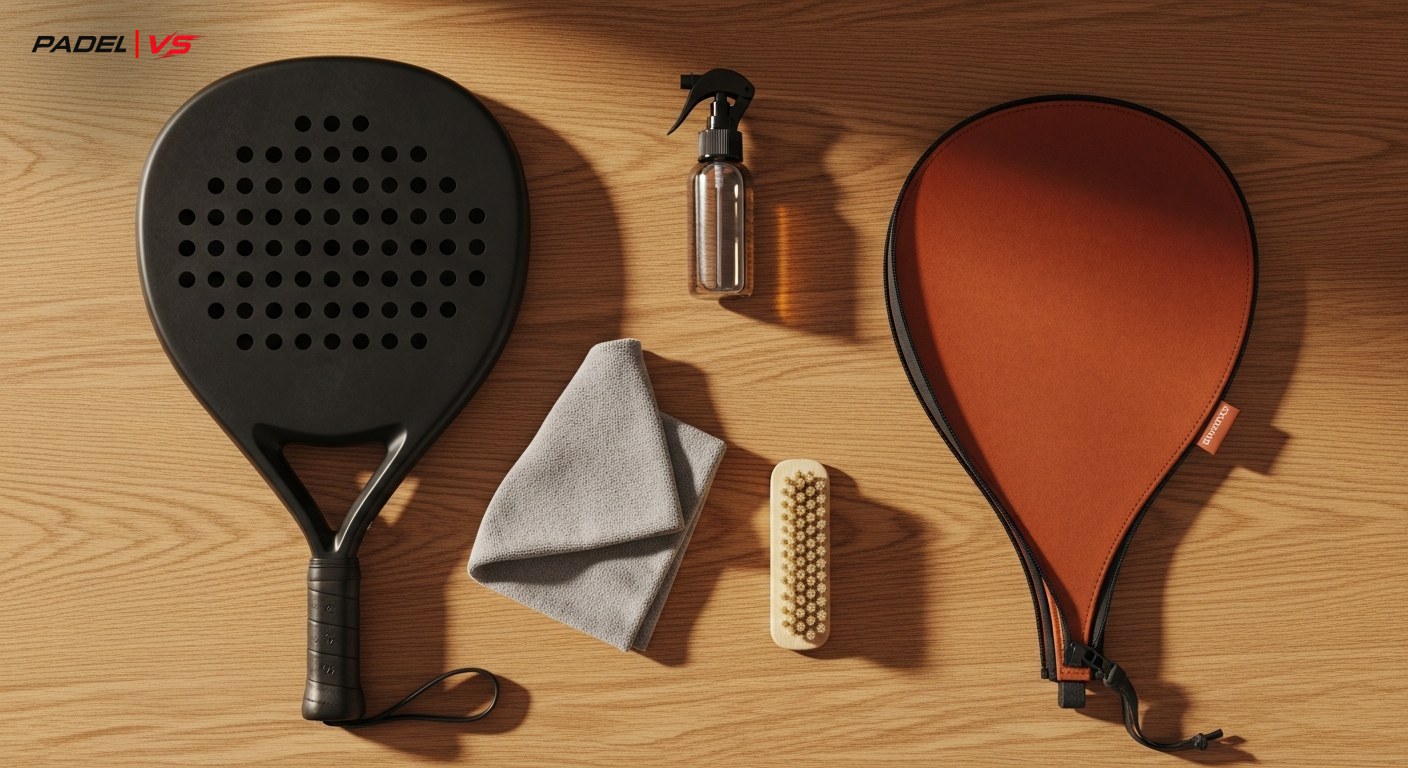
The single highest-impact maintenance habit is cleaning your racket after every single session. Three minutes of your time protects hundreds of dollars in equipment. The logic is straightforward: sweat contains salts that slowly erode surface fibers, and the fine abrasive dust from padel courts — particularly artificial clay, acrylic, or carpet surfaces — acts like sandpaper on your racket's face over time.
What you need
- Soft microfiber cloth — cotton cloths can scratch rough-carbon surfaces like 3K or 12K finishes.
- Lukewarm water — never hot, which can loosen internal adhesives.
- Mild neutral soap — no solvents, concentrated isopropyl alcohol, or abrasive cleaners.
- Soft-bristle brush (optional) — useful for cleaning the textured face of carbon rackets without flattening the surface.
Step-by-step cleaning process
- Remove the overgrip (and grip tape if necessary) from the handle. Cleaning underneath prevents moisture buildup that rots the handle core.
- Wipe the entire racket face with a damp (not soaked) microfiber cloth using gentle circular motions.
- Pay extra attention to the protective edge guard where dust and grit accumulate at the junction between the guard and the surface.
- Dry completely with the clean side of the cloth. No residual moisture.
- Air dry for at least 10 minutes before placing the racket back in its cover.
What you should never do: run the racket under a faucet, use alcohol-based wipes, or wipe with paper towels — paper fibers are abrasive enough to degrade the matte carbon texture that generates spin on your shots. Yes, that texture matters competitively. Protecting it matters too.
Grip and overgrip: the most neglected contact point
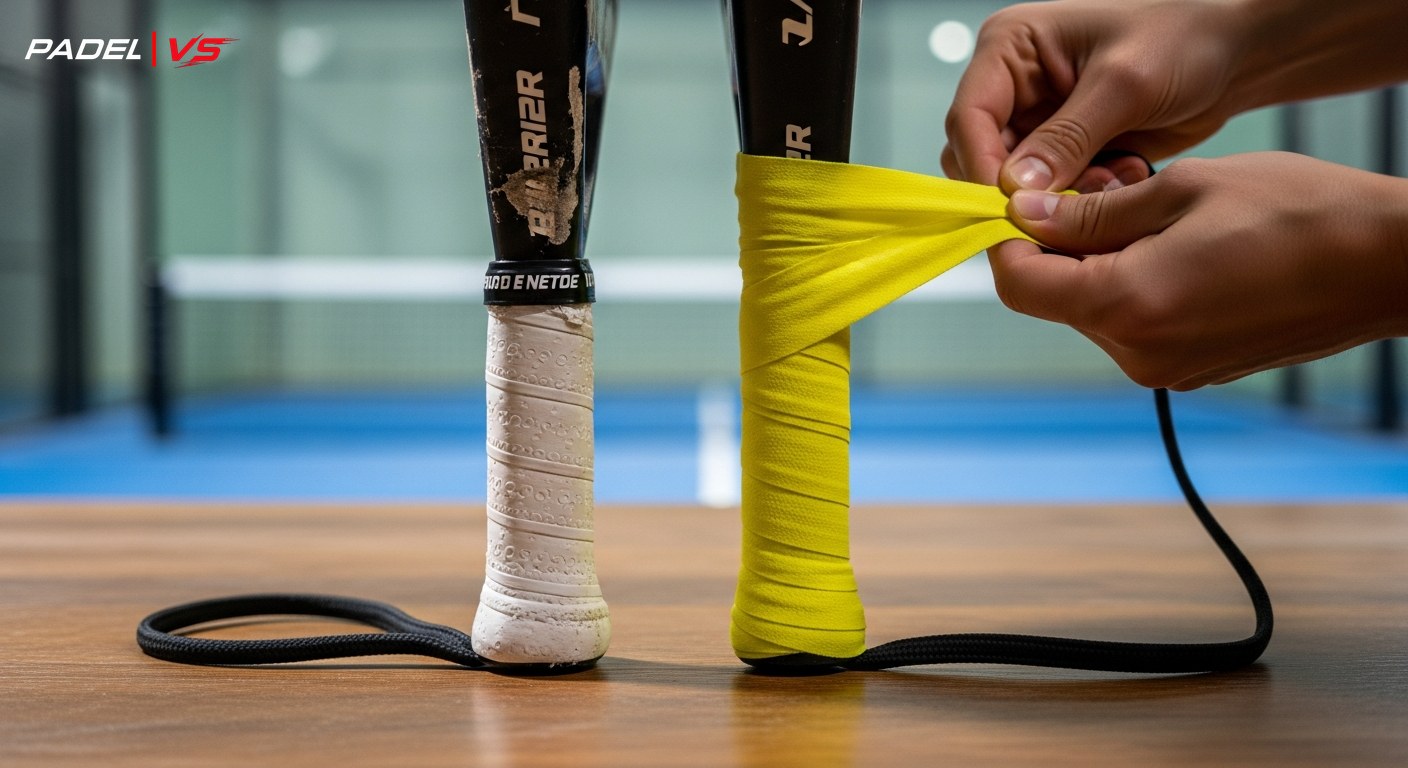
The original grip on your racket — the factory-installed cushion that typically measures between 1.8 and 2.2 mm thick — is your vibration absorber and the bridge between your hand and the racket head. Regular replacement isn't a luxury; it's joint health management. A worn grip transmits significantly more vibration to the wrist and elbow, and is one of the leading causes of lateral epicondylitis (tennis elbow) among recreational padel players who train three or more times per week.
How often should you change your grip?
| Playing frequency | Overgrip change | Base grip change |
|---|---|---|
| 1–2 sessions per week | Every 3–4 weeks | Every 6–8 months |
| 3–4 sessions per week | Every 1–2 weeks | Every 3–4 months |
| 5+ sessions / active tournaments | Every 2–3 sessions | Every 6–8 weeks |
Quality overgrips cost between $2.20 and $6.60 USD ($40–120 MXN aprox) per unit, and buying multipacks of 3 or 9 brings the unit cost down further. Brands like Wilson, Head, and Bullpadel are widely available in Mexico. For humid climates like Cancún, Los Cabos, or Veracruz, prioritize absorbent towel-texture overgrips over smooth synthetic ones — synthetic grips become slippery the moment your palms sweat, which happens fast in coastal heat.
When wrapping a new overgrip, start at the bottom of the handle at a 45-degree angle, overlap each wrap by 2–3 mm consistently, and finish with the included adhesive tape pulled tight. A poorly applied overgrip that shifts or unravels mid-match isn't just annoying — it's genuinely dangerous in a sport where the racket needs to stay firmly in your hand near glass walls and partners.
Edge protection: the frame guard is not optional
The racket's edge — that 8 to 12 mm perimeter frame — is the most impact-exposed zone during actual play. In padel, it is completely normal to brush against the glass wall, drag the racket along the resin floor, and clip the metal net frame during defensive plays like reaching for a low ball off the glass or executing a lob from the back corner. Without protection, repeated contact gradually erodes the edge until micro-fractures form that eventually reach the core.
The edge guard (also called frame tape or bumper strip) is a self-adhesive strip between 1.5 and 3 mm thick that runs around the entire racket perimeter. Two main types exist:
- Soft polyurethane tape — better shock absorption, ideal for fiberglass or hybrid carbon-fiberglass rackets.
- Rigid PVC tape — longer lasting but transmits more vibration into the core on hard edge impacts.
An edge guard kit runs about $4.40–13.90 USD ($80–250 MXN aprox). Inspect it every two weeks: when you notice it losing adhesion in any section, or when the thickness has visibly reduced from wear, replace it immediately. A partially detached edge guard is actually worse than none — it traps grit and moisture between the tape and the racket surface, accelerating the very damage it was designed to prevent.
Storage: the number one cause of premature racket failure
Most damaged rackets we see in competitive play didn't break on the court. They were damaged in transit or storage. These are the most common and most preventable mistakes:
Extreme temperatures
EVA foam cores operate optimally between 10°C and 35°C (50°F–95°F). Above 45°C (113°F) — easily reached inside a parked car in Guadalajara or Cancún at noon — the adhesive bonding the internal layers can begin to fail. Below 5°C (41°F), the core stiffens and becomes more brittle: an off-center impact in cold conditions can create internal fractures that remain invisible until performance has already degraded significantly. Never store your racket in your car trunk as a daily habit. Treat it like a laptop: you wouldn't leave that in a hot car either.
Pressure and stacking
Stacking multiple rackets at the bottom of a padel bag creates sustained pressure across the faces and edges. Each racket weighs between 330 and 400 grams, and over hours of pressure, surface delamination can occur. Store rackets vertically or in individual covers whenever possible.
Humidity and ventilation
A sealed padel bag after a sweaty session is a humidity incubator. Leave the bag open or slightly unzipped when you get home until everything inside has air-dried. For coastal or high-humidity environments, place a silica gel sachet inside the racket cover — it absorbs residual moisture passively without any direct contact with the racket surface.
"Prevention is the best maintenance. A well-stored racket lasts twice as long as one left forgotten in a bag."
Material-specific care: not all rackets are equal
| Surface material | Special care | Primary vulnerability |
|---|---|---|
| Fiberglass | Avoid edge impacts; clean with soft cloth only | UV discoloration (especially white rackets) |
| 3K Carbon | No rough paper; use soft brush for the weave texture | Visible surface scratches on dark finish |
| 12K / 18K Carbon | Edge guard is mandatory; very fragile to lateral impact | Micro-fractures from edge contact |
| Hybrid (fiberglass + carbon) | Intermediate care; monitor layer junctions closely | Delamination at material transition zones |
Carbon fiber rackets — especially 12K and 18K weaves favored by players in the upper competitive categories — offer excellent spin and power but require the most diligent edge care. If you're playing at Segunda (1,180–1,350 ELO) or above, chances are you're already using a high-carbon racket. Treat it accordingly.
Knowing when to replace your racket
Even with perfect care, rackets have a finite lifespan. For a player training three to four times per week, a mid-range racket priced at $139–250 USD ($2,500–4,500 MXN aprox) typically performs optimally for 18 to 30 months. These are the clear signals that it's time to move on:
- Hollow or dead sound on impact — indicates internal core delamination.
- Excessive vibration on centered shots — the sweet spot has structurally degraded.
- Visible cracks on the surface — especially serious if they reach the edge frame.
- Frame deformation — an oval racket that is no longer symmetrical will produce inconsistent ball trajectories regardless of your technique.
- Loss of spin generation — if your slice and topspin shots feel flat, the surface texture has worn smooth.
One important note: if your racket suffered a violent impact against the glass or floor — the classic failed overhead smash — inspect it carefully even if you see no external damage. Internal core deformation is invisible but real, and it can affect your game for weeks before you realize the equipment is the problem, not your technique.
Tournament day care: what serious competitors do
If you're competing in leagues like those on PADEL VS — which span from Quinta (under 850 ELO) all the way up to Open (1,550 ELO and above) — match day has its own care protocol:
- Always bring a backup racket. This isn't superstition; it's serious competitor protocol. One frame crack or overgrip failure away from a match DNF is not a situation you want.
- Check and replace your grip the evening before, not ten minutes before warm-up. Grip anxiety on match day is avoidable.
- If you're playing night sessions (many courts have LED lighting systems that generate localized heat), keep your racket away from the direct beam of reflectors between sets.
- Clean your racket after the tournament even if you're exhausted. The accumulated grime from three or four consecutive matches is precisely the kind of sustained exposure that does the most long-term damage.
The real cost-benefit of proper racket care
Let's run the numbers. A complete annual maintenance kit for a player training three times per week includes:
- 12 overgrips per year: ~$33–50 USD ($600–900 MXN aprox)
- 2 edge guard kits: ~$11–22 USD ($200–400 MXN aprox)
- 1 base grip replacement: ~$8–17 USD ($150–300 MXN aprox)
- Microfiber cloth + neutral soap: ~$4–8 USD ($80–150 MXN aprox)
Annual total: approximately $56–97 USD ($1,030–1,750 MXN aprox). Compare that to replacing a mid-range racket prematurely — a $139–250 USD ($2,500–4,500 MXN aprox) purchase — and the math is overwhelmingly clear. Proper maintenance costs a fraction of early replacement, and it delivers better performance throughout the racket's natural lifespan.
At PADEL VS, we're building a competitive community in Mexico where equipment knowledge is as important as technique. Whether you're just starting out or competing seriously, our platform at app.padelvs.com / padelvs.com, via the WhatsApp AI agent, or through the Telegram Mini App at @padelvsbot is available to help you navigate everything from league registration to gear decisions. Take care of your racket — and it will take care of your game.