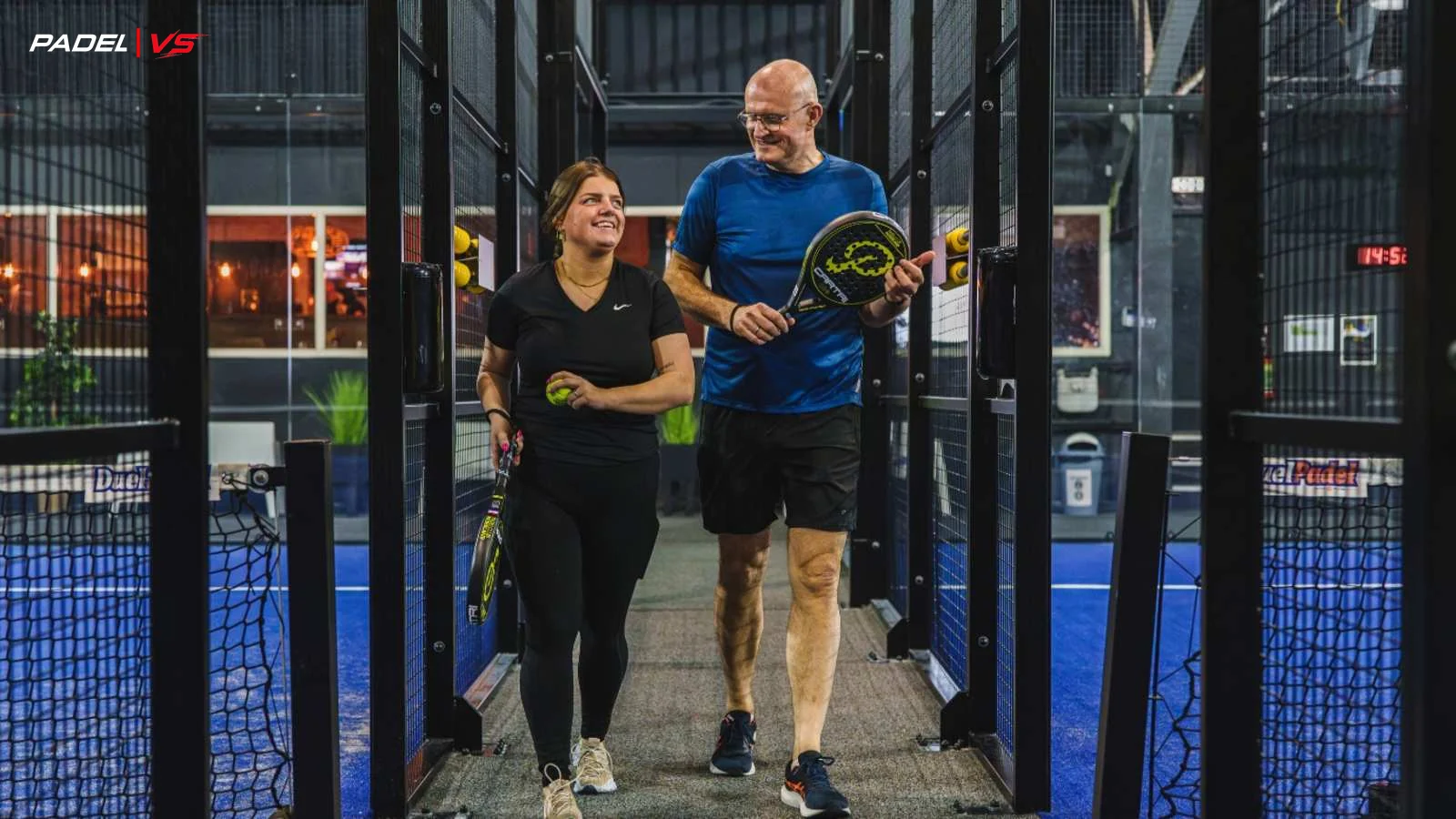
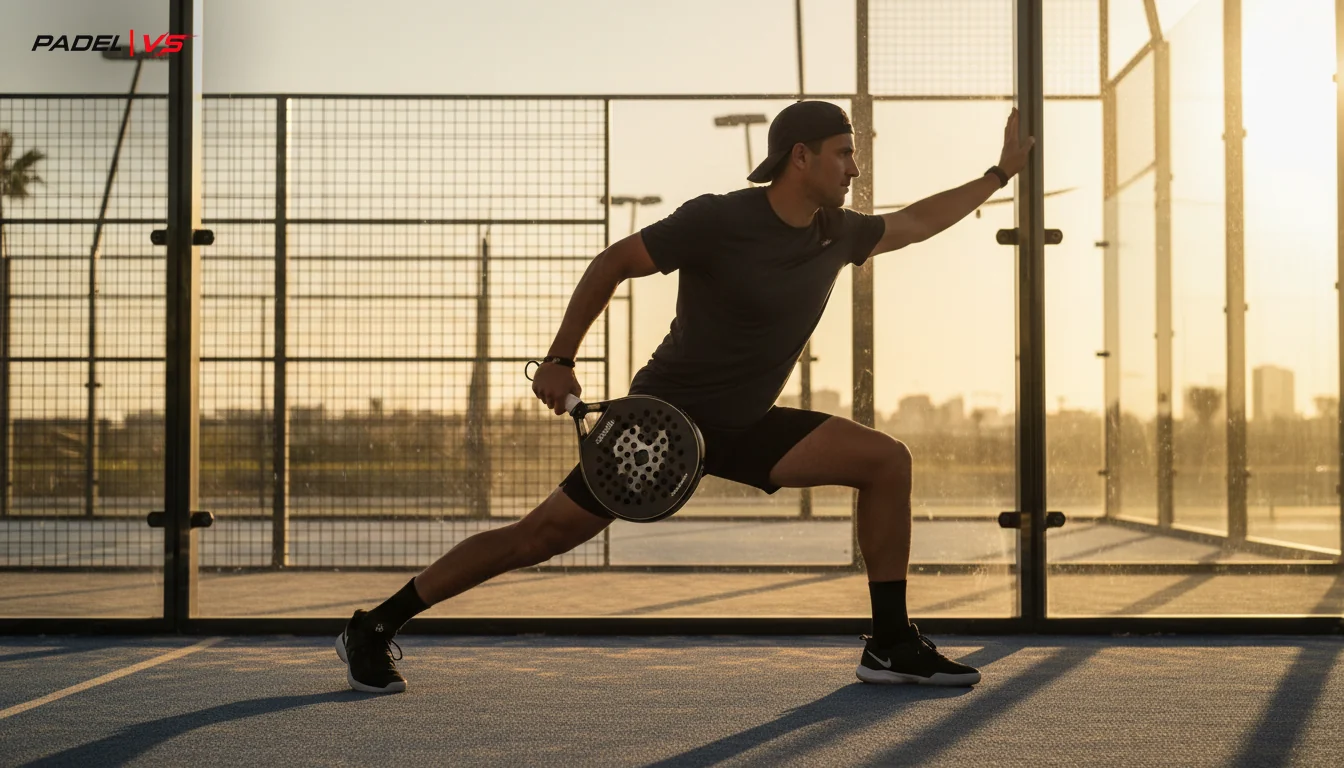
You show up at the club, greet your opponents, hit a couple of soft balls to "get a feel for it," and that's it — game on. If this sounds familiar, you're barely warming up at all, and sooner or later your body is going to send you the bill. Padel demands short explosive sprints, sudden changes of direction, overhead swings, and unpredictable bounces off the glass, and none of that works well with a cold body.
Why padel warm-ups are different from other sports
Padel is played on a 20x10 meter court enclosed by glass walls and mesh, which creates a very particular movement pattern: you don't run in straight lines like in tennis, you do cross-steps, sharp braking, hip rotations for lobs, backward jumps for smashes, and short two-to-three meter sprints to reach a ball that just came off the glass at a strange angle. It's a sport built on explosive power over short distances, not continuous endurance.
This means the most stressed areas are different from other racket sports: the shoulder (from serving and smashing), the wrist (from the víbora and bandeja shots), the calves and adductors (from constant direction changes), and the lower back (from trunk rotation on every stroke). A generic warm-up of jogging and static stretching doesn't prepare the body for those specific movements.
The warm-up isn't what you do before playing padel — it's the first part of the match, the part that decides whether you're still in one piece by the third set.
Phase 1: General cardiovascular activation (3 to 5 minutes)
The goal here is simple: raise body temperature and heart rate progressively. You don't need to run a mile, this is enough:
- Light jogging in place or around the court — 90 seconds
- Jumping jacks — 30 seconds
- High knees, light pace — 30 seconds
- Butt kicks — 30 seconds
If you're playing in Cancún or any hot, humid city, this phase can be shortened a bit since your body arrives already warmer than it would in a cold climate. Adjust based on ambient temperature, but never skip it entirely.
Phase 2: Dynamic joint mobility (4 to 5 minutes)
This is where most recreational players cut corners, and it's exactly what prevents the injuries most specific to padel. No long static stretches here (save those for after the match); this phase is about active mobility:
- Shoulder circles (forward and backward, 10 reps each) — critical for the serve and smash
- Wrist rotations — essential before hitting any víbora or bandeja
- Hip and trunk rotations with arms extended, mimicking forehand and backhand strokes
- Ankle circles — the ankle is the most exposed joint during sharp braking on artificial turf
- Lateral lunges — 8 per side, mimicking the movement toward the side wall
- World's greatest stretch (hip opener) — 5 per side
Phase 3: Padel-specific movements without the ball (3 to 4 minutes)
This is the phase almost nobody does, and it's the one that makes the biggest difference. The idea is to repeat, at low-to-moderate intensity, the exact technical movements you'll use in the match:
- Split step repeated 10 times — the load movement you make before every return
- Shadow forehand and backhand swings — 10 strokes per side, with or without the racket but no ball
- Bandeja and víbora simulation — 5 reps, focusing on trunk rotation, not just arm movement
- Smash simulation with a jump — 5 reps, paying attention to landing technique (bent knees, not stiff)
- Fast lateral shuffles wall to wall — 4 reps
This block activates the neuromuscular system specific to the sport: moving your legs in general isn't the same as moving them in the exact pattern of a cross-step toward the back wall.
Phase 4: On-court progression with the ball (5 to 7 minutes)
If you've already got the court booked and your partners are ready, this is the final phase before the first point. In official international padel tournaments, a regulation warm-up period on court is respected before the match starts, precisely because the body needs to adapt to real ball speed. We recommend this progression:
- Soft baseline strokes (forehand and backhand) at low pace — 2 minutes
- Mid-distance volleys, gradually increasing intensity — 2 minutes
- Lobs and wall rebounds to calibrate that day's bounce (every glass panel, mesh, and turf combination behaves slightly differently) — 1-2 minutes
- A couple of soft smashes to activate the shoulder at real intensity without forcing it from the very first point — 1 minute
Full routine summary
| Phase | Duration | Main goal |
|---|---|---|
| Cardiovascular activation | 3-5 min | Raise body temperature and heart rate |
| Dynamic mobility | 4-5 min | Prepare joints (shoulder, wrist, hip, ankle) |
| Padel-specific dry movements | 3-4 min | Activate padel neuromuscular patterns |
| On-court ball progression | 5-7 min | Calibrate rhythm, bounce, and real game power |
| Total | 15-21 min | Body ready to compete |
Warming up according to your category and level
Warming up for a recreational Quinta match (under 850 ELO) isn't the same as warming up for a competitive Primera or Open match (over 1350 ELO). At higher categories, smashes are more powerful, direction changes more explosive, and matches tend to run longer, so the warm-up needs to be more complete and should never be cut short, even under time pressure at the club.
Within PADEL VS's category system (Quinta, Cuarta, Tercera, Segunda, Primera, and Open), we tend to see that players in higher categories have more structured warm-up routines — many come from other racket sports or have years of competitive experience — while players just starting out in Quinta and Cuarta are usually the ones who skip this part the most. If you're climbing categories, this is a habit worth building now, before the pace of play forces it on you.
Common mistakes when warming up (or not warming up at all)
- Starting straight with hard smashes. The shoulder and rotator cuff need progression, not a max-power overhead in the first minute.
- Static stretching a cold body before playing. Holding a stretch for 30 seconds on a cold muscle without prior movement doesn't improve performance, and in some cases reduces immediate explosive power.
- Ignoring the wrist. It's one of the most commonly injured joints in amateur padel due to poorly executed víbora and bandeja shots taken cold.
- Warming up the body but not reading the bounce. Every court has a different glass panel, mesh, and turf combination; a couple of warm-up lobs save you calculation errors in the first points.
- Arriving late and warming up in two minutes. Get there 15-20 minutes before your booked time — this also applies if you book your court through PADEL VS, where you can see your confirmed time slot in advance and plan an unhurried arrival.
When should you see a physical therapist?
If you feel recurring discomfort in your shoulder, elbow (tennis elbow-type epicondylitis is common in padel too), or knee after several matches, don't wait for it to turn into a chronic injury. A sports physical therapy assessment in Mexico typically costs around $28-50 USD ($500-900 MXN aprox), and a mobility or myofascial release session runs about $39-67 USD ($700-1,200 MXN aprox). That's a much smaller investment than rotator cuff surgery or months away from the court.
The mental warm-up: focus before the first point
The physical warm-up prepares the body, but the last couple of minutes before serving should prepare your mind too: take a couple of deep breaths, visualize your first serve, and decide with your partner who covers which zone in the opening points. This matters even more in tournament matches or ranked matches within PADEL VS, where every point counts toward your ELO, and staying sharp from the start can be the difference between falling behind 0-2 or taking control of the first game.
It's not about arriving tired at the court before you even start — it's about arriving awake: body activated, mind already inside the match.
Fifteen to twenty minutes of a well-structured warm-up isn't wasted time — it's the difference between moving freely from the first point and dragging a cold body through the third game, or worse, ending up with an injury that keeps you off the court for weeks. Next time you book your court, book it with 20 extra minutes before your playing slot. Your body — and your level of play — will thank you for it.