Padel is not an endurance sport, and it's not about raw strength either — it's about acceleration, deceleration, and constant repositioning within a 10 x 20 meter enclosed court. If your legs don't fire in the first three steps, you're arriving late to the ball, and no amount of technical improvement will fix that problem.
Most players trying to level up obsess over their backhand, their lob, or their overhead smash. But when coaches break down lost points — especially at competitive levels like Tercera (1000-1180 ELO) and Segunda (1180-1350 ELO) — the number one culprit is not a bad shot: it's arriving out of position. And arriving out of position is almost always a lower body problem.
This article is not a generic "leg day at the gym" routine. It's a protocol built around the specific biomechanical demands of padel: 90° and 180° direction changes, sustained low position at the net, short sprints of 2 to 5 meters, and explosive stops near the lateral glass wall. Everything here is padel-specific — not tennis, not pickleball, not squash.
Why Padel Places Such Unique Demands on Your Lower Body
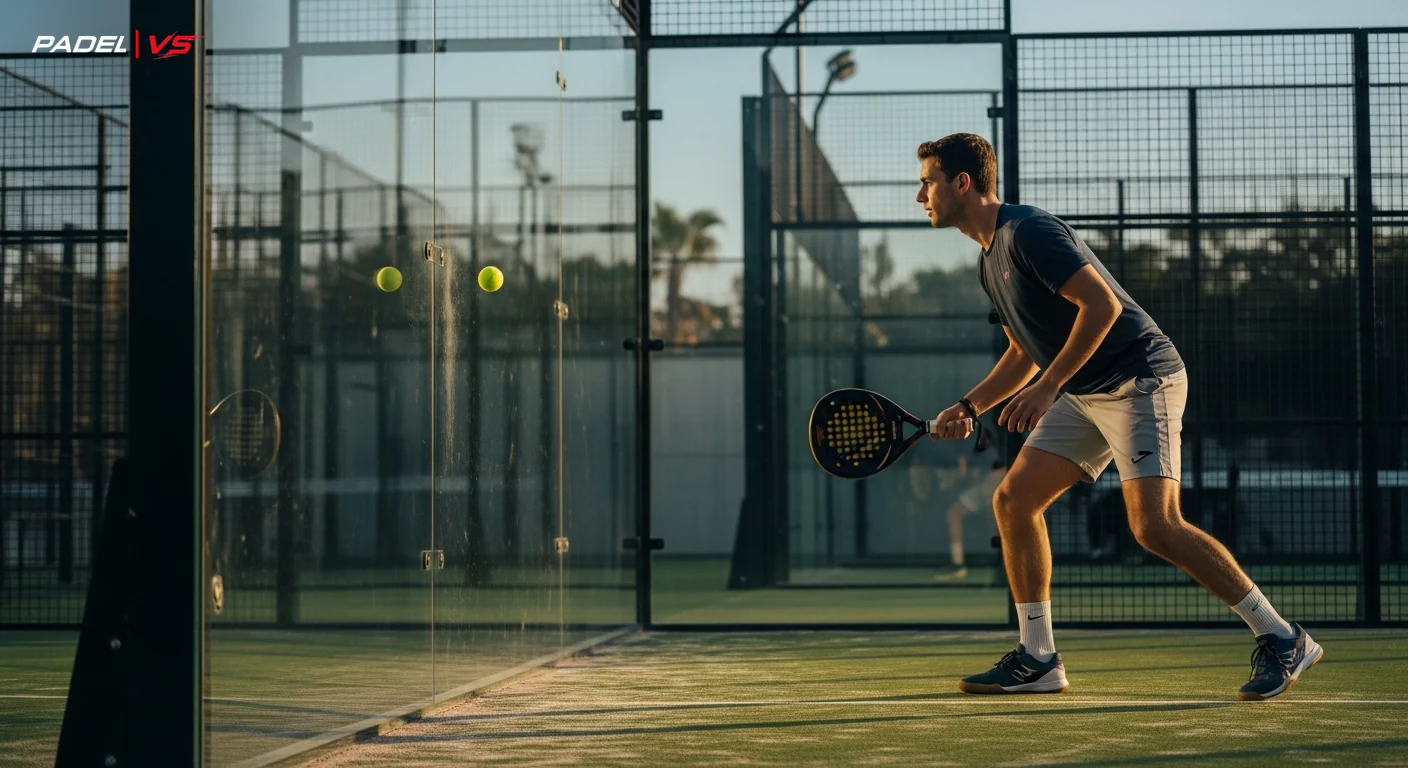
A padel court measures 20 meters long by 10 meters wide, split into two 10 x 10 meter halves. During a single competitive rally, a player typically executes between 4 and 8 direction changes, each of them initiated from a semi-flexed ready position — what coaches call the «ready stance» — with knees bent, weight forward on the balls of the feet, and hips loaded.
This creates three very specific physical demands:
- Reactive power: The ability to absorb energy during deceleration and immediately redirect it for the next movement — the stretch-shortening cycle in action.
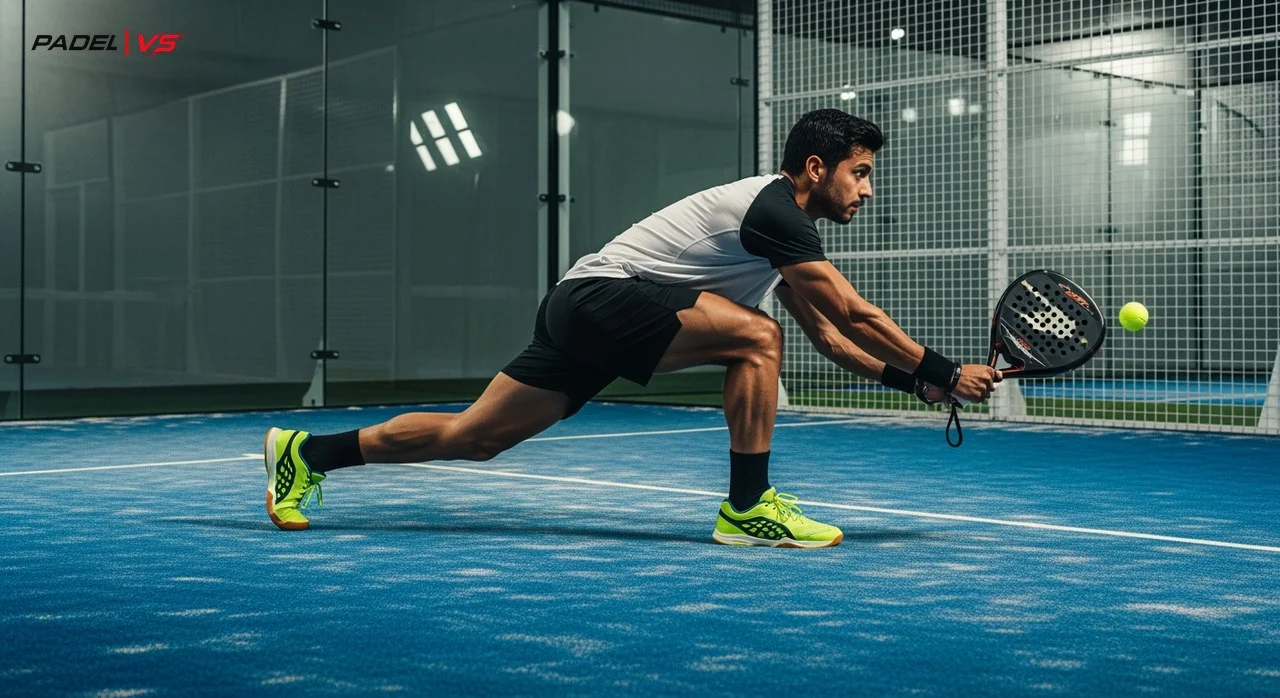
- Eccentric strength: Controlling your body's descent when reaching for a drop shot or a cut lob near the glass without losing balance or court position.
- Lateral hip and ankle stability: Critical when tracking a ball parallel to the side glass or executing a volley in a compromised, one-foot-forward position.
The five exercises below attack exactly these three dimensions. Each one includes the padel-specific adaptation that makes it different from simply going through a generic leg day.
Exercise 1: Bulgarian Split Squat with a Pause at the Bottom
Why it's padel-specific
The Bulgarian split squat (rear-foot elevated split squat) replicates the mechanical pattern of lunging for a wide lateral ball — lead foot forward, trail leg extended behind. The 2-second pause at the lowest point eliminates the bounce reflex and builds strength exactly at the position where the muscle is most vulnerable to injury and most responsible for changing direction.
Protocol
- Sets: 3 x 8 reps per leg
- Load: Start with dumbbells around 22-33 lbs (10-15 kg) per hand — roughly $30-45 USD ($550-825 MXN approx) for a pair at most sporting goods stores. Progress to barbell once you own the technique.
- Pause: 2 full seconds at the bottom, no rebounding
- Rest: 90 seconds between sets
Most common mistake
Letting the torso collapse forward more than about 15 degrees. In padel you need an upright posture to keep your racket in a ready position at all times. Train with your chest tall from day one — it will directly carry over to your court posture.
Exercise 2: Single-Leg Romanian Deadlift (Unilateral RDL)
Why it's padel-specific
Every time you reach for a low ball near the back glass, you're loading your weight onto one leg while your torso tilts toward the ball. That demands a strong, coordinated posterior chain — hamstrings, glute, lower back — in a unilateral stance. The single-leg RDL is the single most transferable exercise you can do for that exact movement pattern.
"Padel is won and lost in the first three steps. If your posterior chain can't brake you on one leg, your technique doesn't matter — you'll always be a fraction too late."
Protocol
- Sets: 3 x 10 reps per leg
- Load: A single dumbbell or kettlebell between 26-44 lbs (12-20 kg). Hold it on the opposite side from your stance leg — the "suitcase" position — to dramatically increase the hip stability challenge.
- Tempo: 3 seconds on the way down, 1 second to return
- Key technique cue: The floating leg is not a decoration. Keep it as straight as possible to maximize the hamstring stretch in the working leg.
Advanced progression
Add a lateral resistance band around the ankle of your stance leg. This fires the gluteus medius — the primary stabilizer for all your lateral movements across the center T of the court — turning a posterior chain exercise into a full lower-body stability drill.
Exercise 3: Lateral Bound with Controlled Single-Leg Landing
Why it's padel-specific
If there's one movement pattern that defines padel above all others, it's an explosive lateral push followed by a single-leg deceleration. The lateral bound trains exactly that cycle: drive off one leg, cover lateral ground, absorb the landing on the opposite leg. The optimal working distance — 5 to 8 feet (1.5 to 2.5 meters) per jump — corresponds directly to the actual distance of a wide lateral step on court.
Protocol
- Sets: 4 x 6 bounds per side (12 total bounds per set)
- Rest: Full 2 minutes between sets. This is pure power work, not conditioning — incomplete rest ruins the quality.
- Landing cue: Your landing must be quiet. If you're making a loud thud, you're absorbing impact with joint rigidity instead of muscle — that's injury risk and wasted energy.
- Progression: Increase distance per bound, not total reps.
Padel-specific adaptation
After each landing, hold your position for a full second before launching the next bound. This replicates the «ball reading» moment that separates players who react with intention from players who just scramble. Beginners in Quinta (<850 ELO) and Cuarta (850-1000 ELO) consistently lose this micro-second — training the pause makes it automatic.
Exercise 4: Lateral Step-Up with Hip Rotation at the Top
Why it's padel-specific
Stepping up onto a box from the side activates the gluteus medius and tensor fasciae latae in a way that bilateral exercises simply cannot replicate. Adding a hip rotation at the top bridges the gap between leg strength and shot preparation: it recreates the hip turn you make when setting up a groundstroke from the back court after a lateral sprint. This is one of the rare exercises that genuinely connects gym work to stroke mechanics.
Protocol
- Box height: 12-18 inches (30-45 cm) — roughly knee height. Going higher doesn't improve results here.
- Sets: 3 x 12 reps per leg
- Load: Light dumbbells (13-22 lbs / 6-10 kg each hand) or a weighted vest at 5-8% of your body weight ($50-90 USD / $900-1,600 MXN approx for a decent adjustable vest).
- Rotation: At the top of the step, rotate your hips 45° toward the side of the support foot. Hold 1 second. Return to neutral, then step down with full control.
Why lateral beats frontal step-up for padel
In padel you almost never move in a straight line. Lateral, diagonal, and backward movements make up the vast majority of what you do on court. The lateral step-up trains the neuromuscular patterns that actually appear in a match. The frontal step-up, by contrast, is more useful for cycling or stair climbing.
Exercise 5: Isometric Hip Thrust with Knee Abduction
Why it's padel-specific
The gluteus maximus is your primary acceleration engine. Full stop. But in padel, that glute also needs to resist internal knee rotation — which is exactly what happens when you brake sharply and redirect. The hip thrust with a resistance band around the knees trains both functions simultaneously: maximal glute extension power AND the lateral knee stability that protects your joints during explosive direction changes.
Protocol
- Sets: 3 x 12 reps + 1 final isometric hold set of 30 seconds
- Band: Medium-to-heavy fabric resistance band above the knees ($8-17 USD / $150-300 MXN approx for a quality set)
- Load: Barbell with 88-176 lbs (40-80 kg) across the hips, or a single dumbbell held vertically on the pelvis if you don't have a barbell setup.
- Key cue: Push your knees OUT against the band throughout the entire movement. That simultaneous abduction fires the gluteus medius alongside the maximus.
The 30-second isometric finisher
After completing the 12 regular reps, drive your hips to full extension and hold. This builds muscular endurance of the glute in maximal hip extension — the exact position where you need stability when executing an overhead smash or a bandeja near the back wall. It hurts. That's the point.
How to Fit These Exercises Into Your Padel Week
You don't need to do all five in a single session. Here's a practical distribution for someone playing 3-4 times per week:
| Day | Session | Exercises |
|---|---|---|
| Monday | Strength A | Bulgarian Split Squat + Unilateral RDL + Hip Thrust |
| Tuesday | Padel | — |
| Wednesday | Power B | Lateral Bound + Lateral Step-Up with Rotation |
| Thursday | Padel | — |
| Friday | Padel or rest | — |
| Saturday | Padel (match day) | — |
| Sunday | Active recovery | Hip mobility, foam rolling |
Critical note: Power sessions (Lateral Bounds, Step-Up with Rotation) must be on days separate from match days, or at minimum in the morning if your match is in the evening — with at least 6 hours between sessions. Your nervous system needs to be fresh for explosive power to be real power. Doing these exercises fatigued turns them into conditioning work, which is not the goal.
The Mistake 80% of Padel Players Make in the Gym
They train legs like a bodybuilder: 4 sets of 15 reps at moderate weight, short rest periods, chasing the burn. The burn — that lactic acid sensation — is not what padel needs. Padel needs neuromuscular power: heavier loads, lower rep counts, complete rest intervals, and pristine movement quality on every single rep.
"Padel doesn't ask you to run for 90 straight minutes. It asks you to explode in 0.3 seconds about 200 times per match. Train for that — not for a marathon."
If you're currently in Quinta (<850 ELO) or Cuarta (850-1000 ELO), the fastest improvement you can make over the next 8 weeks isn't buying an extra lesson — it's improving your ability to arrive to the ball on time. That's entirely a lower body training outcome, achieved outside the court.
How Long Before You Feel the Difference on Court?
With this protocol applied consistently twice a week, most players report perceptible changes in their movement between week 4 and week 6. Not necessarily scoreboard changes — but a feeling: you reach difficult balls more comfortably, the ready stance feels more sustainable, direction changes feel less like an effort and more like a reflex.
Measurable performance improvements — more points won, fewer errors from positioning, ability to sustain longer rallies — typically appear between week 8 and week 12. Lower body training for padel is a medium-term investment, but it's one of the highest-return investments you can make as a competitive player.
Track Your Progress Where It Counts: PADEL VS
At PADEL VS, we believe that off-court training should show up in on-court results. Our ELO ranking system tracks your evolution match by match — if your movement improves, your numbers will follow. Monitor your progress at padelvs.com or through the Telegram Mini App (@padelvsbot), where you can review your complete match history, current ELO, and category progression.
We're building a growing competitive community starting in Cancún and expanding to more cities. If you want ranked matches where the work you put in at the gym actually translates into real ranking points — this is the place to prove it.