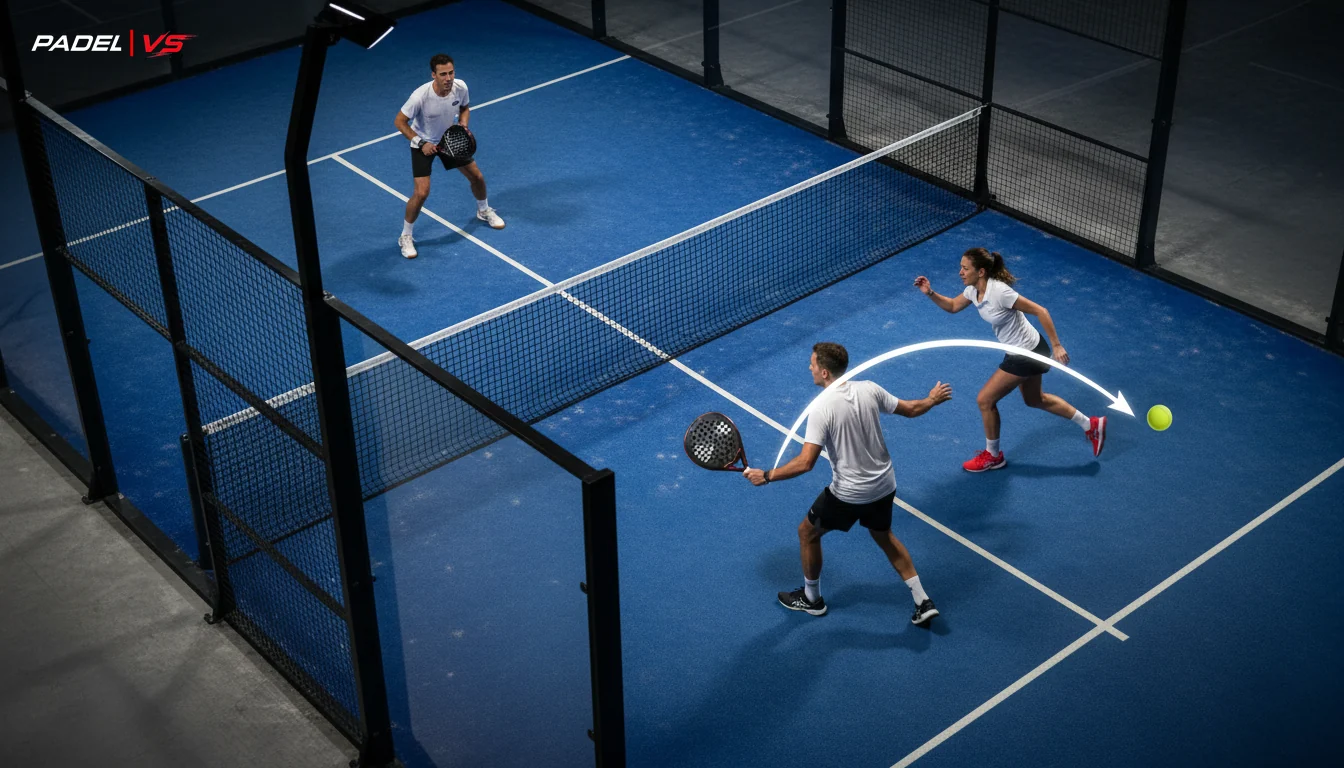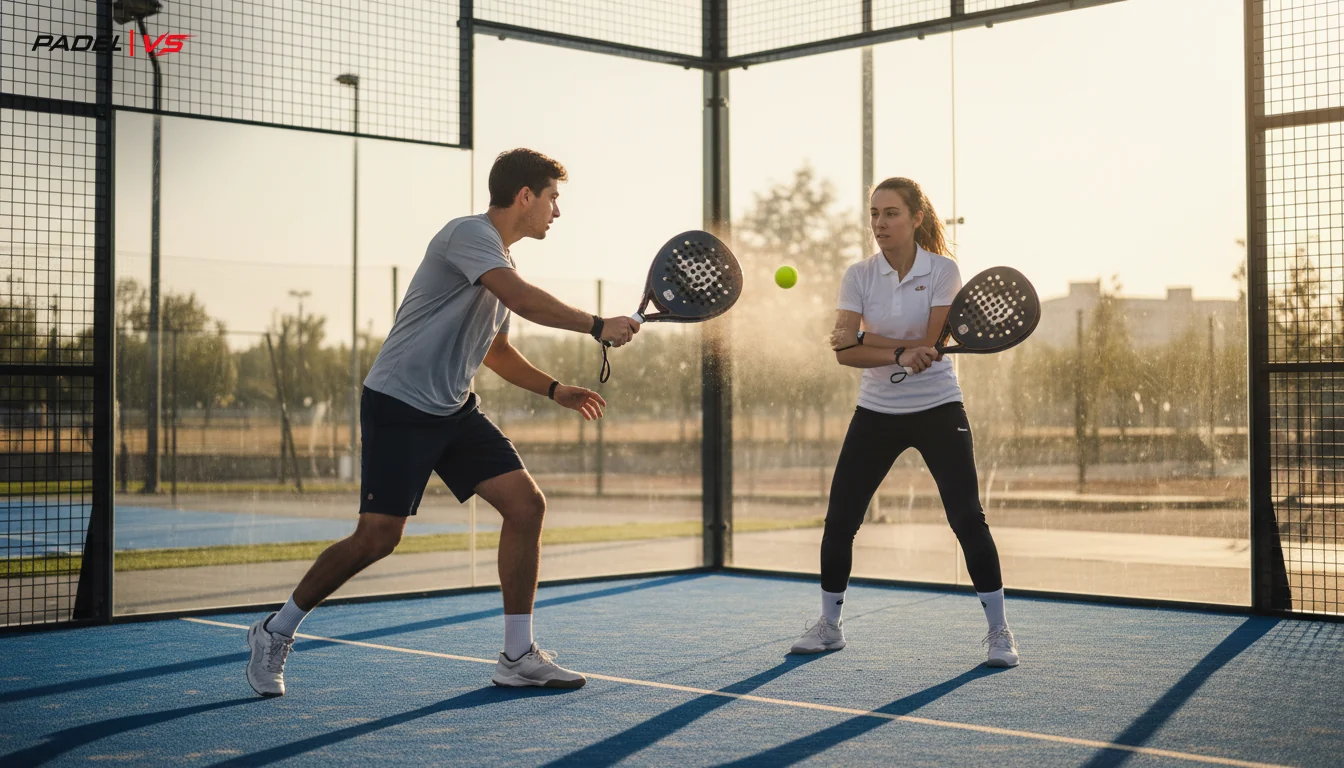

Padel is one of the most beginner-friendly racket sports on the planet — but that accessibility can be deceiving. Many players spend months, even years, carrying the same technical flaws without realizing it. Catching and correcting these mistakes early doesn't just improve your game; it prevents injuries and accelerates your climb through the category ladder.
1. The Grip: The First Mistake Nobody Fixes
The continental grip is the foundation of virtually every shot in padel. Yet most beginners — especially those coming from tennis or squash — instinctively grab the racket like a frying pan, with the thumb pointing upward and the palm flat against the handle. That's an extreme western grip, and it will cap your development fast.
Why does it matter so much? With an incorrect grip, your wrist locks into one position, you lose the ability to generate spin, and backhand volleys become a nightmare. The continental, by contrast, lets you play every shot — volley, lob, smash, off-the-wall retrieval — without rotating your hand between strokes.
How to Find the Continental
Hold the racket perpendicular to the floor. Place your index finger along the upper edge of the handle, as if you were pulling a trigger. That's the continental. If it feels awkward, that's a sign you've been gripping wrong for a while. Give it two weeks of conscious practice and it'll feel natural.
"Your grip in padel is not a minor detail — it's the difference between a player who improves and one who stays stuck at the entry level forever."
2. Camping at the Back of the Court
Padel is won at the net. This isn't motivational language — it's pure geometry. From the net, you control the angles, you have more time to react, and you own the attacking options. But the beginner instinct is to retreat every time the opponent hits hard, ending up pressed against the back glass wall.
Playing permanently from the back means surrendering control of the point. Both you and your partner get locked into a defensive posture while your opponents step up and dictate play from the front. The ideal offensive position is roughly 3 to 4 meters from the net (just behind the service line). You'll be forced back sometimes, but the goal is always to recover that mid-to-front position.
Practical Drill
During your next session, draw an imaginary line at the midpoint of the court (5 meters from the back wall on a standard 10 x 20 meter court). Every time you find yourself behind that line for more than two consecutive shots without being forced there, count it as a positioning error. Awareness is always step one.
3. Swinging Like a Tennis Player
This is probably the most visible mistake for players coming from a tennis background. In tennis, a long swing generates power. In padel, a long swing causes several problems simultaneously:
- You lose timing control because the ball speed changes constantly off the walls.
- You leave yourself exposed to a lob while you're still finishing your swing.
- You put unnecessary strain on your shoulder and elbow.
- You generate unforced errors on bandeja and overhead shots.
In padel, power comes from hip and trunk rotation, not arm swing. The racket path should be compact. On volleys especially, there is almost no backswing at all — it's a controlled block with a firm arm. Think "punch," not "swing."
4. Being Afraid of the Walls
The glass walls are not your enemy — they're a strategic asset. A typical beginner either freezes when the ball comes off a wall, or panics and tries to hit it before it reaches the glass, sacrificing all the depth and angle that the wall bounce would have created.
Off-the-wall retrievals (when the ball comes off the side or back glass) are technically demanding but absolutely fundamental to padel. The key principles are:
- Read the trajectory before moving — let the ball bounce on the floor and then off the glass; don't anticipate early.
- Position sideways, never facing the glass — your dominant shoulder should point toward the wall.
- Contact the ball low and in front — ideal contact point is around knee height, in front of your hip.
Dedicate at least 15 to 20 minutes per session specifically to practicing off-the-wall shots. It's the single technical element that most clearly separates a Quinta player from a Cuarta player.
5. Not Communicating With Your Partner
Padel is a doubles sport at its core. There is no absolute "my side" and "your side" — there is a 10-meter wide court and two players who need to cover it as a unit. The classic beginner mistake is that both players go for the same ball, or neither goes because each assumes the other will take it.
Minimum required on-court communication includes:
- "Mine" — when you're clearly taking the shot.
- "Yours" — when you're ceding the shot to your partner.
- "Back" — when you need your partner to drop back and give you space.
- "Up" — calling your partner to come to the net after a solid defensive lob.
Talking on court isn't a beginner thing or a pro thing — it's simply the right thing. In tournaments organized through PADEL VS, the pairs with better communication consistently win key points just by eliminating positional hesitation.
6. Using the Wrong Racket for Your Level
There's a widespread belief that a more expensive, harder racket makes you a better player. At the Quinta and Cuarta levels, the opposite is true.
| Player Profile | Recommended Racket Type | Price Range |
|---|---|---|
| Beginner (Quinta, <850 ELO) | Round shape, soft foam core, 350-365g | $45-100 USD ($800-1,800 MXN aprox) |
| Intermediate (Cuarta-Tercera, 850-1180 ELO) | Round or teardrop, medium EVA, 360-375g | $100-195 USD ($1,800-3,500 MXN aprox) |
| Advanced (Segunda-Primera, 1180-1550 ELO) | Teardrop or diamond, hard EVA, 365-380g | $195-390 USD ($3,500-7,000 MXN aprox) |
A hard-core racket amplifies technique errors. If your timing isn't precise — and at Quinta, it isn't yet — every slightly off-center contact sends vibrations up through your elbow and produces more unforced errors. A soft, round racket is more forgiving and lets you focus on building foundations rather than fighting your equipment.
7. Skipping the Warm-Up
Tennis elbow (lateral epicondylitis) and shoulder inflammation are the most common injuries in beginner padel players, and in the vast majority of cases they are preventable. The main cause: arriving at the court cold, picking up the racket, and hitting hard from the first minute.
An effective padel warm-up doesn't need more than 8 to 10 minutes:
- 3 minutes of joint mobility: wrists, elbows, shoulders, hips, and knees.
- 2 minutes of light jogging on or around the court.
- 3 to 5 minutes of gentle rally from center court, not involving the walls yet.
After the session, stretch your hamstrings, calves, and especially the extensor forearm muscle — the one that absorbs impact on forehand and smash shots. Sixty seconds per muscle group is sufficient. Don't skip it because you're tired; that's exactly when the muscle is most vulnerable.
8. Trying to Win Points Outright Too Early
Competitive padel, even at the Quinta level, is decided mostly by unforced errors — not by winners. Beginners who've watched World Padel Tour highlights try to imitate impossible off-glass drops or cross-court smashes from deep, with entirely predictable results: the ball hits the net or sails out.
"In padel, the patient player who makes fewer mistakes almost always beats the spectacular player who makes many. Especially at the base categories."
The most effective strategy for Quinta and Cuarta is straightforward: keep the ball in play, move forward when the opponent leaves a short ball, and only attempt a smash when the ball drops in front of you and above your shoulder. Consistency beats spectacle in entry-level padel every single time.
Understanding Your Real Level
One of the biggest mistakes beginners make off the court is misidentifying their own level — either overestimating or underestimating where they stand. Self-perception is notoriously unreliable in racket sports.
At PADEL VS, we apply an ELO-based rating system that places every player in their real category from the first matches. There are no generic "beginner/intermediate/advanced" buckets or subjective self-assessments. The six categories are:
| Category | ELO Range | What It Means |
|---|---|---|
| Quinta | <850 | Where it all starts. Learn without pressure. |
| Cuarta | 850-1000 | You understand the game. |
| Tercera | 1000-1180 | Real competitive padel. |
| Segunda | 1180-1350 | One step from the top. |
| Primera | 1350-1550 | Elite padel. |
| Open | ≥1550 | The maximum category. |
This system has a huge advantage for beginners: you can focus on fixing the errors relevant to your level, not the advanced techniques that won't apply to you for another year. A Quinta player doesn't need to master the vibora — they need a correct grip, basic positioning, and fewer unforced errors.
Getting Started With PADEL VS
You can register and explore available tournaments at padelvs.com or through our WhatsApp bot (wa.me/5219991400244). We're also on Telegram (@padelvsbot).
We accept card, bank transfer, cash and crypto (USDT/BTC/ETH), with QR registration at the club.
We launched in Cancún and are in our early stages of building the network. If your local club isn't on the platform yet, visit them directly through their Instagram or website — when they integrate with PADEL VS, you'll be able to manage everything in one place.
Quick Reference: 8 Mistakes and Their Fixes
| Mistake | Key Fix |
|---|---|
| Western / frying pan grip | Switch to continental from day one |
| Glued to the back glass | Hold mid-to-front position, 3-4m from net |
| Long tennis-style swing | Compact punch, power from hip rotation |
| Fearing the walls | Practice off-the-wall shots 15-20 min/session |
| Silence on court | Always communicate: "mine", "yours", "up" |
| Hard racket for a beginner | Soft core, round shape until Tercera |
| No warm-up | 8-10 min of mobility + gentle rally |
| Chasing winners too early | Patience, consistency, fewer errors |
Padel rewards deliberate, patient technique development. Every single error on this list is completely fixable with awareness and intentional practice. Start with your grip this week — just that one change — and you'll feel the difference in your very next match.