We've all lived through the same frustrating moment: the ball heads straight for the back glass, you calculate the rebound with total confidence, you move... and the ball comes out somewhere completely different. It's not bad luck or slow reflexes. Nobody ever explained how the glass actually behaves, and that gap in understanding is one of the biggest differences between a Cuarta-level player and a Segunda-level one.
Why Padel Isn't Squash or Tennis
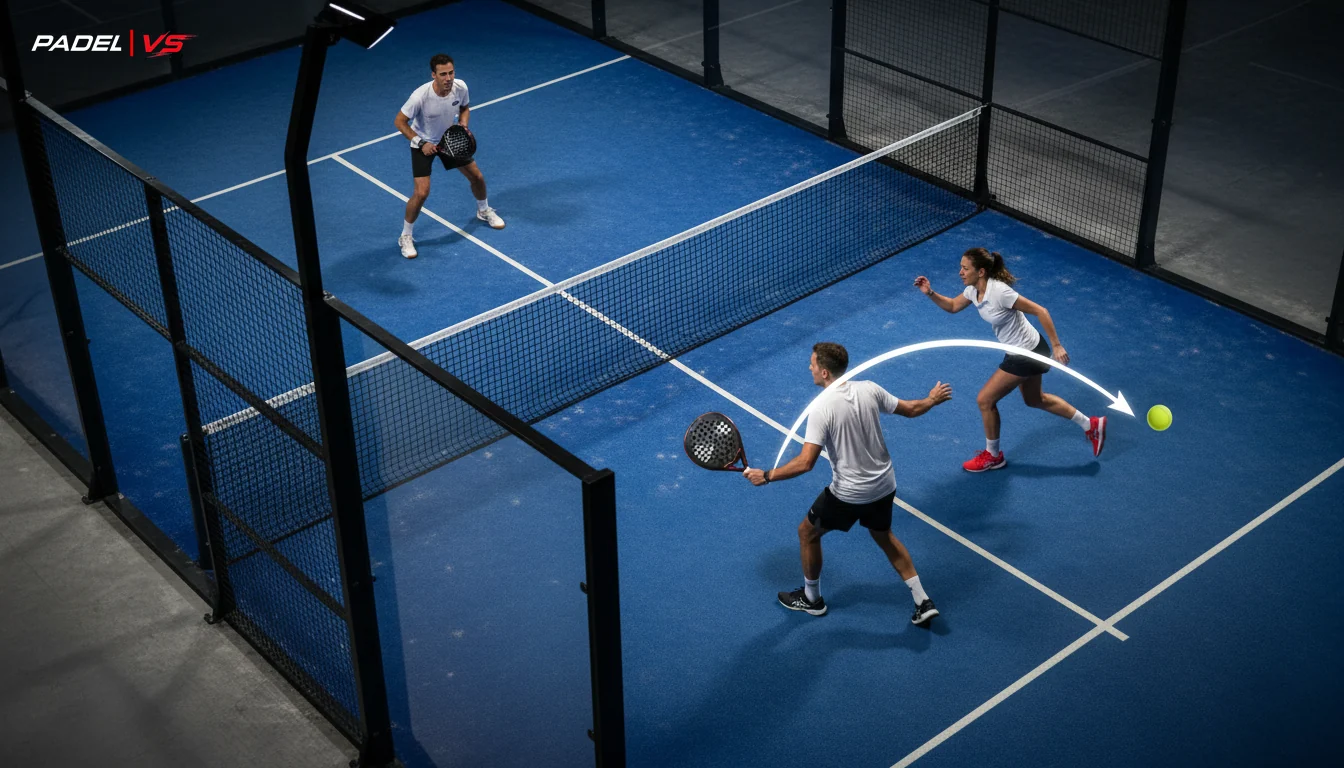
In squash, the wall is smooth, uniform, and always reacts the same way. In tennis, there's no wall at all. Padel gives you a strange hybrid: a court 20 meters long by 10 meters wide, with a back wall made of tempered glass standing roughly 3 to 4 meters tall, plus side walls that combine metal mesh with glass panels in the final stretches. Each surface absorbs and returns energy differently, and that's exactly where the trouble starts for anyone who came from tennis thinking “a bounce is a bounce.”
Tempered glass is rigid but not perfectly elastic. Depending on the panel thickness (usually between 10 and 12mm), the ambient temperature, and especially the seams between panels, the ball can either accelerate slightly on exit or lose speed almost imperceptibly. Fully panoramic glass courts — increasingly common in clubs across Cancún, Mexico City, and Guadalajara — tend to produce livelier, more predictable rebounds than mixed courts with mesh sections, where energy gets partially absorbed and the bounce comes out shorter.
The Detail Almost Nobody Explains: Order Matters
Here's the technical key that separates a player who reads the wall from one who just runs behind it: floor-then-glass is not the same as glass-then-floor.
- Floor-glass (ground first, glass second): the ball hits the floor, loses speed from surface friction, and reaches the glass already decelerated. The resulting rebound is higher, shorter, and gives you more reaction time.
- Glass-floor (glass first, ground second): the ball keeps almost all its speed when it hits the glass, and the resulting rebound is flat, fast, and travels much farther from the wall. This is the one that catches intermediate players off guard because it “should” behave like the previous case, but it doesn't.
Most positioning mistakes at Tercera and Cuarta levels come from treating both rebounds as if they were identical. If you train your eye to distinguish which of the two is happening before the ball reaches the glass, you're already one step ahead.
The Three Rebound Patterns You Need to Master
Beyond the floor-glass order, there are three rebound patterns that repeat constantly in a real match. Mastering how you read them is, quite literally, the difference between arriving comfortably on the ball or arriving stretched out and on the defensive.
| Rebound Type | How It Happens | Ball Behavior | Typical Response |
|---|---|---|---|
| Direct back-wall rebound | Ball travels in a straight line into the back glass without touching a side wall | Symmetric and predictable: angle of entry ≈ angle of exit | Bandeja, lob, or deep forehand |
| Side-back rebound (double) | Hits the side wall first and the back wall second, or vice versa | Changes direction roughly 90°, opens toward the center of the court | Víbora, cross-court counter |
| Corner rebound | Hits near the seam where the side wall meets the back wall | Tight, fast, low bounce; shoots out at sharp angles | Bajada or emergency defense |
The corner rebound gives away the most points at Quinta and Cuarta levels because the ball seems to “die” in the glass seam and then shoots out at an angle almost nobody anticipates. If you play at those levels, it's worth specifically practicing that corner with a training partner.
The Basic Physics, Without Overcomplicating It
The theoretical principle is simple: angle of incidence equals angle of reflection, just like on a billiard table. The problem is that in padel you're almost never facing a pure rebound, because three extra variables get involved:
- Spin on the ball: a topspin ball grips the glass more and exits at a sharper downward angle. A sliced ball skids and exits flatter and more open.
- Impact speed: higher speed means less contact time with the glass and a “cleaner” rebound. Lower speed means the glass absorbs more energy and the rebound becomes less predictable.
- Exact impact point on the panel: glass panels aren't one single block — they're joined together with aluminum frames. Hitting near those seams creates irregular micro-bounces that no player can calculate with 100% certainty, only anticipate by probability.
The wall isn't your enemy on court. It's your third teammate. The problem is almost nobody takes the time to learn its language.
Common Mistakes at Intermediate Levels
At PADEL VS, when analyzing tactical patterns across different ELO categories, one pattern repeats constantly between Quinta (under 850 ELO) and Cuarta (850-1000 ELO): the player keeps staring at the wall instead of watching the ball before it bounces. This produces three recurring mistakes:
- Standing still waiting for the rebound instead of moving toward a recovery position while the ball is still traveling.
- Calculating the rebound as if it were tennis, assuming the ball behaves the same as if there were no wall, which causes late or early contact.
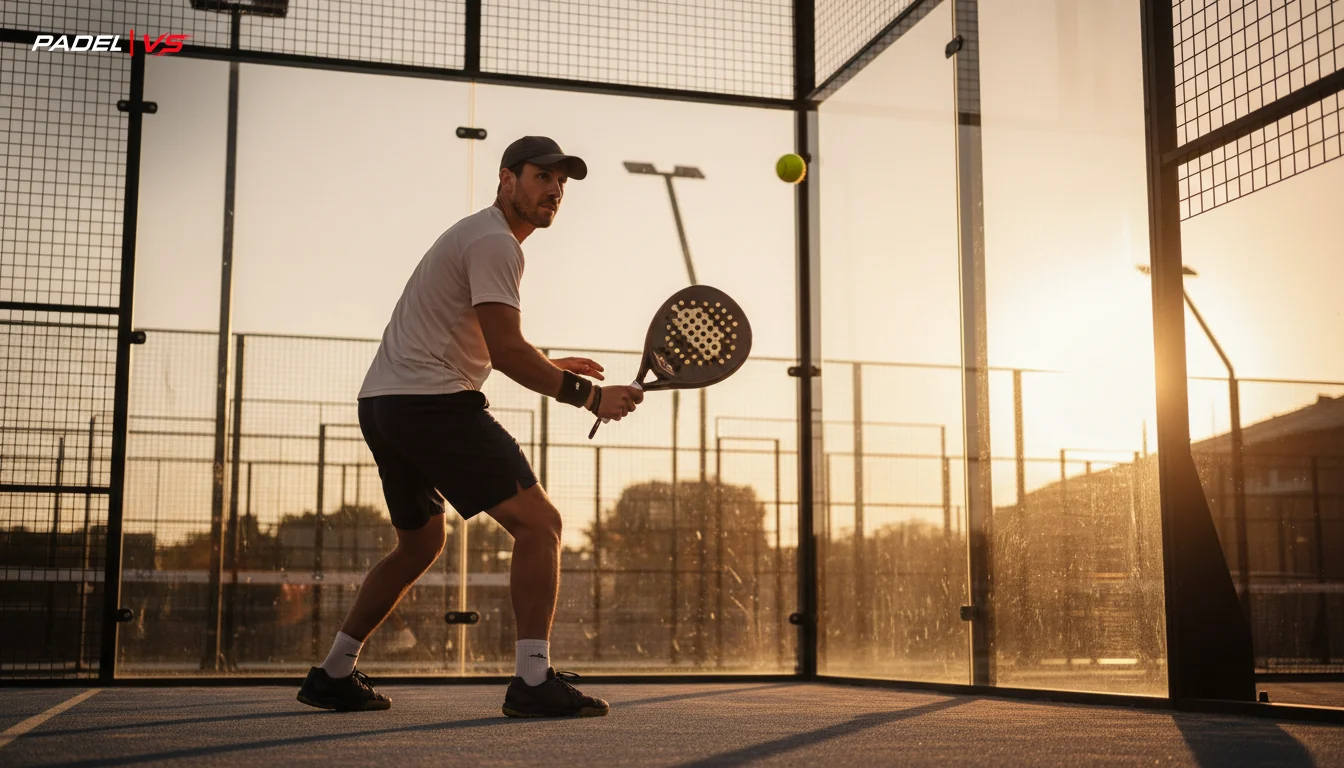
- Turning the back too early, losing sight of the ball right at the critical moment it hits the glass.
Starting at Tercera (1000-1180 ELO), a clear improvement shows up: the player begins anticipating the rebound type before it even happens, based on the ball's trajectory and whether it's carrying spin. At Segunda and Primera (1180-1550 ELO), players essentially “read” the glass as naturally as they read a forehand — they already know, from speed and entry angle, whether the ball is going to come out short or long before it even touches the glass. At Open level (1550+ ELO), this reading combines with instant tactical decisions: using the rebound to set up an offensive lob, a víbora, or a straight-up winning bajada.
How to Train Wall-Reading: Concrete Drills
You don't need fancy equipment, you need conscious repetition. These are the drills we recommend practicing when PADEL VS shares training content with the community:
1. The Three-Zone Drill
Mentally divide the back wall into three zones: left, center, and right. Have a partner or coach feed balls alternating zones without warning. Your goal isn't to return the ball yet — just call out “short” or “long” before the ball finishes its rebound. This drill trains pure prediction, separated from execution.
2. Shadow Reading
For 10 minutes, set up in back-court position and move as if you were reading imaginary rebounds that your coach narrates out loud (“floor-glass short to the right,” “glass-floor long to the center”). It sounds simple, but it dramatically improves your first step, which is 80% of arriving well positioned.
3. The Corner Focus
Dedicate 15 minutes per session exclusively to balls directed at the side-back seam. It's the least-trained rebound and the one that gives away the most points in real matches, especially in Cuarta and Tercera level tournaments.
4. Video Review
Film yourself from the stands with your phone during a full set. Review specifically the points where you lost position because of a miscalculated wall rebound. In most cases, you'll notice the mistake wasn't physical — it was a reading error. You moved late because you didn't recognize the rebound type in time.
Clinics and Specialized Training
If you want to speed up this learning curve, many clubs in Mexico offer specific “wall play” clinics with certified coaches. A typical 2-hour group clinic focused on wall technique runs between $28-50 USD ($500-900 MXN aprox) per session, while a private hour with a specialized coach can range from $33-67 USD ($600-1,200 MXN aprox), depending on the city and the coach's experience level.
Anticipation as a Competitive Edge
Reading the wall well doesn't just save you unnecessary running — it lets you anticipate one step ahead of your opponent and turn a defensive ball into an offensive opportunity. It's literally one of the skills that PADEL VS's category system ends up reflecting over time: players who move from Tercera to Segunda almost always show a measurable improvement in their post-bounce reaction time, even when their groundstroke itself didn't change much.
Whoever doesn't read the wall, runs. Whoever reads it, arrives with time to spare and decides what to do with the ball — not just where to put it.
Next time you step on court, don't just watch the ball — watch how it approaches the glass, at what speed, with what spin, and at exactly which point on the panel it's going to land. That information, processed in fractions of a second, is what separates someone who plays padel from someone who truly understands padel.