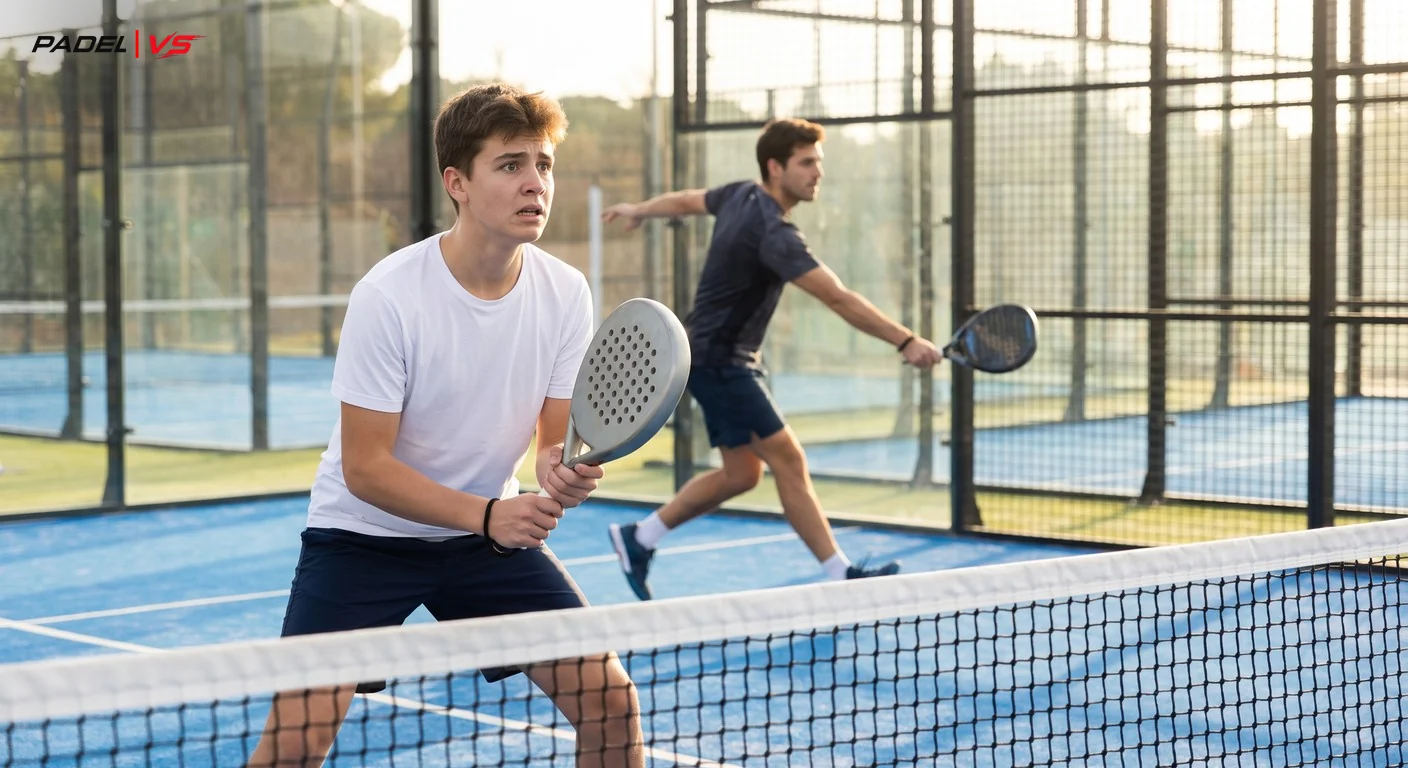
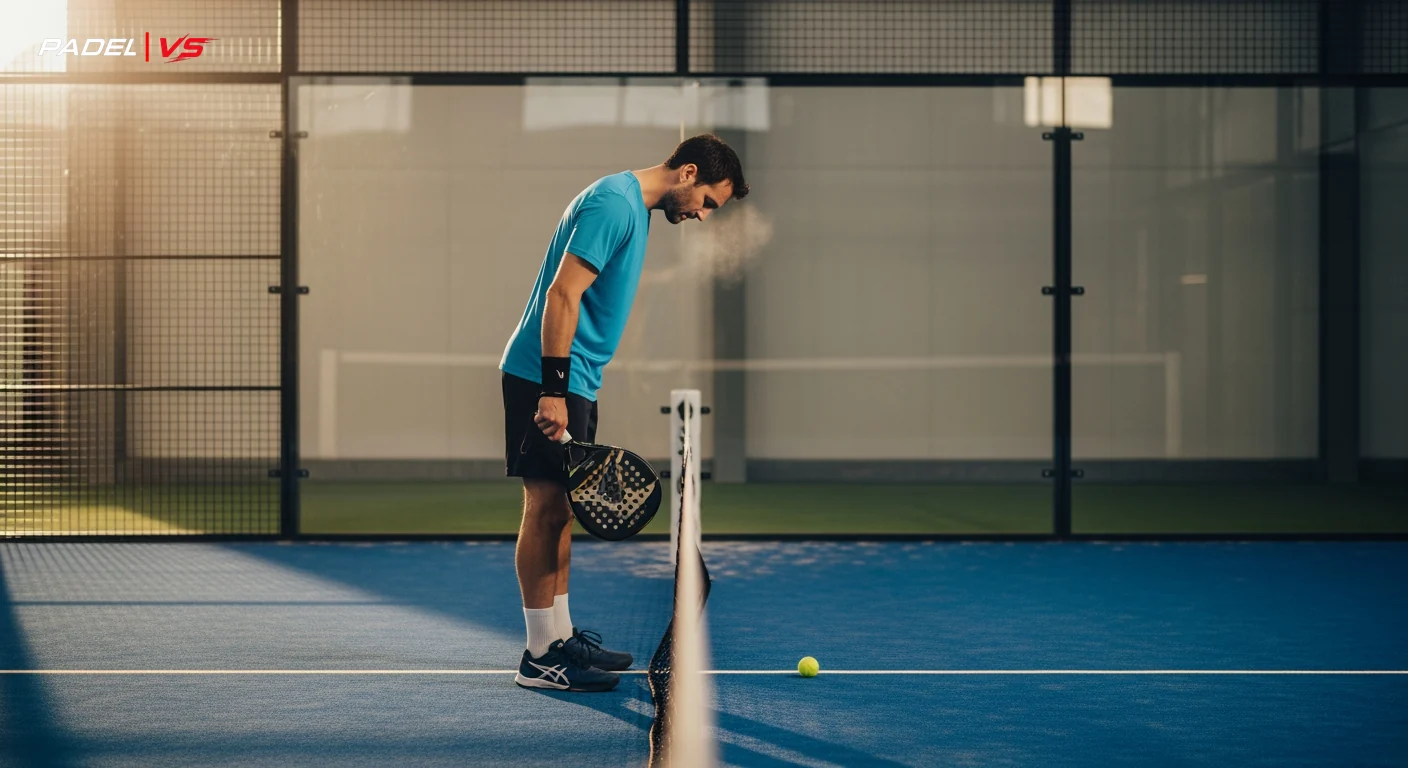
You just hit a double fault. Then another one. In under 90 seconds you handed the opponents a free game — no rally, no chance to compete — and now you're standing at the service line with that specific, suffocating dread that the next serve might go exactly the same way. That's not weakness. That's neurology. And you can work with it.
Why a Double Fault Hits Differently Than Any Other Error
In padel, losing a point off a mistimed smash or a volley that clips the net makes a certain kind of competitive sense: there was an exchange, the opponent applied pressure, something went wrong. A double fault is categorically different. It's a unilateral error — no exchange, no direct pressure from the other side, just two consecutive failures at something that, on paper, is entirely within your control. That triggers a very specific psychological mechanism: the sudden, visceral sensation of losing control over your own game.
Chain two double faults together in the same match — especially in a high-stakes moment like 5-5 in the third set on one of those 10×20-meter courts where every point echoes off the glass — and your brain starts constructing a catastrophic narrative at alarming speed. «I'm going to miss the next one too.» «They can see my serve is broken.» «How do I serve with confidence when I've just proved I can't?»
The error doesn't break you. The story you tell yourself about the error can.
The good news: that narrative is rewritable. We see this pattern across every ELO range at PADEL VS — from players in Quinta (under 850 ELO) who are still learning the game's rhythms, to competitors in Primera (1350-1550) who have the technique fully dialed in but suddenly chain two serves into the net and proceed to unravel over the next four games. The pattern is universal. So is the solution, once you understand its structure.
What's Actually Happening in Your Body
When you hit that first double fault, your autonomic nervous system registers a social threat — the possibility of embarrassment in front of your partner, your opponents, and whoever is watching through those glass panels. Cortisol spikes. Muscle tension increases, particularly in the shoulders, neck, and the arm holding your racket. Your visual field narrows. And here's where the technical problem compounds the mental one: you approach the next serve gripping a racket that weighs somewhere between 340 and 375 grams, but your arm is so tense it feels like twice that.
Your ball toss becomes erratic. The swing loses its natural arc. You start watching the net instead of the ball's trajectory. And the predictable result is either another fault — or a serve so soft and directionless that the receiver steps in and attacks it before you even set your position.
The Negative Feedback Loop
The most dangerous part isn't the lost point. It's the cycle that follows:
- Double fault → social threat activation
- Muscle tension → technical degradation of the serve motion
- Defensive serve or third fault → confirmation of the negative narrative
- Eroded confidence in the next service game
- Behavioral changes across your entire game: avoiding aggressive serves, playing more conservative passing shots, stopping the drive to the net
That fifth step is the most damaging and the least visible. When fear of failure starts changing your entire game — not just your serve — you're no longer playing padel. You're managing anxiety on a padel court. Those are very different activities, and only one of them wins matches.
The Three-Phase Immediate Mental Reset
This isn't about ten-minute meditation sessions or visualization techniques that take months to internalize. This is a 15-to-20-second protocol you can execute right now, in the gap between your second failed serve and the moment you walk back to the service line.
Phase 1: Active Physical Pause (4-6 seconds)
Walk toward the back glass wall on your side — those 10-meter-wide panels that define the court's perimeter. Touch the glass with your non-dominant hand. That physical contact does something concrete: it activates tactile receptors that interrupt the automatic thought loop. This isn't dramatic or theatrical — you're using basic neuroscience to your advantage.
As you walk, consciously drop your shoulders. Shake out the arm holding your racket as if you're flicking water off your fingers. These movements aren't empty rituals. They're physical signals you're sending your nervous system: the threat has passed, the muscles can release.
Phase 2: The Count Breath (6-8 seconds)
Inhale for a count of 4. Hold for 2. Exhale for a count of 6. One repetition is enough. The pattern of exhaling longer than you inhale activates the vagus nerve and measurably reduces heart rate within seconds. You don't need more — the time between points in padel doesn't allow it, and physiologically you don't need it.
Phase 3: One Technical Cue (3-5 seconds)
Here's where most players get it completely wrong. They walk into the next serve thinking about not faulting. That's a negative instruction the brain can't process efficiently — when you try to «not do» something, you activate precisely the circuits you'd use to do it. It's why telling yourself «don't hit the net» makes you stare directly at the net.
Instead, choose one single positive, concrete technical cue. Options that work well in padel:
- «Toss high — above my hairline»
- «Contact with the flat face of the racket, not the edge»
- «Hit through the ball — don't cut the swing short»
- «Cucharita serve, soft, aimed at the receiver's hip on the left»
Just one. A brain under pressure can't run a checklist. It can follow one clear instruction.
The Partner Conversation: What Helps vs. What Destroys
Padel doubles — the standard format on a 10×20-meter court with four players — means your partner has a critical role in these moments. And most partners get it wrong, usually with the best possible intentions.
| What your partner says | What the stressed brain hears | Real effect |
|---|---|---|
| «Relax, no pressure» | «There's enough pressure that someone needed to address it» | Increases anxiety |
| «Just get it in somehow» | «Your serve is a problem we need to survive» | Reinforces negative narrative |
| «Want me to serve instead?» | «You've lost my confidence» | Devastating to self-trust |
| «Toss high — next one's yours» | One clear cue + a vote of confidence | Activates execution mode |
| [Silence + pat on the shoulder] | «We're fine, this happens» | Neutralizes without adding mental noise |
The golden rule for partners: one technical cue or supportive silence. Never hot analysis, never «what happened on that one?», never a string of hollow «come on, you got this» that starts to feel like a countdown to another failure.
Tactical Adjustment: What Nobody Tells You About Serving After a Double Fault
The obvious temptation is to go «safe» — a very soft, very slow serve with no direction, just to get the ball in. The problem is that serve hands the receiver a perfect ball to attack, and if you lose the point anyway, you've reinforced the narrative that your serve is broken rather than simply having had a rough patch.
The smarter tactical play is what padel players call the cucharita or topspin lob serve: a serve with heavy topspin that bounces high toward the side glass wall and forces the receiver to take a step back. It's not your most aggressive weapon, but it's not defensive either — it has clear tactical intent. More importantly, its mechanics are simpler than a flat serve, which reduces your technical error margin exactly when you need to reduce it most.
At Tercera level (1000-1180 ELO) and above, this serve doesn't just get in — placed correctly at the body or toward the back corner, it can genuinely create difficulties for the receiver, especially when they're expecting you to serve timidly after two faults.
Long-Term Work: Building a Serve That Holds Under Pressure
Everything above is crisis management. But if double faults are recurring across your matches — more than two per set on average — there's a technical layer that deserves dedicated work outside of match play.
Simulated Pressure Practice
Dedicate 15 minutes at the start of your training sessions solely to serving, with one rule: every missed serve adds a point against you. If you accumulate 5 points against, you do 10 squats before continuing. This isn't punishment — it's controlled exposure to consequence, which trains your nervous system to function under pressure without triggering the panic response. Do this consistently for four to six weeks and your «pressure serve» and your «casual serve» will start to converge.
Intentional Variety
Practice three serve types regularly: flat to the body, topspin lob toward the side glass, and slice that opens toward the outside. Having three concrete options in your mind during a real match reduces the psychological load on any single one. If the flat serve isn't landing, you have alternatives with tactical intent — not just survival intent. That mental distinction changes everything about how you execute.
Using PADEL VS to Work on This Systematically
At PADEL VS, every match you play is logged and your ELO shifts point by point. That means you have real data on how your performance moves across a match — you can start identifying whether your most competitive matches near category thresholds show specific patterns of mental collapse at high-pressure moments.
If you're currently in Cuarta (850-1000 ELO) and aiming for Tercera, the technical gap between those categories is smaller than most players think. The gap in pressure management at critical points is larger. Using your match history in the platform as an analytical tool — not just a scoreboard — is an advantage very few players actually exploit. You can access your full history directly from padelvs.com in your browser, or through the Telegram Mini App at @padelvsbot.
High-level padel isn't won purely on technique. It's won on your ability to execute your technique when it hurts most to do so.
The Full Protocol: Quick Reference
When you chain a double fault (or two) in your next match, run this sequence:
- Physical pause: walk to the back glass, touch it with your non-dominant hand, drop your shoulders, shake out the racket arm — 5 seconds.
- 4-2-6 breath: one repetition, exhale longer than the inhale — 6 seconds.
- One positive technical cue: choose it before stepping back to the line — 3 seconds.
- Tactical adjustment: if the flat serve isn't landing, switch to the topspin lob with directional intent.
- Next point as if it's the first of the match: the scoreboard exists, but your execution has no memory.
This doesn't guarantee the next serve goes in. It guarantees you arrive at that serve in the best possible mental and physical condition for it to go in. In a sport where the difference between categories is measured in decisions made under pressure — on a court surrounded by glass where every grimace is visible — that is a real, concrete competitive advantage.