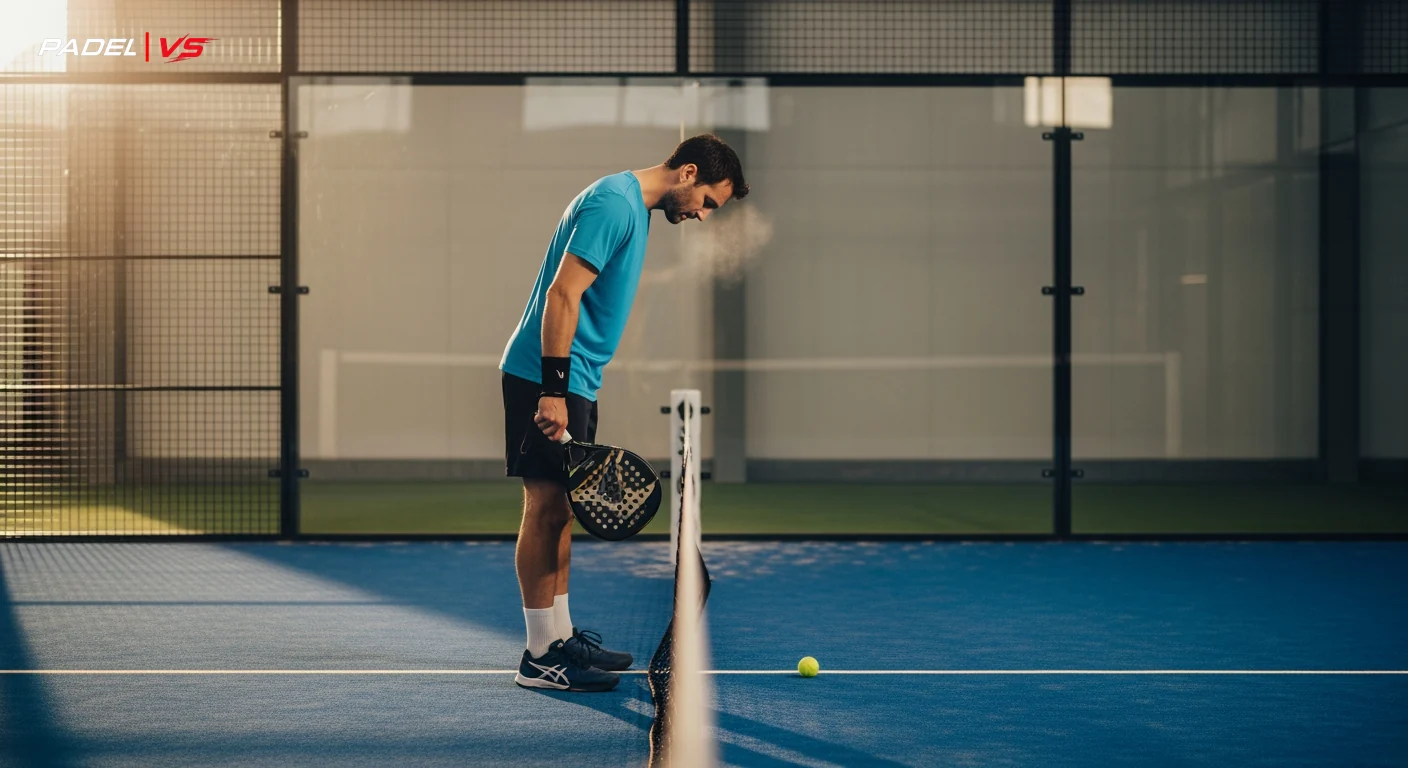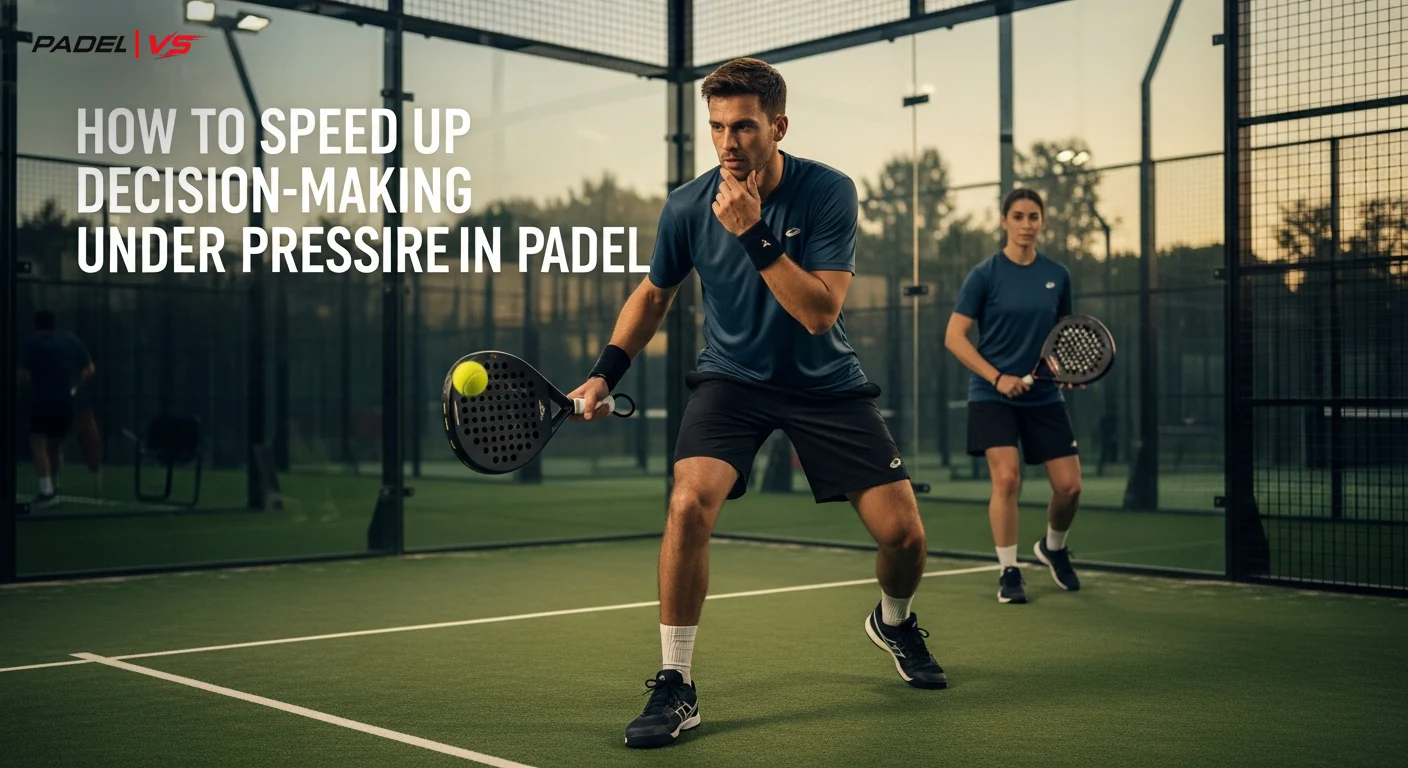
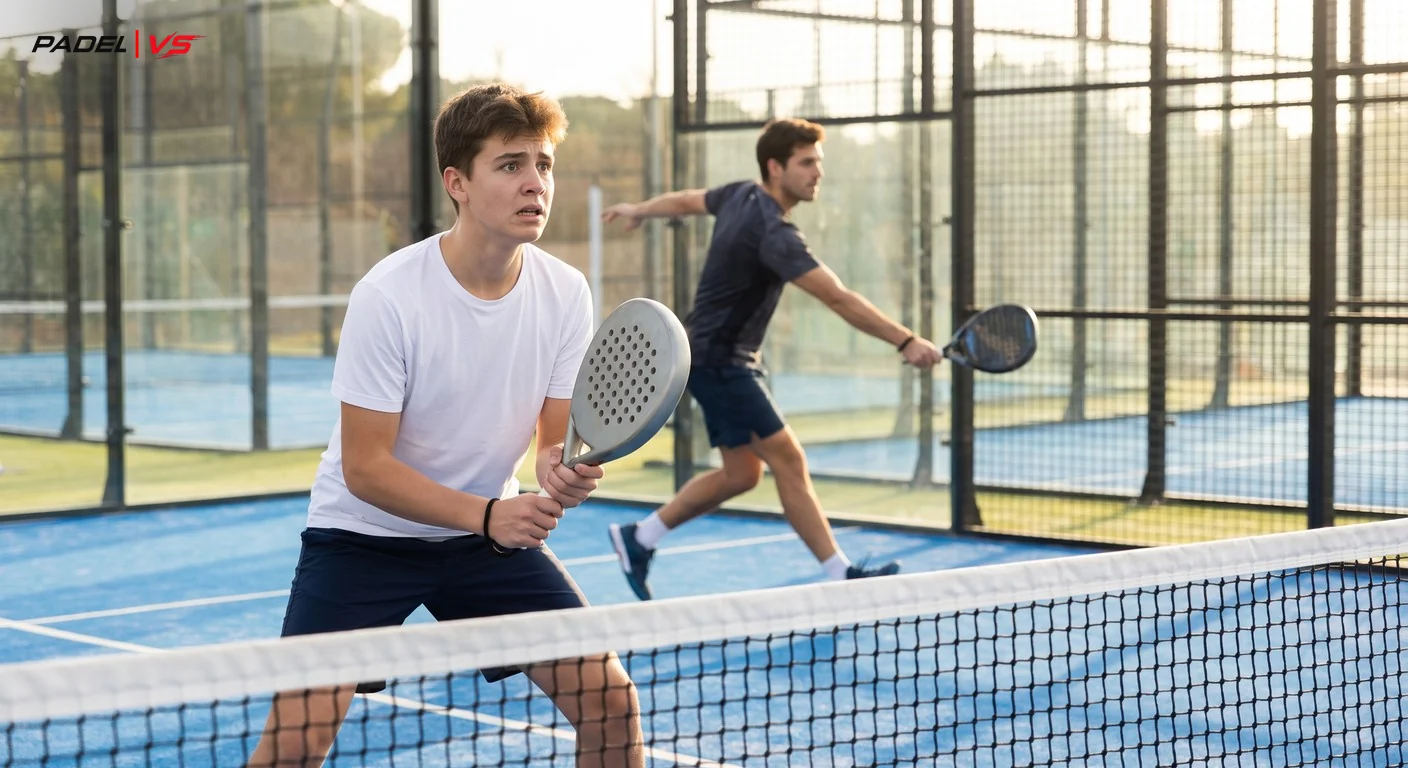
You've been training consistently, your shots are reasonably dialed in, and then suddenly you're paired with someone who's clearly two levels above you. Your body tightens, your mind races, and on the first big point you make the dumbest unforced error of your life. It's not a technique failure — it's poorly managed pressure. And in padel, where the court is just 10 × 20 meters and every mistake echoes off four glass walls, that mental freeze can derail an entire match.
Why Padel Amplifies Psychological Pressure
Padel has a characteristic that makes it psychologically more demanding than most other racket sports: proximity. On a 200 m² court, you're literally meters away from your partner, your opponents, and the walls at all times. There's nowhere to hide. Every mistimed lob, every bandeja into the net, every smash that flies over the back glass is completely visible to everyone present.
This creates what sports psychologists call perceived social evaluation: the sense that others are constantly judging your performance. When your partner is better than you, that perception intensifies. You assume — almost always incorrectly — that they're cataloguing your every mistake and privately regretting choosing you as their partner.
Physiologically, this triggers a full stress response: elevated cortisol, increased heart rate, tense muscles. Ironically, the very things you need to play well — fine motor coordination, timing on your swing, reading the bounce off the back glass — are exactly what stress dismantles first.
"The problem isn't missing the shot. The problem is the fear of missing in front of someone you think never misses."
Who Freezes Up — And Why It's Not Who You Think
Before jumping to solutions, it's worth understanding who freezes most often. It's not necessarily the least technical player in the group. Mental blocking in padel hits hardest on:
- Perfectionists who hold an extremely high internal standard and have zero tolerance for their own errors.
- Ego-oriented players who measure their self-worth by how they appear to others rather than by their own improvement process.
- Players in category transition — for example, someone who recently moved from Quinta to Cuarta (crossing the 850 ELO threshold) and feels like they don't quite belong at that level yet.
- Players who rarely compete up a level and haven't built the experience of managing that dynamic repeatedly.
Recognize yourself in any of these? Good. That recognition is step one.
Reframe the Situation: You're the One With Everything to Gain
The most powerful shift you can make is reframing who actually has the advantageous position. When you play with someone at a higher level — say, someone in Segunda (1,180-1,350 ELO) while you're in Tercera (1,000-1,180) — the automatic narrative in your head says: "I have to keep up." Replace it with this: "I'm the one with everything to gain here."
Think about it objectively:
- If you play well, you prove you can compete up a level. Massive upside.
- If you make mistakes, nobody is surprised — you're playing above your usual level. Minimal downside.
- The better player, meanwhile, carries an implicit performance expectation that you simply don't have. The real pressure belongs to them, not you.
This isn't self-delusion. It's reading the situation accurately. The risk-reward asymmetry is in your favor. Use it.
The Pre-Point Anchor Technique
One of the most practical tools used in high-performance coaching is the pre-point anchor ritual. In padel this is especially valuable because between each point there's a window of roughly 15-25 seconds — longer during side changes — where the untrained mind drifts either backward to the previous point (already gone, can't change it) or forward to the scoreboard (uncertain future you can't control either).
An anchor is a brief, physical sequence that brings you back to the present moment. Concrete examples for padel:
- Touch your racket grip. Feel the texture. Is it rough, smooth, slightly damp? This physical contact activates the sensory system and short-circuits the anxious mental loop.
- Three breaths with a long exhale. Inhale for 3 seconds, exhale for 6. That's it. This activates the vagus nerve and measurably reduces the stress response in under 20 seconds.
- Set your intention for the next point. Not "please don't mess up" — that's avoidance framing. Say something specific and positive internally: "short return to their body on the right", "cross-court lob if they push me to my backhand side".
The key is that the sequence must be exactly the same every single time. Repetition creates a pattern the brain recognizes as a "competition mode" trigger, separating it from the anxious baseline state.
Communicate With Your Better Partner — Break the Uncomfortable Silence
One of the most common mistakes when playing with a superior partner is going into silent mode. You feel small, you don't want to bother them, you avoid eye contact after errors. This is precisely the opposite of what you need.
Tactical communication between partners is one of the pillars of padel. On a 10 × 20 meter court, there is no room for mute ego. What actually works:
- Before the match starts: be direct. "Hey, which side do you prefer I play? Left or right? If you notice something I could adjust mid-match, just tell me." That 15-second conversation changes the dynamic completely. You're proposing collaboration, not internal competition.
- During the match: use minimal signals. Showing fingers behind your back to signal serve tactics is standard padel practice. If you don't know the convention, ask. Not knowing isn't weakness; refusing to ask is.
- After one of your errors: a simple "next point" or "let's go" out loud breaks the mental loop and signals to your partner that you're present and focused. Far better than guilty silence.
Set Your Own Performance Metrics for the Match
Here's one of the most damaging mental errors: measuring success exclusively by the scoreboard or by the absence of mistakes. When playing with someone better, you need your own performance metrics, independent of the result.
Before the match, choose two or three personal metrics you're going to track:
| Process Metric | Why It Works |
|---|---|
| First serve percentage in | 100% within your control, opponent-independent |
| Defensive lobs executed cleanly | Measures your tactical judgment under pressure |
| Times I arrive correctly to the volley position | Measures court positioning and anticipation |
| Points where I executed my intended tactic | Separates process from outcome entirely |
If at the end of the match you hit your personal metrics even if your team lost, that was a quality performance. This process mindset is what separates players who improve quickly from those who plateau for years.
When the Better Player Makes Errors — Don't Let It Throw You
There's a curious psychological phenomenon that happens almost every time: when the superior player makes an error — and they do, everyone does — the lower-level player gets destabilized in either direction. Either they get more nervous thinking "I'm making more mistakes than them", or they relax too much thinking they've suddenly gained an advantage.
The reality: a Primera-level player (1,350-1,550 ELO) in a casual match might be playing at 70-75% of their ceiling. That's still an extremely high level, but it also means they'll make mistakes they wouldn't make in a serious tournament. Don't interpret their errors as a signal about anything. Play your own match.
"The player feeling the most pressure isn't always the lower-ranked one. Sometimes it's the one who has the most to lose in perception."
Using Category Structure to Calibrate Your Expectations
At PADEL VS we apply a structured ELO system with clearly defined categories precisely for this reason: so you know exactly where you stand, and so you can choose matches where the challenge is real but not psychologically destructive.
If you're in Quinta (under 850 ELO) and you're playing with someone in Primera (1,350-1,550 ELO), the gap is over 500 ELO points. That's not a level difference; it's nearly a different sport. In that context, the objective cannot be "win points" — it must be "absorb the pace and rhythm of higher-speed play."
On the other hand, if you're in Cuarta (850-1,000) playing with someone from Segunda (1,180-1,350), the gap is very manageable. With the right mindset, clear communication, and a concrete tactical plan, you can be a genuine asset to your partner and surprise everyone — including yourself — on more points than you'd expect.
Knowing your current ELO — whether through PADEL VS tournament play or an honest self-assessment — gives you the calibrated expectations that are the most effective antidote to performance anxiety. Open padelvs.com in your browser or message @padelvsbot on Telegram to see how the category structure works and find matches at the right level for where you are right now.
Train the Discomfort Before Match Day
The best way to handle pressure in a real match is to have rehearsed it already. Some concrete ideas to integrate into your training sessions:
- Play handicap points. For example, the better players start every game down 0-30. This creates artificial pressure situations and forces everyone to manage the scoreboard from uncomfortable positions — defending a lead or clawing back a deficit.
- Ask for active feedback. Ask the better player to tell you, after each point, what the correct tactical choice would have been. Three weeks of this is worth months of playing "blind."
- Time your anchor ritual. Practice the pre-point sequence consciously during training sessions so it becomes fully automatic during match play.
The Long Game: Discomfort Is the Path
End with this in mind: the players who improve fastest in padel are not the ones who constantly seek comfortable matches where they feel superior. They're the ones who regularly expose themselves to higher levels, learn to tolerate being the weakest link on the court, and — over time — stop being that.
The pressure of playing with someone better never fully disappears. But you learn to use it instead of fighting it. That shift — from threat to resource — is exactly what eventually turns you into the player who used to intimidate you.
At PADEL VS, we're building a community in Mexico where that progression is visible, measurable, and structured. Your ELO moves because you improve, and you improve in part because you have the courage to play up. We're starting in Cancún and expanding — and we'd love to have you be part of this from early on. Check out padelvs.com or reach the WhatsApp bot to explore categories, find matches, and track your progress as you climb.