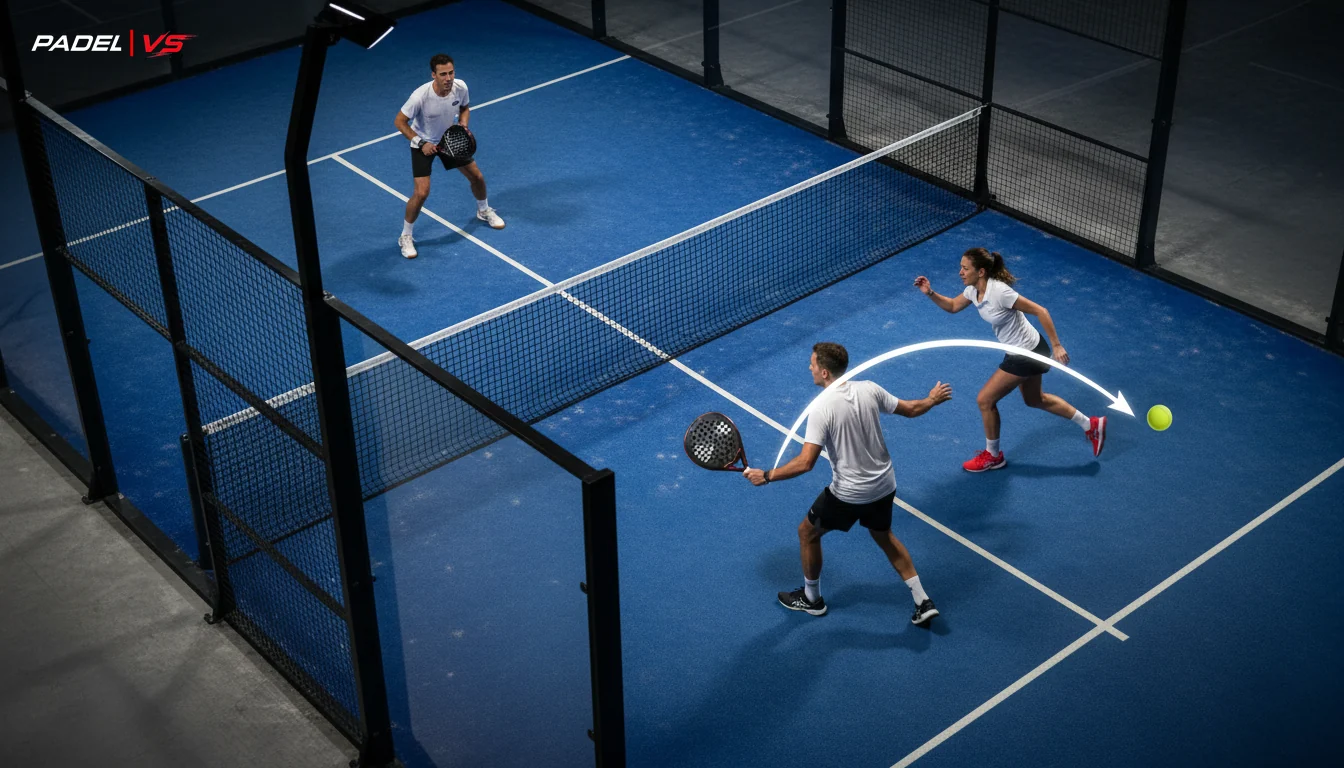

A well-executed lob is one of the most disruptive weapons in modern padel: it pulls you off the net, flips the momentum of the point, and forces both you and your partner to reorganize in fractions of a second. Knowing how to defend that lob without surrendering court control is precisely what separates players stuck at the Cuarta level from those pushing into Tercera and Segunda. This article breaks down every phase of the process — from the moment you detect the lob leaving your opponent's racket to the moment you step back into a dominant net position.
Why the Lob Is So Hard to Handle
A padel court is 20 meters long and 10 meters wide. When you're standing at the T near the net — roughly 3 to 4 meters from the mesh — and your opponent throws a deep lob, you need to cover between 7 and 9 meters backward in the time it takes the ball to rise, travel, and begin its descent. It's not purely a speed problem: it's a problem of early reading, fast decision-making, and shot-specific technique.
The most common mistake at the Cuarta and Quinta levels is reacting too late. The player sees the lob when it's already at the peak of its arc and bolts toward the back without knowing what shot they're going to play. They arrive disordered, hit without control, and on top of that, they don't recover the net because they're standing in the back corner with no return plan. The solution starts well before the ball even gets there.
Phase 1: Early Lob Recognition
Everything begins with reading your opponent's body. There are clear signals that announce a lob before the racket even makes contact:
- Open stance loaded backward: a player about to lob will open their shoulders and drop their center of gravity. If you see that posture, start moving.
- Low contact point: when the ball bounces and the opponent takes it below hip height, the natural trajectory is upward. An attacking shot from there is nearly impossible.
- Direction of gaze: mid-level players tend to glance upward just before lobbing. Train yourself to catch that micro-gesture.
- Prior point pressure: if you've just landed two or three short volleys that pushed your opponents into the back glass, a lob is their most likely response. Anticipate it.
"The lob doesn't surprise you if you're reading the match. It surprises you when you're only watching the ball."
Phase 2: The Net Exit — Moving Back Without Losing Balance
Once you read the lob, your exit needs to be explosive but controlled. This is where many players make the second major mistake: they back-pedal with the racket out front as if they're about to hit a volley. That's wrong.
The correct mechanics for retreating from the net in padel work like this:
- Hip pivot toward the lob side: if the lob is heading to your right (playing right-handed on the forehand side), rotate your right hip backward. Don't fully turn your back yet.
- First crossover step: the outside foot crosses behind the body. This generates speed without losing sight of the ball and the glass.
- Oblique lateral run: don't sprint directly to the back glass. Run diagonally toward the spot where you calculate the ball will bounce — typically 1 to 2 meters from the back wall.
- Arrive early: get there with one or two steps to spare. A player who arrives right on time has no room to prepare the shot. The player who arrives early gets to choose.
Phase 3: The Shot From the Back — Your Real Options
You're at the back of the court. The lob is about to bounce or just did. What shot do you choose? It depends on the height, the depth of the lob, and your opponents' positioning. Here are your options ranked from highest to lowest risk:
| Shot | When to Use It | Risk Level | Expected Outcome |
|---|---|---|---|
| Smash off the back glass (por tres) | Short lob, medium height, opponents out of position | High | Direct winner or very difficult exit for opponents |
| Vibora | Deep lob, ball height between shoulder and head | Medium-High | Spin pressure, forces an error |
| Bandeja | Deep or difficult lob, need to reset and recover | Medium | Control, keeps the rally alive, buys time |
| Defensive lob | Very deep lob, barely reaching it, opponents at net | Low | Full reset, time to reorganize |
| Shot into the side glass (dejada) | Ball bounces very close to the side glass | Very High | Direct winner if executed, unforced error if not |
The Bandeja: The Most Underrated Shot in Padel
In match footage we review on PADEL VS, we consistently see players at the Cuarta and Tercera levels attempt the vibora in situations where the bandeja was the correct call. The bandeja is not a shot of surrender — it's a shot of tactical intelligence. A solid cross-court bandeja with depth and a bit of slice gives you enough time to recover the net and leaves your opponents with an uncomfortable ball from the center of the back court.
The key technical cues for the bandeja under pressure:
- Contact point above and in front of the head, arm extended but relaxed — not locked
- Racket swing from back to front with a slight downward slice (not flat)
- Direction: cross-court and deep is the safest. Down the line can drift into the alley if you're pressed for time
- Body weight flowing forward at the moment of contact — that momentum propels you back toward the net
Phase 4: Recovering the Net — This Is Where the Point Is Won or Lost
This is the moment that most separates players at different levels. Hitting the shot from the back is relatively straightforward with practice. What's genuinely difficult is what happens in the 2 to 3 seconds that follow.
After you execute your bandeja or vibora, there's a time window while the ball travels to the opponents' side. That window is your only chance to recover the controlling T position at the net. If you waste it standing still to admire your shot — and this happens constantly — your opponents seize the initiative.
The Timing of the Return Sprint
The practical rule is simple: start moving forward the instant you finish your swing. Don't wait to see where the ball goes. If your shot was good, you have time. If it was short, that's even more reason to run.
Your return path is not a straight line to the T. Advance diagonally, prioritizing coverage of the center of the court. Your starting position determines which zone you cover and which your partner covers. Call it out with a word or a hand signal as you're running back.
The Intermediate Zone Trap: Commit or Get Punished
There's a very common trap known in padel as "no man's land" (tierra de nadie): getting stuck halfway between the back and the net when your opponent strikes. From that position you can neither volley effectively nor retreat in time to defend a lob. The solution is to make a decision and commit to it:
- If your shot was offensive (vibora, smash): sprint to the net, anticipate the passing shot or the easy volley.
- If your shot was defensive (lob, soft bandeja): stay at the back, organize your defense from there, and wait for a more comfortable ball before advancing.
"The net isn't a place you arrive at. It's a place you constantly return to. The player who recaptures the T most often accumulates the most points."
Your Partner's Role During Your Retreat
Padel is a doubles sport and defending the lob is never a solo responsibility. Your partner has a critical role in those 3 to 4 seconds while you're sprinting to the back.
What your partner should be doing while you chase the lob:
- Step back to center-deep: not stay alone at the net. Dropping one or two steps toward the center covers the passing shot that might come while you're in the back.
- Don't cross uninvited: unless there's prior communication, your partner should not cross to cover your side. That opens more space than it closes.
- Communicate: if a lob comes toward your partner (the one who stayed), they must call "mine" or "yours" immediately. Two seconds of hesitation is a gifted point.
- Prepare to poach: if you execute a solid deep bandeja, your partner can step forward and finish the point with a pressure volley while you're still making your way back to the net.
Common Mistakes by Category
Based on match patterns observed in PADEL VS games, here are the most frequent errors per level when defending a lob:
| Category | Most Common Lob Defense Mistake |
|---|---|
| Quinta (<850 ELO) | Failing to read the lob until it's already in the air. Arriving late and hitting without any plan. |
| Cuarta (850–1000 ELO) | Arriving in decent position but always attempting the vibora. Unforced error rate is high and net recovery doesn't happen. |
| Tercera (1000–1180 ELO) | Good shot but slow return to the net. They stop to watch the ball and get caught in no man's land. |
| Segunda (1180–1350 ELO) | Solid technique but poor coordination with the partner during the retreat. Zones are left uncovered. |
Drills to Train Lob Defense
Theoretical knowledge means nothing without specific repetition. Here are three concrete drills you can run in your next training session:
Drill 1: Mirror Exit (10–15 min)
One player stands at the T near the net. The coach or sparring partner feeds lobs alternating to the right and left sides from the other end. The goal is not to hit a perfect shot — it's to always arrive balanced and with time to spare. If you arrive running wildly with no control, the drill is being done wrong. Total focus on the exit mechanics and the arrival posture. Do 30 to 40 reps per session.
Drill 2: Bandeja and Sprint (10 min)
Same setup, but now you actually hit a cross-court bandeja, and the moment your swing ends, you sprint back to the T. Your sparring partner immediately feeds a comfortable ball to the net for you to volley. The goal is to train the complete cycle: retreat → shot → return sprint → volley. Run this 20 times per session. It's exhausting. That's the point.
Drill 3: Conditioned Match Play
Play normal sets but add this rule: if an opponent's lob bounces in your court without you reaching it in time, they score double points. The added pressure forces you to anticipate and exit the net significantly faster than you normally would. It's uncomfortable — which means it's working.
Applying This in Real Matches
If you play tournaments or leagues on PADEL VS, you already know the rally pace increases noticeably between Cuarta and Tercera. At the Quinta level, lobs get defended poorly, but opponents don't capitalize well either. At Cuarta and above, a poorly defended lob almost always means a lost point.
The practical takeaway is this: in your next match, don't attempt the vibora from the back unless the ball comes to you at shoulder height or above and you have plenty of time. When in doubt, play a deep cross-court bandeja and run back. You'll lose fewer points from unforced errors and win more rallies through superior positioning.
You can access PADEL VS on the web at padelvs.com, through the Telegram Mini App at @padelvsbot, or via our WhatsApp AI agent. Tracking your ELO evolution and reviewing point-by-point rally data helps you identify exactly which phase of the rally is costing you points — including how many you're losing after an opponent's lob.
Lob defense isn't glamorous. Nobody posts a highlight reel of a perfectly timed bandeja and net recovery. But it is one of the clearest markers of players who genuinely move up the ladder. Master it, and you'll see the results in your scorelines before you expect to.