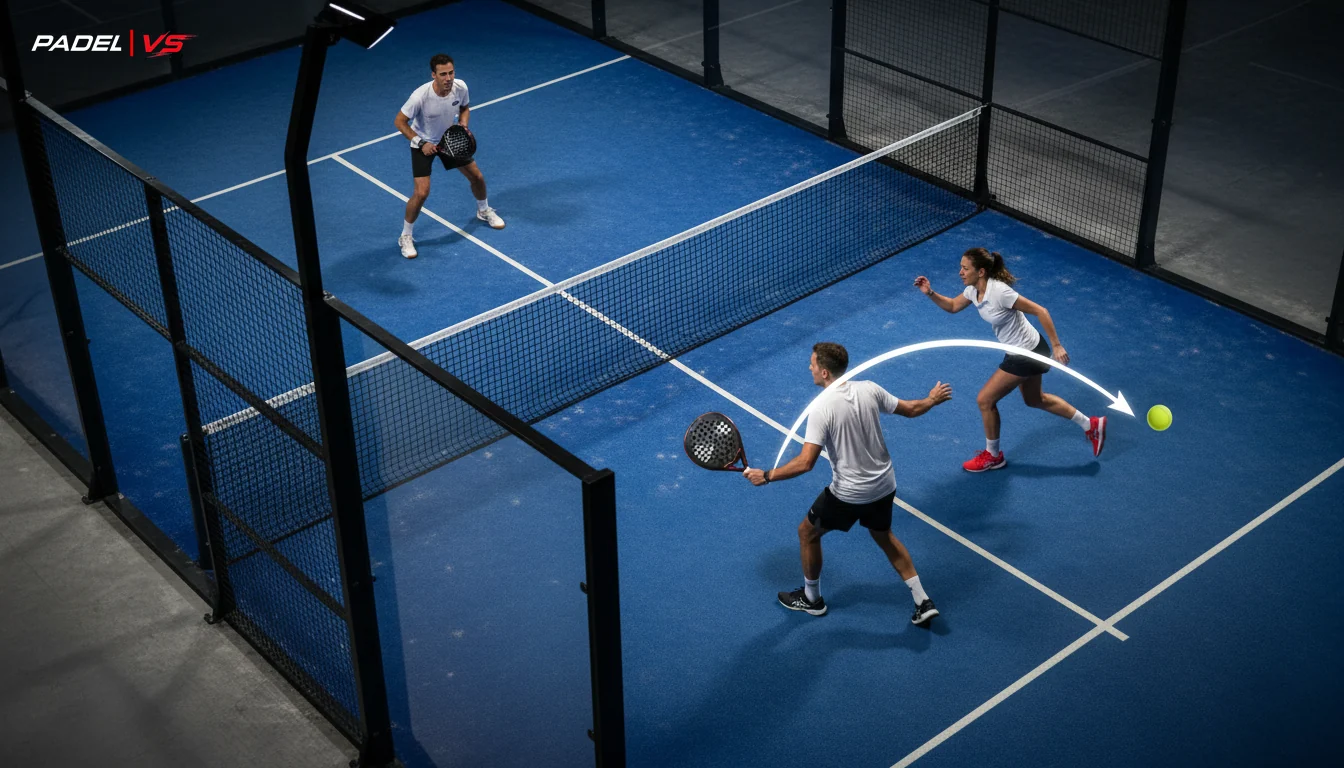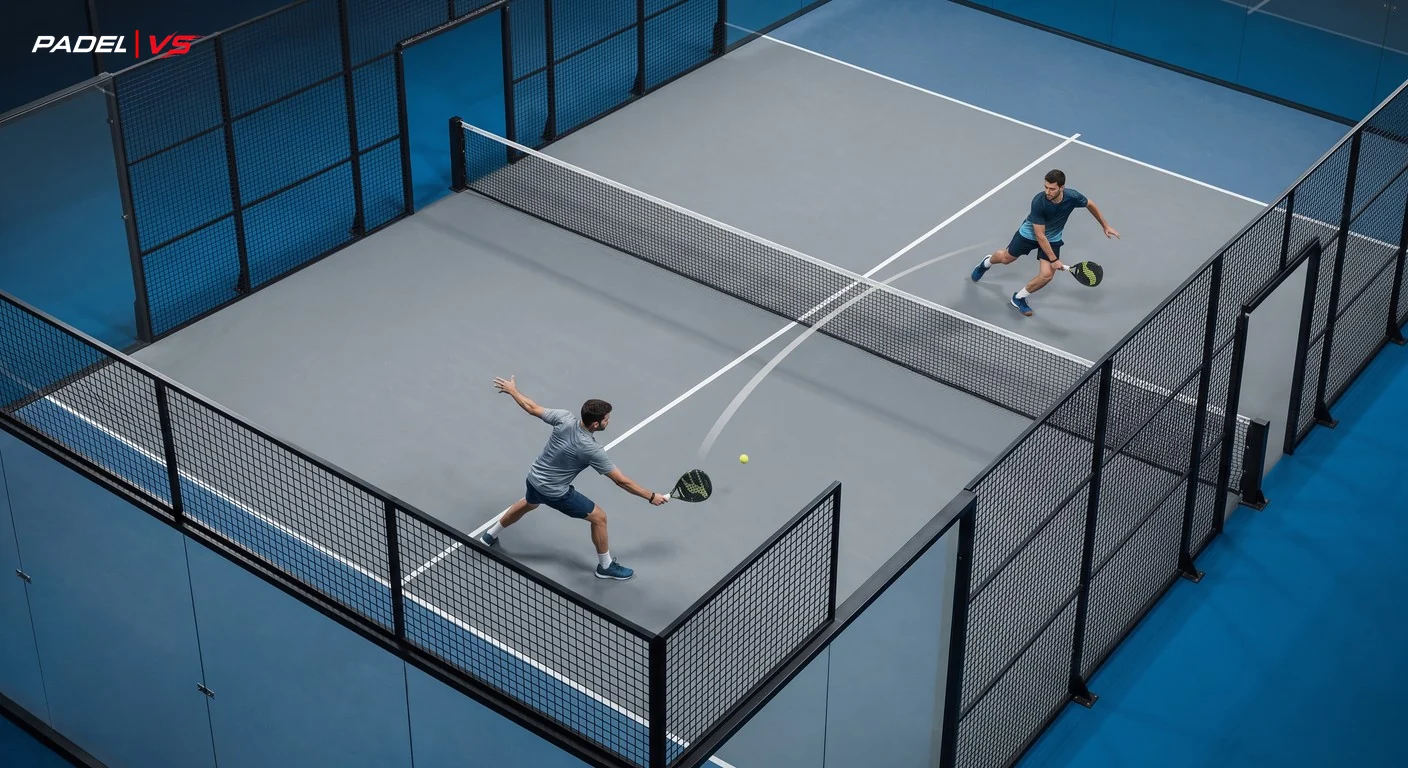
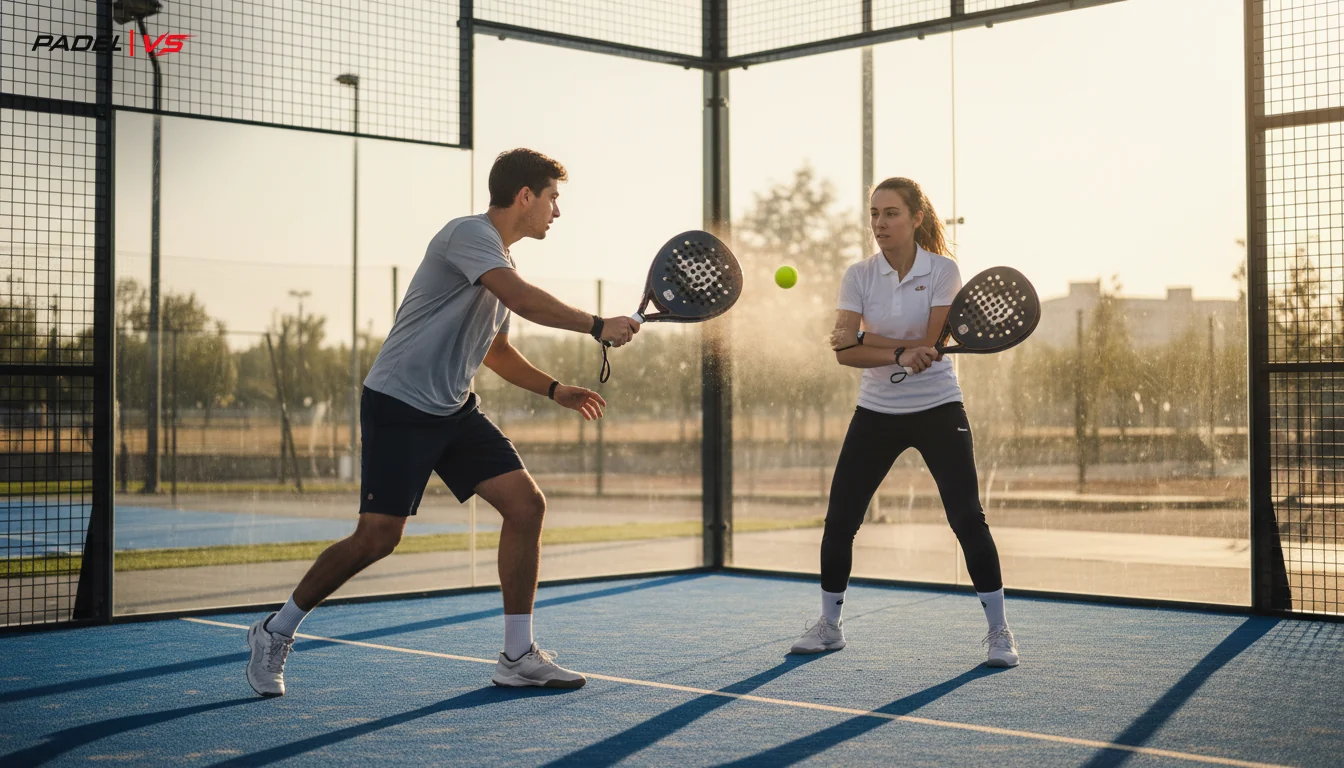
There's a moment in every padel match when the ball simply can't find gaps. The opponent covers well, covers the lines, covers the crosscourt, and every lob comes back exactly where you don't want it. That's when experienced players stop hunting for open space and start attacking the one target that's always available: the opponent's body.
What Body Attacking Actually Means
Attacking the body means directing the ball straight at the opponent's torso, hip, or shoulder instead of aiming for corners or side alleys. It's a shot that doesn't win points through raw speed or an impossible angle — it wins through biomechanical discomfort. When a ball arrives at the body, the opponent has a fraction of a second to decide whether to hit forehand or backhand, and that hesitation is exactly what breaks defenses that looked airtight moments earlier.
In tennis this is known as the "body shot," a staple on return of serve. In padel it gains an extra dimension because of the glass walls: the opponent can't just step back to buy time like in tennis. The glass is right there, a meter and a half away, compressing their reaction margin even further.
"Don't hit where the opponent isn't. Hit where the opponent is, but where they can't decide fast."
The Biomechanics Behind the Uncomfortable Shot
When a ball travels toward the feet or toward the corners, the player's brain processes the trajectory and activates a clear motor pattern: forehand or backhand, no ambiguity. But when the ball arrives between the belly button and the chest — roughly 80 to 120 cm off the ground — the body enters what coaches call a neutral decision zone. The player must first create space with their arms or rotate the hip before executing any clean shot.
This delay, which in real time lasts between 0.2 and 0.4 seconds, is enough to produce a shot off the frame, with little control, or one that falls short into the net. In categories from Tercera down (1000-1180 ELO on the PADEL VS system), this hesitation is even more pronounced because players haven't yet automated reading mid-body trajectories.
When to Use the Body Attack
This isn't a shot for every point. Its effectiveness depends heavily on tactical context:
- When the opponent is centered on court, equidistant from both side walls, without a clear lateral advantage.
- Right after a defensive lob where the opponent rushes forward and doesn't have time to set up laterally before the shot arrives.
- Against left-right paired opponents, targeting the exact zone where both rackets "compete" for the shot, creating doubt about who should respond.
- Off the back wall, when the opponent is set up for a lateral shot and suddenly the ball arrives straight at the body, breaking the timing they already calculated.
A common mistake among players moving from Cuarta to Tercera is reserving this shot only for smashes. In reality, the body attack works even better on lower-power shots because it doesn't depend on speed — it depends on precision and reading the exact moment.
The Shots That Execute Body Attacks Best
Not every padel shot is equally effective for this tactic. Some create more discomfort than others based on trajectory and ball flight time.
| Shot | Why It Works | Recommended Level (ELO) |
|---|---|---|
| Bandeja to the body | Descending, deep trajectory forces contact close to the body, with no room for a full swing | Cuarta and up (850+) |
| Víbora aimed at the chest | Sidespin creates an unexpected bounce right when the opponent has already committed to a side | Tercera and up (1000+) |
| Medium-power smash to the dominant shoulder | Directly attacks the racket arm, making any clean block difficult | Segunda and up (1180+) |
| Short lob that drops onto the body after the bounce | Combines depth surprise with an uncomfortable height for the opponent's overhead | All levels |
| Direct back-wall shot to the torso | Uses the fast rebound off the back glass to deny time for repositioning | Primera and Open (1350+) |
Where to Aim Exactly
Precision matters more than power here. There are three target zones, each producing a different effect:
- Belly button zone (body midline): creates maximum indecision between forehand and backhand. Ideal when the opponent is squared up facing the net.
- Racket-arm shoulder: forces an unnatural elbow-flexion movement, almost impossible to resolve with power.
- Hip on the side opposite to the opponent's movement: useful when the opponent is already moving laterally and must stop their momentum to hit.
One detail many coaches don't explain well: aiming at the body doesn't mean "hitting the opponent." The goal is for the ball to pass extremely close, grazing that decision zone, not to strike them directly (which would also be unsportsmanlike and is sanctioned at many clubs if intentional and repeated). The difference between an effective body attack and a pointless aggressive shot lies in those 15-20 centimeters of precision.
Common Mistakes When Attempting This Shot
- Hitting too hard without depth control, turning a tactical shot into a simple unforced error when it sails long.
- Telegraphing the shot with the body, revealing intent early and giving the opponent time to move before the ball arrives.
- Using it as your only resource, losing the surprise factor. The body attack works best mixed in with shots to the lines and corners, never as a repetitive pattern.
- Not adjusting contact height, especially on bandejas, where a shot that's too high loses the discomfort effect and becomes an easy smash setup for the opponent.
"The best body attack is the one the opponent doesn't see coming until the racket is already against their ribs."
How to Train This Shot on Court
The most efficient way to automate the body attack is through targeted repetition drills, not live match play where pressure pulls players back to familiar shots. A classic drill:
- Three-cone drill: place a cone in each corner of the opponent's court and one in the center, at torso height. Practice alternating between hitting the corners and hitting the center cone, aiming for 40% of shots to land center.
- Restricted rally play: play points where you're only allowed to attack the center of the court, never the lines. This forces you to develop depth sensitivity without relying on angle.
- Video analysis: many Segunda and Primera players record their matches to identify moments when the opponent was centered without clear lateral defense, then review whether they capitalized with a body attack.
Body Attacks by Skill Level
Within PADEL VS's category system, the effectiveness of this shot shifts depending on the players' ELO on court:
- Quinta (under 850 ELO): body attacks are barely necessary because unforced errors already generate enough points. Better to focus learning on basic consistency.
- Cuarta (850-1000): starts becoming useful against opponents who already defend more solidly but still take time deciding which side to hit.
- Tercera (1000-1180): this is where the shot becomes truly decisive, since players already cover the lines well but haven't trained the central zone.
- Segunda and Primera (1180-1550): body attacks combine with spin and pace changes, becoming a complex tactical tool rather than an isolated shot.
- Open (1550+): players at this level are rarely surprised by a plain body attack; the effective variant here is combining it with trajectory deception and disguised intentions.
If you're competing in tournaments organized through PADEL VS, reviewing your match history and ELO progression can help you figure out whether your current level justifies spending training time on this specific shot, or whether you need to consolidate more basic fundamentals first.
Conclusion: Discomfort as a Tactical Weapon
The body attack isn't a spectacular shot, nor the kind that fills viral highlight reels of impossible smashes. It is, however, one of the most effective tactical resources for breaking down opponents who position themselves well but haven't trained quick decision-making under direct physical pressure. Mastering this shot doesn't require more power or more raw technique — it requires patience to read the exact moment an opponent gets caught centered, and precision to place the ball within those 15-20 centimeters that separate discomfort from an easy error.
Next time you feel like your opponent "never misses," instead of chasing impossible angles, try simply attacking their body. You'll likely discover that the solid defense you're facing depends more on the comfort of their shots than on their actual technical level.