The bandeja and the vibora are the two most important overhead shots in modern padel, and using them interchangeably — or picking the wrong one at the wrong moment — can cost you a point even when you're in a dominant net position. Understanding not just how to hit them, but when to choose one over the other, is what separates a player stuck in Cuarta from one pushing into Tercera and beyond.
Let's Define Both Shots First
Before comparing them, we need absolute clarity on what each shot actually is. Both are executed overhead, both are used from the net position, and both aim to apply pressure or finish the point. That's where the similarities end.
The Bandeja
The bandeja is padel's control shot par excellence. The name literally means "tray" in Spanish — think of a waiter holding a serving tray flat: the racket swings downward and forward at a moderate angle, generating a sliced effect that keeps the ball low after it bounces off the glass. The wrist stays firm, the movement is compact, and the primary goal is not to win the point outright — it's to maintain pressure, control the rally, and deny the opponents any chance to take initiative.
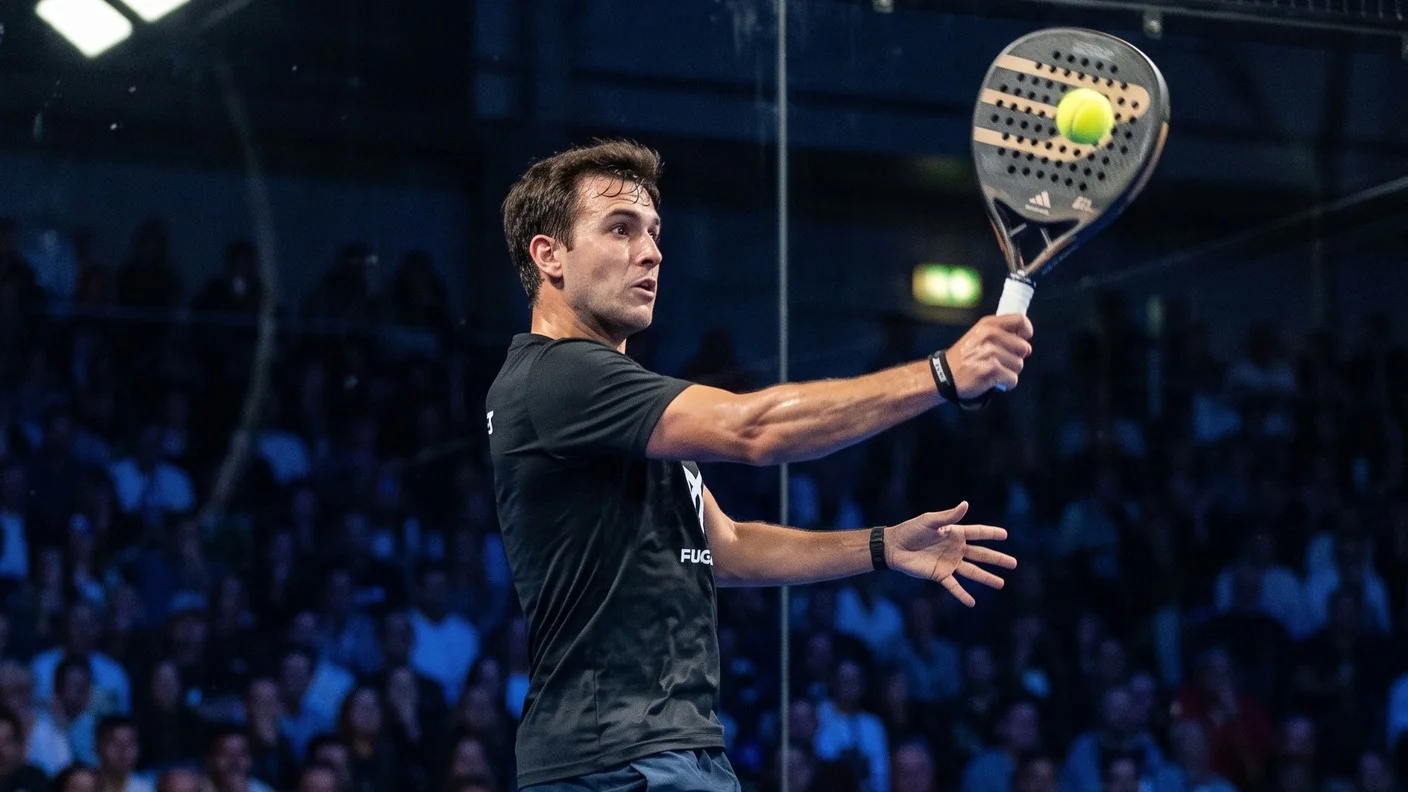
Technically: contact happens at roughly the 11 o'clock position (slightly forward and above), the swing path moves outside-in generating slice, and the follow-through finishes toward the dominant side of the body. The racket face should be slightly open at impact. On a standard padel court (10 x 20 meters), a well-placed bandeja directed at the side glass can create a bounce that's extremely difficult to pick up cleanly.
The Vibora
The vibora — named after the snake-like movement of the arm — is a high-risk, high-reward offensive shot. Unlike the bandeja, the vibora generates a lateral topspin effect that sends the ball flying toward the sidewall with an incredibly tricky bounce: it deflects toward the lateral glass and kicks unpredictably, making it nearly impossible to return when executed correctly. The swing path starts behind the body, brushes laterally across the ball, and finishes as if your arm were drawing an S-curve.
The contact point is more lateral and slightly more forward than the bandeja. The wrist plays a much larger role — that wrist snap is precisely what creates the shot's signature effect. Swing speed is higher, and therefore the margin for error is significantly higher as well.
The Core Tactical Difference
"The bandeja keeps you in the rally. The vibora ends it — one way or the other."
That phrase captures everything. The bandeja is a management shot; the vibora is a finishing shot. Confusing their roles is one of the most common mistakes at the Cuarta and Tercera levels, where players start incorporating the vibora before they've consolidated their bandeja. The result is a steady stream of unforced errors on balls they should comfortably control.
| Characteristic | Bandeja | Vibora |
|---|---|---|
| Primary goal | Control and pressure | Win the point outright |
| Effect | Downward slice | Lateral topspin |
| Margin for error | Low | High |
| Swing speed | Moderate | High |
| Technical difficulty | Medium | High |
| Ideal situation | High ball, position not ideal | Comfortable ball, opponents off-balance |
| Unforced error risk | Low | Very high if not consolidated |
When to Use the Bandeja
The bandeja is your go-to in a surprisingly large number of situations. Mastering it before even thinking about the vibora is non-negotiable. Use it when:
- The ball lands close to the back glass: If you're within about 1.5 meters of the back wall and the ball comes high, the bandeja gives you the control to avoid gifting the point.
- You're short on preparation time: The compact swing makes the bandeja executable even with limited reaction time — something the vibora's longer swing simply can't offer.
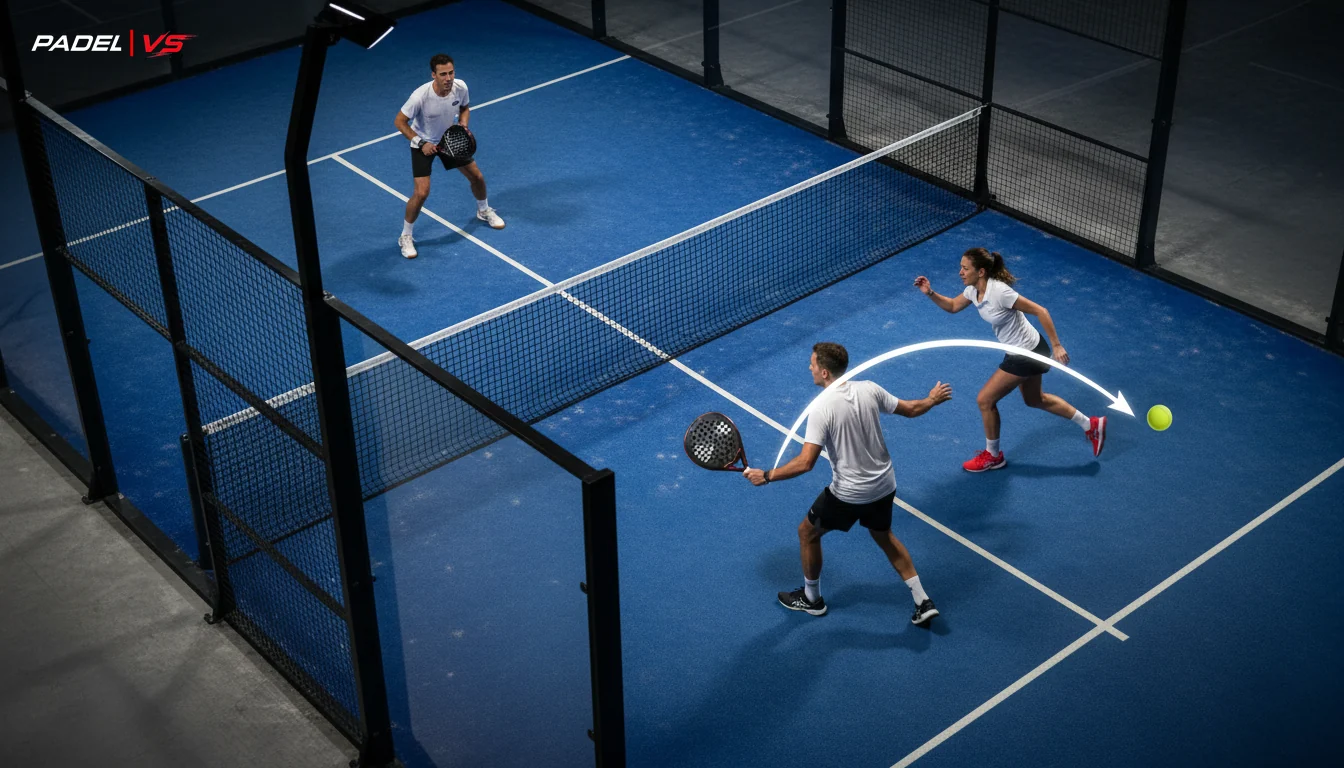
- You want to hold your net position: A well-directed bandeja toward the opponent's side glass forces them back without giving them a counterattack opportunity.
- The rally is even and you don't want to force: On a critical point — say, 30-40 — the bandeja manages risk. The vibora gambles.
- Opponents are well-positioned defensively: Attempting a vibora against opponents in good defensive position usually means they either return it comfortably or you commit the error yourself.
A well-executed cross-court bandeja that hits the lateral glass at the right angle can generate a bounce so awkward that the opponent makes the mistake without you doing anything heroic. That's the elegant intelligence of high-IQ padel.
When to Use the Vibora
The vibora has specific conditions under which it's genuinely effective. It's not a shot you improvise — it's a shot you plan for. Use it when:
- The ball is comfortable and in your strike zone: Roughly shoulder height or slightly above, with enough time to prepare the full swing.
- An opponent is out of position: If one of the two opponents is pulled wide or pushed forward, a vibora to the open side is devastating.
- You've built a clear advantage: After a series of bandejas that have moved opponents around, the vibora moment arrives when the point is already half-won.
- You're targeting the side-glass corridor: The vibora produces a sidewall angle that no other overhead shot can replicate. When you need the ball to die in the corner, this is your shot.
- You're feeling confident and in rhythm: The vibora requires a positive mental state. Attempting it when anxious multiplies errors dramatically.
By Skill Level: What to Prioritize
Quinta (<850 ELO) and Cuarta (850-1000 ELO)
Honestly: forget the vibora for now. Not because it's impossible to learn early, but because without a solid bandeja foundation, the vibora becomes a constant source of unforced errors that destroy points you already had in the bag. At these levels, the data pattern is clear — the vast majority of points are given away, not earned. Focus your training on:
- Building a consistent bandeja with clean slice effect
- Learning to direct it: cross-court, down the line, and down the middle
- Understanding from which position on the 10 x 20 meter court each direction makes tactical sense
Tercera (1000-1180 ELO)
This is where it starts making sense to incorporate the vibora — but selectively. In Tercera, opponents defend better, and a predictable bandeja can be neutralized by a competent pair. The vibora enters as a tactical variant, not as your primary shot. We recommend practicing it in training until your success rate exceeds 70% before deploying it in competitive matches. In PADEL VS, Tercera players competing in our ranking tournaments typically show exactly this blend: bandeja as the foundation, vibora as the surprise weapon.
Segunda (1180-1350 ELO) and Primera (1350-1550 ELO)
At Segunda and Primera, both shots must be fully integrated into your game. The question is no longer whether to use the vibora — it's about when, and that decision happens in a fraction of a second based on opponent positioning, ball trajectory, and score situation. Players at this level also manage variations: the long bandeja vs. the short bandeja that drops near the service line, and the vibora aimed at the alley vs. the vibora cut toward the center.
Open (≥1550 ELO)
At Open level, the vibora is a standard tool — everyone has it. What distinguishes the top players, paradoxically, is the quality of their bandeja. On the world professional circuit, the best players hit bandejas that generate near-impossible bounces, which creates the conditions for the vibora to be effective when it appears. The fundamentals always win in the long run.
Most Common Mistakes When Learning Both Shots
Bandeja Mistakes
- Swing too long: The bandeja is not a smash. The movement must be compact and controlled — a full overhead swing generates a flat, uncontrolled ball.
- Contact point too far behind the body: The strike must happen forward and above, not beside or behind you. Late contact kills your direction.
- No shoulder rotation in preparation: Trunk rotation is what provides power without requiring an aggressive swing. Skip it and you'll muscle the shot with your arm alone — inconsistent every time.
- Closed racket face at impact: With a closed face, the ball either goes into the net or sails long. Keep that face slightly open.
Vibora Mistakes
- Attempting it from an uncomfortable position: Trying a vibora from directly in front of the back glass is almost always an error. The swing simply has no room to work.
- Insufficient wrist speed: Without the wrist snap, the lateral effect doesn't generate and the ball comes out flat — no spin, no direction, easy to attack.
- Going for it on key points without conviction: The vibora demands full commitment. Hesitating mid-swing produces the worst possible outcome — a slow, spinless ball that floats to your opponent.
- Not communicating with your partner: In doubles padel — which is how the sport is always played — your partner needs to anticipate whether you're bandejaing or vibora-ing to position themselves correctly after the shot. This split-second communication is often overlooked at the Cuarta and Tercera levels.
A Specific Training Drill to Develop Both
This drill can be done with a training partner on any standard padel court:
- You take the net position (1 to 1.5 meters behind the service line), partner stands at the far end of the opposite side.
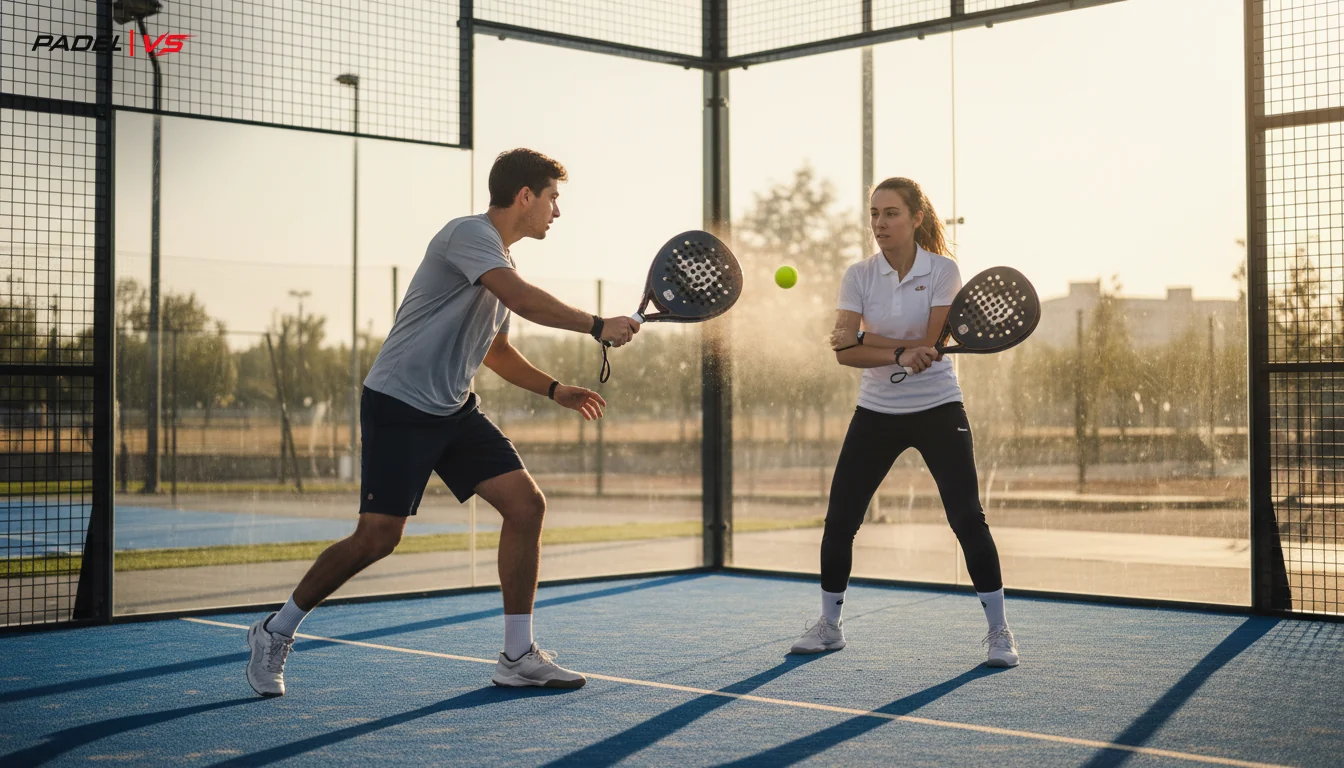
- Your partner feeds lobs at varying heights and positions: some comfortable, some awkward.
- The rule: if the ball arrives above your shoulder with sufficient preparation time, you hit a vibora. Any other situation, you bandeja.
- 25 repetitions, tracking your errors. If you exceed 5 vibora errors in a session, return to bandejas exclusively for the rest of that practice.
This situational training — where the situation dictates the shot, not your personal preference — is what accelerates genuine tactical learning. Your brain starts reading the ball and making the decision before your conscious mind gets involved.
Racket Considerations for Both Shots
Worth noting: the type of racket you use affects both shots. Heavier rackets (370-390g, round shape with soft core) tend to favor the bandeja because the mass creates natural slice. Lighter rackets (340-360g, teardrop or diamond shape) with a harder core favor the vibora because the stiffer frame amplifies wrist snap speed. Most players in the Cuarta to Segunda range ($80-165 USD / $1,500-3,000 MXN aprox) use a hybrid teardrop that handles both reasonably well. As you advance toward Primera and Open, equipment specialization starts to matter more.
The Psychological Dimension
"The smart player doesn't choose the shot they like best. They choose the shot the situation demands."
There's a variable that coaches rarely talk about: your mental state in the moment of decision. The vibora requires total commitment. If you enter the preparation with even 1% of doubt — should I vibora? maybe I should just bandeja? — the result is usually a failed hybrid: a slow, flat ball with no spin and no direction that sits up perfectly for your opponents to attack.
Half the work of integrating the vibora into your game is physical practice. The other half is mental training — learning to execute with full conviction when the situation calls for it. In competitive padel tournaments where ELO points are on the line, that psychological weight is very real. Attempting the vibora in a ranked match before you've consolidated it in training is gambling — and in competitive padel, gambling usually loses.
Conclusion: They're Not Rivals, They're Complements
The question "bandeja or vibora?" doesn't have a single answer — it has a situational one. The bandeja is the foundation; the vibora is the finish. Without a solid bandeja base, the vibora has nothing to build on. With both integrated and used intelligently, your net game becomes genuinely difficult to defend against at any level.
If you want to measure where your level actually stands right now — and find opponents in your exact ELO range to practice these shots in a real competitive context — open padelvs.com in your browser or launch the Mini App in Telegram by searching @padelvsbot. We're building Mexico's competitive padel community where every match feeds into the ELO system, giving you the clearest possible mirror of your real progress. Payments for court reservations and tournaments are flexible: card via Stripe, Mercado Pago (including OXXO and cash), crypto via B4Bit (USDT, BTC, ETH), and direct cash payment at the club. We're starting in Cancún and expanding — if your club isn't integrated yet, stay tuned for when it joins the network.