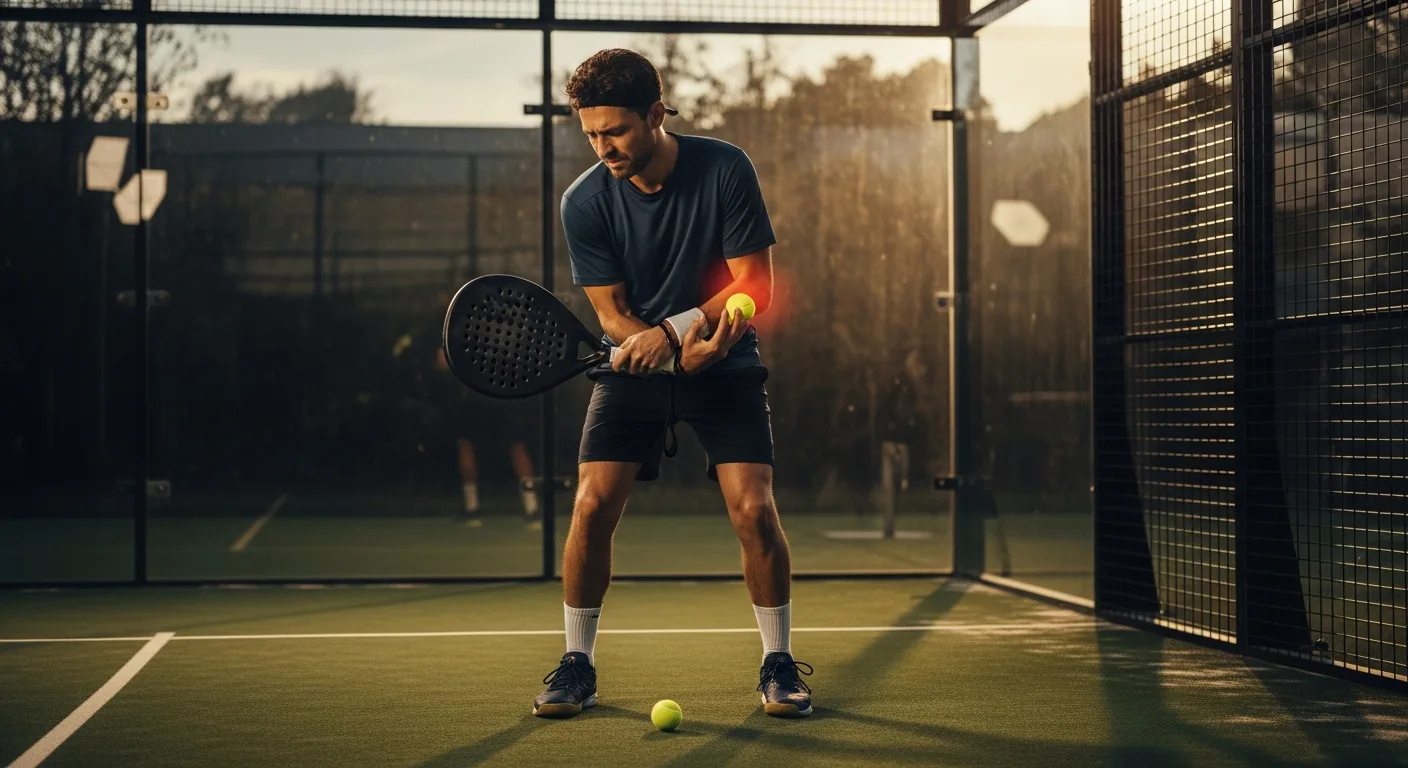

While padel and tennis share a common ancestor and both involve rackets and balls, the similarities end there. These two disciplines present fundamental differences in their courts, equipment, rules, and game philosophies that make them completely distinct sports.
If you're considering starting padel coming from tennis, or simply curious about what makes each sport unique, this guide will help you understand the key differences. At PADEL VS, we work with players from both disciplines and have identified the most important distinctions every athlete should know.
1. Court Dimensions and Structure: Radically Different Spaces
The most obvious difference between padel and tennis is the court itself. A singles tennis court measures 78 feet long by 27 feet wide (2,106 sq ft total), while doubles courts expand to 36 feet wide (2,808 sq ft). In contrast, a padel court is significantly more compact: 65.6 feet long by 32.8 feet wide, with a total area of 2,152 sq ft.
But the truly revolutionary difference in padel isn't the size—it's the walls. The padel court is surrounded by tempered glass walls 10 feet high at the back and 13 feet on some sides, interspersed with metal mesh. These walls are an integral part of the game: the ball can bounce off them and remain in play, adding a vertical and strategic dimension non-existent in tennis.
| Aspect | Padel | Tennis (Doubles) |
|---|---|---|
| Length | 65.6 feet (20m) | 78 feet (23.77m) |
| Width | 32.8 feet (10m) | 36 feet (10.97m) |
| Total area | 2,152 sq ft (200m²) | 2,808 sq ft (260.87m²) |
| Walls | Tempered glass (10-13ft) and mesh | None |
| Clearance height | Minimum 20 feet (6m) | No limit (outdoor) |
This configuration makes padel more suitable for indoor or semi-covered facilities, while tennis traditionally plays outdoors, although professional indoor courts exist.
2. Equipment: Solid Paddles vs Stringed Rackets
The difference between a padel paddle and a tennis racket goes far beyond nomenclature. A padel paddle is completely solid, typically manufactured with an EVA or FOAM rubber core and fiberglass or carbon surface. It has no strings. Its dimensions are regulated: maximum 17.9 inches long, 10.2 inches wide, and 1.5 inches thick, with weight ranging between 12-14 ounces.
Tennis rackets, on the other hand, feature string beds of synthetic or natural strings tensioned at specific pressures (generally between 48-66 lbs). They're longer (27 inches maximum) and weight varies considerably by level: from 8.8 ounces for beginners to 12 ounces for professionals.
"The solid paddle in padel offers greater control and less natural power, forcing players to generate speed with technique and placement, while tennis strings allow greater ball acceleration with less effort."
In terms of investment, a quality intermediate padel paddle costs between $80-165 USD ($1,500-3,000 MXN aprox), while a similar-level tennis racket can be found in the range of $100-220 USD ($1,800-4,000 MXN aprox). Professionals in both sports invest significantly more: premium paddles can reach $330-440 USD ($6,000-8,000 MXN aprox) and professional tennis rackets easily exceed $390 USD ($7,000 MXN aprox).
3. The Ball: Different Pressure and Behavior
Although visually similar, padel and tennis balls have different technical characteristics. Both measure between 2.5 and 2.66 inches in diameter, but internal pressure varies significantly.
Tennis balls have higher internal pressure (between 8.165 and 9.7 PSI or 56.3-66.9 kPa), giving them more bounce and speed. Padel balls operate with slightly lower pressure (between 4.6 and 6.1 PSI or 31.7-42 kPa), resulting in more controlled and predictable bounce, especially important when interacting with glass walls.
Additionally, padel balls lose pressure more slowly than tennis balls. A can of tennis balls is considered "dead" after 2-3 intense matches, while padel balls maintain their characteristics for 4-6 play sessions, depending on frequency and surface.
4. Service: Opposite Techniques
The serve represents perhaps the most dramatic technical difference between both sports. In tennis, the service is a powerful offensive stroke where the player tosses the ball in the air and hits it with a downward motion, seeking speed (professionals exceed 125 mph) and spin to win points directly.
In padel, the serve is deliberately restrictive. The server must:
- Bounce the ball on the ground before hitting it
- Hit the ball at waist height or below
- Keep at least one foot in contact with the ground until contact
- Direct the ball diagonally to the opposite service box
- Allow the ball to bounce before the receiver's first contact
This deliberate limitation converts the padel serve into a neutral point-starting stroke, not an offensive weapon. At PADEL VS, we observe that players with ELO above 1400 win less than 5% of points directly with the serve, compared to 10-15% in equivalent-level tennis.
"In tennis, the serve can be your best weapon; in padel, it's simply the beginning of a rally where point construction and positioning determine the outcome."
5. Game Format: Always Doubles in Padel
While tennis is played in both singles and doubles formats, padel is exclusively a doubles sport. This fundamental characteristic affects the entire game dynamic:
Constant cooperation: In padel, communication with your partner is critical on every point. You must move as a unit, cover spaces jointly, and make coordinated tactical decisions. There's no option to "go it alone" that exists in singles tennis.
Position specialization: In high-level padel, players frequently specialize in right or left side (forehand or backhand), developing specific roles. The forehand player typically handles more attacking balls, while the backhand player usually has better defensive and placement game.
Rotations and formations: Modern padel uses complex formations: parallel (both players at the same level), diagonal, Australian, and constant transitions between net and baseline. In tennis doubles, although formations exist, the game is generally more static.
This collaborative nature makes padel especially attractive for social and corporate events. In Mexico, 78% of new padel players start in recreational format with friends or colleagues, according to data from the Padel Federation.
6. Strategy and Point Construction
Fundamental strategy differs radically between both sports due to padel's walls and court dimensions.
In tennis: Strategy revolves around power, angles, and direct winners. Points are typically shorter (average 3-5 shots at recreational level). Players constantly seek to win points with winners or force unforced errors from opponents. Net control is advantageous but not mandatory.
In padel: Strategy centers on point construction, patience, and positioning. Rallies are notably longer (average 8-12 shots at intermediate level, 15+ at advanced level). Walls allow returning almost any ball, making direct points rare. The objective isn't to hit a winner, but to:
- Win the net through precise lobs that force opponents to the back
- Maintain pressure with deep and placed balls
- Provoke errors through rhythm and direction changes
- Create smash opportunities when controlling the net
At PADEL VS, we analyze thousands of matches and found that at ELO levels 1200-1500, only 12% of points end in direct winners, compared to 35-40% in club-level tennis. The remaining 88% end in forced or unforced errors, evidencing the importance of consistency over power.
7. Learning Curve and Accessibility
One of padel's most discussed advantages is its smoother learning curve compared to tennis, though this deserves important nuances.
Initial level (0-3 months): Padel is objectively more accessible. The smaller court reduces necessary displacement, walls allow returning balls that would be unreachable in tennis, and the doubles format means your partner can compensate for initial weaknesses. An absolute beginner can have 5-8 shot rallies in their first padel session, something unthinkable in tennis.
Intermediate level (3-12 months): Progression in padel continues being rapid. Players learn to use walls, develop basic lobs, and begin understanding positioning. In tennis, this period is frustrating for many: the serve remains inconsistent, groundstrokes require precise timing, and unforced errors are frequent.
Advanced level (1+ years): Here difficulty balances out. Mastering padel requires millimetric spin control, anticipatory game reading, perfect coordination with your partner, and ability to execute under pressure. Advanced tennis demands the same plus considerable physical power. Both sports have extremely high skill ceilings.
| Aspect | Padel | Tennis |
|---|---|---|
| First session | Rallies possible immediately | Mostly technique drills |
| Competitive matches | Possible after 2-4 weeks | Require 2-3 months minimum |
| Initial physical demand | Moderate (small court) | High (large court, displacement) |
| Maximum technical complexity | Very high (walls, spin, placement) | Very high (power, timing, variety) |
| Typical beginner injuries | Tennis elbow, shoulder injuries | Tennis elbow, knee injuries |
Which Sport to Choose? Factors to Consider
Choose padel if:
- You seek a social sport where playing with friends is priority
- You prefer emphasis on strategy and placement over raw power
- You want to see rapid initial progress and compete soon
- You're attracted to the tactical dimension of using walls and complex spins
- You have space limitations (padel works well in urban facilities)
Choose tennis if:
- You enjoy both singles and doubles play
- You're attracted to the tradition and established infrastructure of the sport
- You prefer emphasis on power, speed, and spectacular winners
- You seek a sport with greater Olympic recognition and professional infrastructure
- You like variety of surfaces (clay, grass, hard court)
Practice both if: Many players find that padel and tennis complement each other perfectly. Padel develops control, spin, and tactical thinking that improve your tennis game. Tennis develops power and clean strokes that elevate your padel level. At PADEL VS we have ranked players in both disciplines who report significant cross-benefits.
Conclusion: Two Sports, Two Philosophies
Padel and tennis aren't simply different versions of the same sport. They're distinct disciplines with their own philosophies, techniques, and cultures. Tennis emphasizes individualism, power, and impeccable technical execution. Padel prioritizes collaboration, point construction, and tactical creativity.
In Mexico, both sports are experiencing growth, but padel has shown particularly explosive expansion: between 2020 and 2024, the number of padel courts in Mexico grew 340%, while tennis courts increased 12%. This reflects not superiority of one over the other, but different value propositions for different player profiles.
The good news is you don't have to choose one permanently. Many racket sport athletes practice both sports, enjoying the unique strengths of each. If you're beginning your journey in racket sports, we recommend trying both for several sessions before deciding. Your personal experience, goals, and preferences will determine which resonates more with you.
At PADEL VS, we believe the most important thing isn't which sport you choose, but that you find one that motivates you to move, compete, and improve constantly. Whether you're attracted to the traditional elegance of tennis or the social energy of padel, both offer paths toward athletic excellence and lasting enjoyment.