Home  ›  Blog  ›  Padel
Padel

Padel in Mexico: the history and growth of a sport that was born here

From a garden in Acapulco to a national community that won't stop growing

· May 22, 2026 · 9 min read
Pádel en México: historia y crecimiento — PADEL VS

Padel was invented in Mexico. That sentence stops most people cold, because the sport feels so deeply Spanish — the language, the TV coverage, the World Padel Tour. But the truth is that the first padel court in modern history was built in Acapulco in 1969, and the full-circle story of how Mexico lost, exported, and is now rediscovering its own sport is one of the most interesting narratives in Latin American sports.

The invention: Acapulco, 1969

The man behind padel was Enrique Corcuera, a Mexican businessman with a house in Acapulco and not enough space for a proper tennis court. He enclosed a smaller area with walls, improvised some rules, and ended up with something neither tennis nor squash — something better than both for social play. His Spanish friend Alfonso de Hohenlohe visited, fell in love with the game, and introduced it to the Marbella Club on the Costa del Sol. From there, padel became a Spanish phenomenon, spread to Argentina through the jetset circuit, and quietly conquered Southern Europe while Mexico moved on to other things.

For roughly two decades after Corcuera's invention, padel existed in Mexico almost exclusively as a curiosity at expensive private clubs. If you were a member of Golf Club Chapultepec or a racket club in Pedregal in Mexico City, you might have seen those glass walls and played a few points. For most Mexicans, the sport simply didn't exist.

"Padel was invented by a Mexican in Acapulco, perfected by Spain, and now Mexico is rediscovering it with an energy nobody saw coming."

The quiet years: 1980s to early 2000s

The quiet years: 1980s to early 2000s

While Spain was building hundreds of thousands of padel courts and Argentina was developing world-class players like Fernando Belasteguín — widely considered the greatest padel player ever — Mexico's relationship with the sport remained dormant. Club membership was expensive, courts were rare, and there was no organized competitive structure to give recreational players a reason to take it seriously.

The technical specs of a padel court hadn't changed much from Corcuera's original concept: 10 meters wide by 20 meters long, enclosed by glass walls (at least on the back and partial sides) and metallic mesh, with a net at 88cm in the center. The playing surface — typically artificial turf with sand infill, or in indoor clubs, synthetic carpet — determines a lot about how the ball bounces and how the game feels. These dimensions make it roughly one-third the size of a tennis singles court, which is part of why the game is so much more social and approachable.

Court construction in Mexico during this era was expensive and technically demanding. The 10mm tempered glass panels required specialized installation, and there were very few local suppliers. Most materials came from Spain, driving up costs and keeping padel firmly in the luxury category.

The awakening: 2012–2019

The awakening: 2012–2019

Several forces converged to shift padel from a niche hobby into a real movement in Mexico during the mid-2010s. The most important was probably digital media. World Padel Tour highlights on YouTube gave Mexican sports fans their first real exposure to what competitive padel looked like at the highest level — and it was spectacular. Watching Belasteguín and Lima execute a perfectly timed back-glass lob from an impossible angle, or seeing Sanyo Gutiérrez hit a winner off the frame of his racket, was the kind of content that converted curious viewers into obsessed beginners.

The second factor was the sport's low technical barrier. Unlike tennis, where it takes months to develop a reliable forehand, padel is playable from day one. The walls forgive mistimed shots. The smaller court means less running. The slower ball bounce gives you more time to react. This accessibility is not a coincidence — it's the core design feature of the sport, and it's why padel retains players who would otherwise quit tennis out of frustration.

Third was Mexico's real estate boom in upscale neighborhoods. Developers who had visited Madrid or Barcelona started including padel courts as premium amenities in residential and mixed-use projects — the same way an earlier generation had included squash courts that no one ever used. Padel courts became a status symbol, which paradoxically accelerated their proliferation.

By 2017, Mexico City alone had more than 80 registered courts. Club concepts with dedicated padel facilities — proper lighting, locker rooms, pro shop areas — started appearing in Santa Fe, Polanco, and Lomas. Court rental prices in that era hovered around $17–28 USD ($300–500 MXN aprox) per hour, accessible for the urban professional class that was discovering the sport.

The pandemic pivot: 2020–2022

When gyms and indoor sports facilities closed across Mexico in 2020, something unexpected happened. Once restrictions partially lifted, outdoor and semi-open-air sports had a massive advantage. Padel courts — typically covered with a roof but open on the sides, offering ventilation and natural light — fit perfectly into the post-lockdown appetite for outdoor activity. Families that had never considered the sport tried it. Corporate groups that used to rent a racquetball court switched to padel. The waiting lists at popular clubs in Mexico City, Guadalajara, and Monterrey stretched to weeks.

This demand surge hit the equipment market too. Brands like Bullpadel, Head, Nox, and Babolat deepened their commercial presence in Mexico. Specialty padel shops opened in cities that had never sold a padel racket before. Today, entry-level rackets in Mexico range from $44–100 USD ($800–1,800 MXN aprox), while competition-grade carbon fiber rackets (3K or 12K carbon weaves, with teardrop or diamond shapes for different playing styles) run from $250–444 USD ($4,500–8,000 MXN aprox) and up.

The Mexican padel map in 2026

Padel in Mexico today is no longer a capital-city phenomenon. The geographic spread has been significant, with each region developing its own padel culture:

City / RegionDominant player profileNotable growth since 2022
Mexico CityProfessionals 30–45, mix of private and public clubsExpansion into neighborhoods like Coyoacán and Iztapalapa
GuadalajaraUniversity students and families, strong sports cultureGrowth of structured academies with certified coaches
MonterreyExecutives, corporate fitness cultureCourts integrated into corporate campuses and residential towers
Cancún / Riviera MayaExpats, long-stay tourists, localsHighest court-per-capita density in tourist zones
QuerétaroRising middle class, industrial corridor populationNew clubs with 6–8 courts in residential developments
MéridaRecent growth, strong European expat influenceFirst generation of formal padel academies

Cancún deserves special attention. The combination of year-round warm weather (playing at sunset with Caribbean breeze is genuinely hard to beat), a large community of European expats who grew up playing padel, and a tourist economy that draws sports-minded travelers has created one of the most vibrant padel ecosystems in the country. The social mix — locals, snowbirds from Europe, Mexican professionals from other cities who relocate for work — generates exactly the kind of diverse player pool that makes competitive padel interesting.

That's precisely why PADEL VS started operations in Cancún. We saw a community with real demand for organized competition, players who were already serious about improving, and openness to digital tools that make finding opponents and booking courts easier. From Cancún, we're building the network that will eventually connect players across Mexico.

The competitive structure: from club tournaments to national rankings

One of the persistent weaknesses of Mexican padel has been the fragmentation of its competitive ecosystem. For years, tournaments were isolated club initiatives with no standardized rankings and no way for a player in Monterrey to meaningfully compare their level to a player in Guadalajara. The Federación Mexicana de Pádel (FEMEPA) has worked to create more coherent structures, but the progress has been gradual.

At PADEL VS, we're tackling that problem from the ground up with our own ELO rating system that places players into clearly defined, objective categories. Our men's category structure works as follows:

This system solves a problem that plagues amateur padel everywhere: the "intermediate forever" player who's been playing for eight years but avoids moving up because of ego or habit. With ELO, numbers do the talking. Your rating reflects actual performance, not self-reported level.

"In padel, your level isn't declared — it's demonstrated. An honest ELO ranking is the best thing you can do for your community."

The padel business in Mexico: courts, academies, and club economics

Building a padel court in Mexico is a significant investment. A panoramic glass court with 10mm tempered glass, LED lighting, and Italian carpet surface typically costs between $19,400–33,300 USD ($350,000–600,000 MXN aprox) fully installed. Wire mesh courts are cheaper — around $10,000–15,500 USD ($180,000–280,000 MXN aprox) — but the playing experience is meaningfully different. The way balls interact with mesh versus glass changes the tactics of the back-court game, and most serious players have a strong preference for glass.

This capital requirement explains why the dominant business model in Mexico remains the multi-court club (minimum 4–6 courts to be economically viable), combining hourly court rental, group and private lessons, internal leagues, and tournaments. Current hourly court rental rates in 2026 look approximately like this:

Academy programs have proliferated alongside the club growth. A package of 8 group lessons (maximum 4 players, 90 minutes each) typically runs $133–250 USD ($2,400–4,500 MXN aprox). Private lessons with a certified coach range from $33–67 USD ($600–1,200 MXN aprox) per session.

Technology and the next frontier

Mexican padel in 2026 sits at an inflection point. The physical infrastructure is there. The player community is real and growing. But the digital layer — the tools that turn a collection of clubs and players into a connected ecosystem — is still catching up. Most clubs still manage court bookings via WhatsApp, track internal rankings in Excel spreadsheets, and run tournaments through Google Forms. It works, but it doesn't scale.

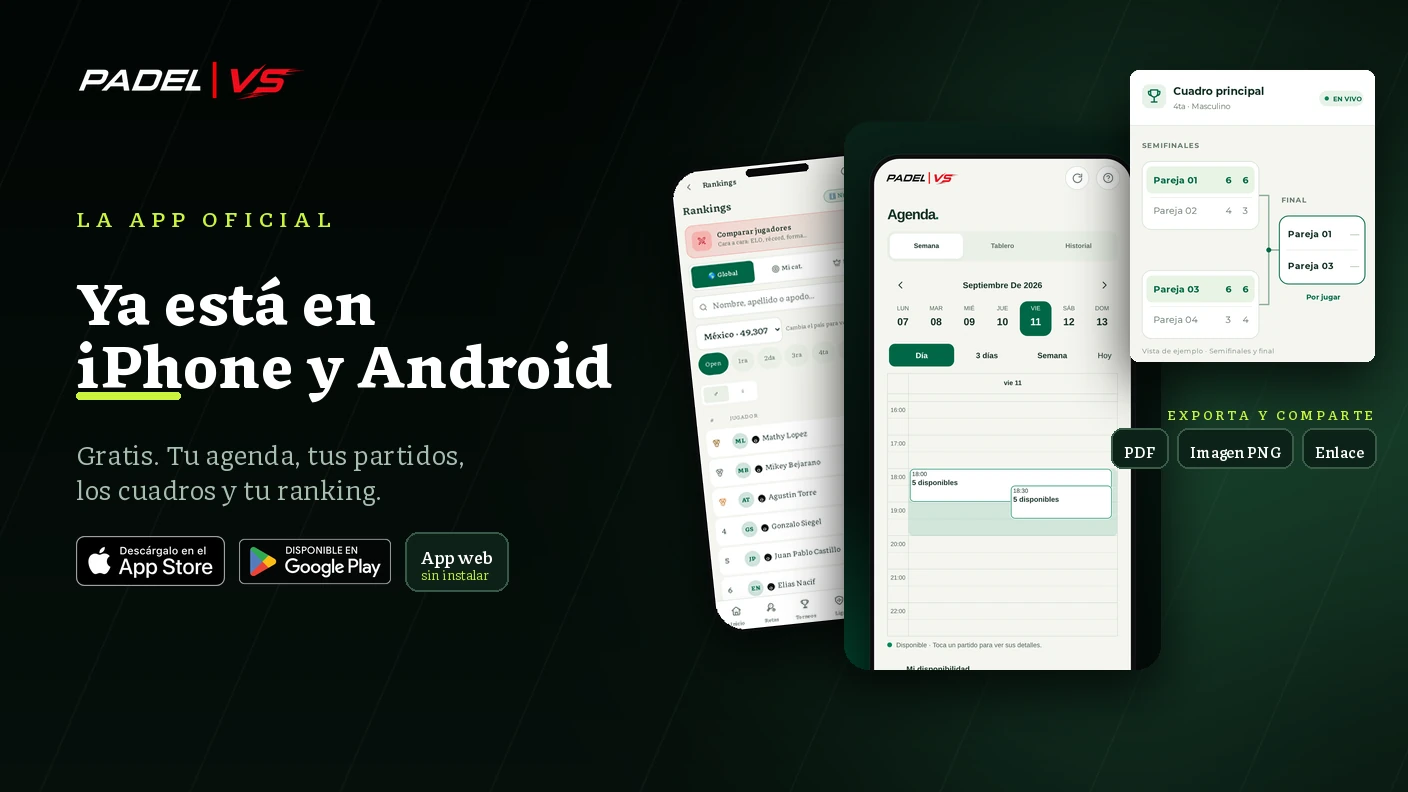
That's the gap PADEL VS is built to fill. Our platform — accessible at app.padelvs.com / padelvs.com, as a Telegram Mini App through @padelvsbot, or via our WhatsApp AI bot — gives clubs a complete digital infrastructure: booking management, tournament organization, ELO-based player rankings, and flexible payment processing. And when we say flexible, we mean it. Clubs on PADEL VS can accept payments by credit/debit card, card (card, OXXO cash payment, bank transfer, or card credit), cryptocurrency via crypto (USDT, BTC, ETH) — making us genuine world pioneers in crypto payments for padel — cash at the club with QR code for subsequent registration, and bank transfer with automatic validation. Recurring memberships and club prepaid credits are also supported.

Why does this matter? Because payment friction is real in Mexico. Not everyone has a credit card. Some players prefer OXXO cash payments. Some international expats in Cancún genuinely prefer to pay in USDT. A platform that handles all of these without the club having to manage each one manually removes a real barrier to organized competition.

What's next for Mexican padel

The structural outlook is genuinely positive. Padel has inherent advantages over other racket sports in the Mexican context: it's always played in doubles (social by design), it's intergenerational (a 65-year-old can realistically play against a 25-year-old and have a fun match), and the court footprint is smaller than tennis. As more residential developments and municipal facilities include padel courts in their plans, the player base will keep growing.

The challenge ahead is professionalization. Mexico needs more certified coaches — not people who played for a few years and started giving lessons, but coaches with actual methodology and pedagogical training. It needs more qualified referees for tournaments. It needs a nationally standardized competitive structure that gives a player in Tijuana and a player in Mérida a meaningful way to compare ratings and compete. And it needs digital infrastructure that doesn't rely on group chats and spreadsheets.

At PADEL VS, we're clear that we're in the early stages of building that infrastructure. We started in Cancún, we're expanding to other cities, and our medium-term goal is for any padel player in Mexico — from Baja California to the Yucatán Peninsula — to be able to find opponents at their exact ELO level, book a court with their preferred payment method, and enter a coherent tournament circuit, all from their phone. We won't promise what we don't have yet. But we know exactly where we're going.

Enrique Corcuera deserved to see his sport flourish in Mexico first. Decades later, that debt is finally being paid — one court, one player, one match at a time.

Ready to level up?

Join PADEL VS for free, find matches in your city and start scoring ELO.

Create free account →