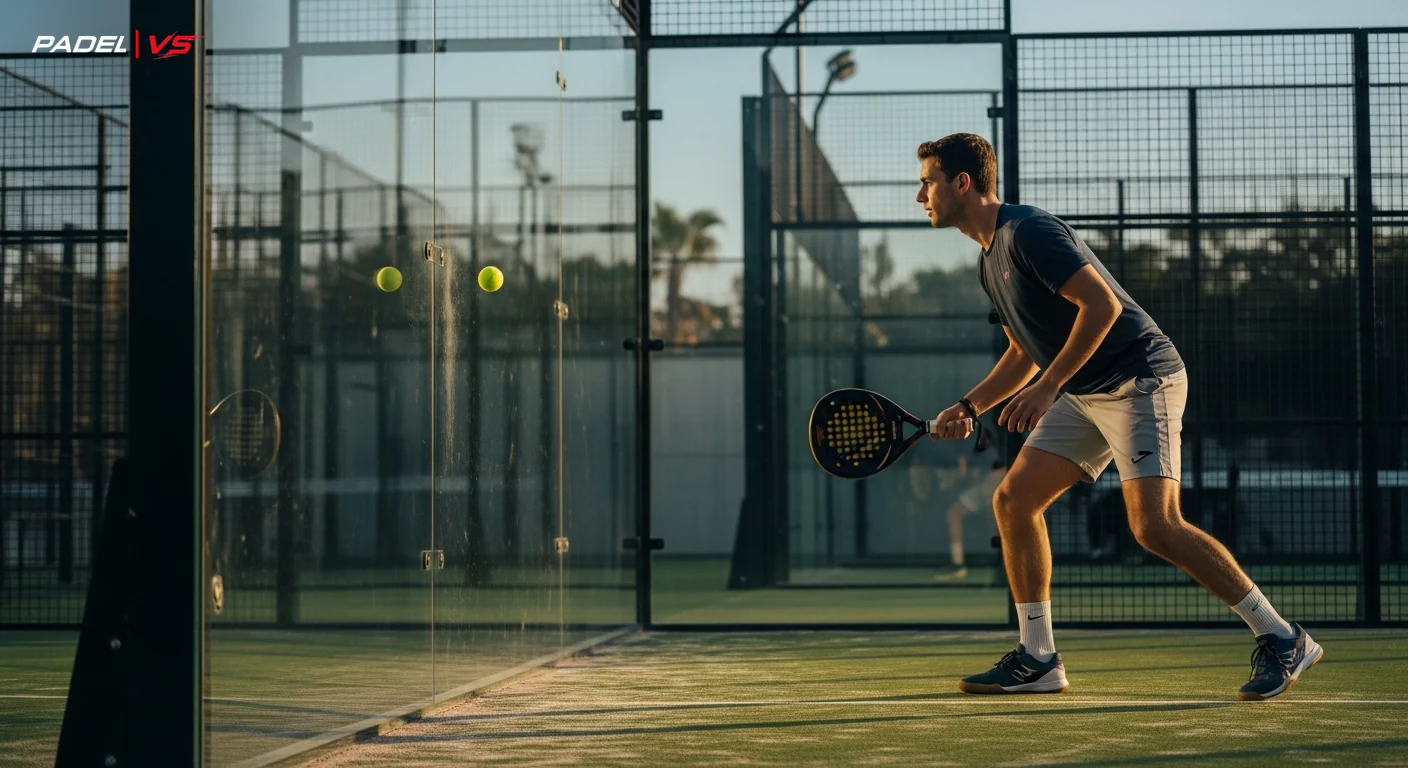

Moving up a category in padel isn't about luck or simply playing more matches — it's a structured process with clear logic. There are technical skills you need to master, tactical habits you need to build, and above all, an honest understanding of where you currently stand and what the next level actually demands. This guide gives you the complete map, step by step, to climb from Quinta to Cuarta, from Cuarta to Tercera, and beyond.
Start here: understand the category system
At PADEL VS, we use an ELO system adapted to competitive padel with six men's categories (plus an additional women's division). Each category has a specific point range that reflects actual playing level. Here's the full breakdown:
| Category | ELO Range | Player Profile |
|---|---|---|
| Quinta | < 850 | Learning the game, building technical foundation |
| Cuarta | 850 – 1000 | Understands padel logic, frequent unforced errors |
| Tercera | 1000 – 1180 | Real competitive play, solid wall control |
| Segunda | 1180 – 1350 | Tactical, consistent, strong serve and bandeja |
| Primera | 1350 – 1550 | Regional elite, high technical and physical level |
| Open | ≥ 1550 | Top category, semiprofessional or professional level |
Knowing these numbers matters because it gives you clarity: you're not "improving in the abstract" — you're moving along a measurable scale. Every win or loss against certain opponents adjusts your ELO, and that adjustment reflects whether you're playing above or below your current level. Tracking this over time is one of the most honest performance indicators available to amateur players.
"Your ELO doesn't lie. If you've played 30 matches in Cuarta without moving up, the problem isn't the system — it's something specific in your game. And that's actually good news, because it means there's something concrete to fix."
Quinta to Cuarta: the technical foundation is non-negotiable
Most players in Quinta share the same problem: plenty of enthusiasm, very little structure. Moving to Cuarta (850-1000 ELO) requires building the fundamentals that wall-based play demands. You cannot skip this stage.
What you need to master
- Forehand and backhand groundstrokes: At this stage, you're not looking for winners from the back — you're looking for continuity. The goal is placing the ball where your opponent has to work for it, not blasting it into the net.
- Basic side and back wall reading: In padel, the glass walls aren't obstacles — they're part of the game. A Quinta player who learns to read the rebound off glass (especially in back corners, roughly 3 meters from the back wall) instantly gains a real advantage over peers who still treat the wall as an accident.
- Court positioning: The padel court measures 20x10 meters. When a pair is in attack position, their decision center should be approximately 5-6 meters from the net. Learning not to stay glued to the back wall is one of the highest-return positional changes you can make.
- Directional serve: Power isn't the priority. Placing the serve at the opponent's hip or into the body already creates genuine discomfort without requiring elite technique.
The most effective drill at this stage
Play practice matches where the only objective is zero unforced errors. Every ball you hit into the net or wide when your opponent isn't putting you under pressure is a free point you're giving away. In Quinta and Cuarta, the player who makes fewer self-inflicted errors usually wins. Keep a tally of your unforced errors per set — if you're consistently above 8 per set, that's your practice focus.
Cuarta to Tercera: where real padel begins
The jump from Cuarta (850-1000) to Tercera (1000-1180) is the one most amateur players describe as the hardest of their recreational career. It makes sense: in Cuarta, you can win by being consistent and staying patient. In Tercera, consistency is the baseline, not the differentiator.
Three competencies that open the door
- A reliable bandeja: The bandeja (the overhead smash played with slice, sending the ball to the side glass) is the shot that defines net control in padel. If your bandeja frequently sails into the side glass or cuts too wide, you're surrendering net position every time you attack. You need at least 7 out of 10 bandejas placed inside the court before you can genuinely call yourself a Tercera-level player.
- Offensive wall play: Not just reading the wall defensively, but using it actively. A well-placed deep lob to the back gives you time to recover position. A perfectly executed back-wall rebound can win points outright and demoralize opponents who don't know how to defend it.
- Communication with your partner: In Tercera, pairs who communicate clearly — "yours", "mine", "go back" — dominate those who play individually. Padel is a four-player sport on 200 square meters of court. Coordination isn't a nice-to-have; it's a genuine performance differentiator at this level.
A training session structure that works
Two weekly technical training sessions (not just friendly matches) make a massive difference during this transition. Spend 30 minutes on bandejas from both sides of the court, 20 minutes on smash-and-recover sequences after a high lob, and close with 20 minutes of restricted play where you can only smash after constructing at least 4 attack-phase shots. The restriction forces tactical thinking instead of reactive play.
Tercera to Segunda: tactics become the main event
In the 1000-1350 ELO range, the difference between staying stuck in Tercera and crossing into Segunda isn't primarily technical — it's tactical. Segunda players construct the point with intention from the very first shot. They don't just react; they plan.
Tactical concepts you need to internalize
- Down the line vs. cross-court: Knowing when to use each direction isn't intuition — it's reading opponent positions. If both opponents are centered, a cross-court shot opens the court. If one opponent is displaced, a line shot pulls them further out of position.
- The lob as a weapon, not a panic button: In Tercera, most players lob only when they've run out of other options. In Segunda, the lob is used proactively — to reclaim net position, to neutralize an incoming smash, or to change rhythm and disrupt the opponent's timing.
- Pace variation: Playing every ball at full power, or always soft, is predictable. Segunda players mix power and spin, depth and angle, to destabilize opponents even when the technical skill level is similar on both sides of the net.
"In Tercera, you win from your opponent's mistakes. In Segunda, you start creating your opponent's mistakes. That distinction defines the entire jump between the two categories."
The physical factor in this range
Be honest with yourself: playing competitive Segunda with consistency requires padel-specific endurance. A 3-set match can last 75-90 minutes with short sprints every 10-15 seconds. If your bandeja deteriorates in the third set because your arm and legs are cooked, you're losing to fitness, not technique. Two weekly physical sessions focused on padel-specific work — multijump sequences, directional change drills, wrist strengthening with resistance bands — already make a measurable difference by the second month.
Segunda to Primera and beyond
The 1180-1550 ELO range is territory for players with years of serious competition. In these categories, meaningful progress requires something that at lower levels is optional: a dedicated padel coach. Not a friend who gives you tips between points, but someone who reviews match video, identifies patterns in your decision-making, and builds a personalized improvement plan.
The Primera and Open players I've seen develop in Mexico share one trait almost universally: they've lost — often badly — against better opponents, and they've extracted specific lessons from every single defeat. Intentional exposure to better players (even if you lose 6-0, 6-0) is the most effective accelerator of progress in these upper categories. It's uncomfortable. It also works.
Common mistakes that slow your climb
- Only playing against peers at your level: It's comfortable but it won't grow your game. Aim for at least 30-40% of your matches against players one category above you.
- Ignoring ELO as feedback: If you've played 20 matches without your rating moving, there's a specific problem. Identify it. Are you consistently losing to players who dominate the net? Do you struggle against heavy topspin serves? ELO tells you there's a problem; you have to diagnose which one.
- Changing partners constantly: The chemistry and non-verbal communication with a regular partner takes 15-20 matches to develop properly. Changing partners every week permanently resets that process.
- Training only technique, ignoring tactics: A perfect shot executed at the wrong moment or sent to the wrong place still loses the point. Technique and tactics develop together or they don't develop effectively at all.
- Wrong racket weight for your level: Many Quinta and Cuarta players use 370-385g rackets because they "hit harder." But the control and swing speed that a 350-360g racket provides are typically far more valuable during the learning and development phase.
How PADEL VS helps you measure and accelerate your progress
At PADEL VS, we built the competition system specifically for this kind of structured improvement. When you register your matches on the platform — via padelvs.com, the Telegram Mini App at @padelvsbot, or the WhatsApp AI bot — your ELO updates automatically and you can see exactly where you stand relative to each category threshold.
The matchmaking system pairs you with opponents at similar ELO so every match is genuinely competitive — not so easy that you learn nothing, not so hard that you stop enjoying the game. And when you're ready to test the next level, category-specific tournaments give you the structured opportunity to prove it where it counts.
We're in early stage, based in Cancún and growing our footprint city by city. When it comes to payments, we've built flexibility as a core feature: you can pay via Stripe (credit/debit card), Mercado Pago (card, OXXO cash, transfer, MP credit), or even crypto through B4Bit (USDT, BTC, ETH) — which makes PADEL VS one of the first padel platforms in the world to accept cryptocurrency. You can also pay cash at the club with a QR code for registration. No friction between you and your next match.
A 90-day plan to move up one category
- Weeks 1-2: Honest self-diagnosis. Record two or three matches and analyze your unforced errors, your positioning, and your wall play. Identify the two or three most frequent error patterns.
- Weeks 3-6: Technical work focused specifically on those patterns. Two technical training sessions per week, plus two competitive matches.
- Weeks 7-10: Introduce the tactical elements of the category above yours. Play against opponents from the next category at least once a week, even if it's uncomfortable.
- Weeks 11-12: Evaluation tournaments. Compete at your current category with your new tools and watch whether your ELO moves in the right direction consistently.
Moving up a padel category is one of the most satisfying progressions in amateur sport. There's a specific moment — usually in the middle of a match — when you execute a bandeja that used to sail into the glass, or you read a corner rebound that used to catch you completely off guard, and you know something has genuinely shifted. That moment exists at every category jump. With the right work, it's closer than you think.